Showing posts with label Kojiro Umezaki. Show all posts

Tuesday, November 02, 2021

Record Roundup: Solos, Duos, Ensembles

We are officially in the fourth quarter of 2021, which means all the albums I have yet to tell you about are starting to weigh heavily upon me. Here's an attempt to catch you up with some next-level new music releases featuring solo players, duos, and ensembles. Get comfy!

Note: feel free to press play on this playlist, which has selections from eight of the albums below.

Berglind María Tómasdóttir - Ethereality Icelandic flutist and multidisciplinary artist Tómasdóttir opens her latest album in quietly spectacular fashion, with Carolyn Chen's mysterious Stomachs Of Ravens (2018). An exploration of the flute's breathier tones, it has a rhythm that darts here and there, then stretches out, creating an abstract narrative. The recording is as superb as Tómasdóttir's technique, which is true for the whole album, including the folkish charms of Tryggvi M. Baldvinsson's Riposo (2015) and Anna Thorvaldsdottir's title track, composed in 2011. The latter makes stunning use of extended techniques, making for some startling noises amidst a wide dynamic range. It's an epic in 6:21 and, as this is the premiere - and only - recording, it will likely stand as definitive. The same can be said for Clint McCallum's Shut Open (2021), which arises from bass notes to a suspended, silvery cloud of sound, like the soundtrack for an as-yet-unwritten creation myth. In a word: spellbinding!

Wu Man and Kojiro Umezaki - 流芳Flow In 2014, I raved about Umezaki's (Cycles), praising it as the most complete picture to date of this master of the shakuhachi, the Japanese flute. I looked forward to more and now, seven years later, I finally have it in this gorgeous collaboration with Wu Man, as much as virtuoso on the pipa (a Chinese lute) as Umezaki is on his instrument. A series of solo and duo compositions/improvisations inspired by the classical Chinese garden at the Huntington museum near Los Angeles, and drawing on their deep experience of both folk and contemporary traditions, these gentle and spare pieces will transport you there - or wherever you let your imagination take you. 

The City Of Tomorrow - Blow The three works here serve as both an introduction to this pioneering wind quartet and as a justification for the role of such an ensemble in contemporary music. The centerpiece is a world premiere recording of Hannah Lash's Leander and Hero (2015), an episodic series of nine short movements, which uses the Greek myth of lovers kept apart by an apocalyptic storm to bring the climate crisis down to the level of individuals trying to survive on the planet. But there's nothing didactic or obvious about the music, which is consistently fascinating as it pulls you through the story. Blow, Franco Donatoni's piece from 1989, opens the album and dazzles in its layering of the instruments, with muted horns backing up swirling flute and oboe with three-dimensional effect. The final piece is Esa-Pekka Salonen's Memoria (2003) and, while it meanders a bit, the assured ensemble writing lets these remarkable players revel in the tones and textures of their instruments - you will, too.

Recap - Count To Five There is every kind of struck object on this fantastic debut from a new percussion quartet, resulting in a kaleidoscopic array of sounds. Angelica Negron's title track, which includes the crackles and thwaps of found instruments, opens the album with a ritual flair as it interpolates fragments of what sound like field recordings. The ceremony continues with the bongos and side drums of Hammers by Alison Loggins-Hull, which finds the drums chasing Tiahna Sterling's flute in a merry dance. Ellen Reid's Fear | Release introduces bells into the equation, with playful trills and a stop-start bass drum pattern that gains inevitability as the piece goes on. It's delightful and unsettling all at once. Equally arresting is Hedera by Lesley Flannigan, who first caught my attention when she opened for Tristan Perich a few years ago. With rumbling drums and the composer singing long held notes, it maintains a level of intrigue for a full 20 minutes. As the layers of voices accumulate, it becomes ever more a mournful balm for our times, both comforting and acknowledging how hard things can be. New music from Mary Kouyoumdjian is always welcome and Children Of Conflict: Samar's Song is among her most powerful works. Andie Tanning's violin soars elegiacally over pensive eighth notes, a dramatic meditation on loss and tragedy. Caroline Shaw's arrangement of the 1897 hymn, Will There Be Any Stars In My Crown, with the composer's clear soprano and Recap joined by Transit New Music, sounds both luxurious and spare, like a Shaker table made of rich mahogany. It strikes the perfect note of hope and strength to end a masterfully sequenced collection. I would be remiss if I didn't note that all the members of Recap are BIPOC females, not the most common thing in this space, and all the composers are women. But this band needs no special pleading to get on your radar and on your repeat playlist.

Borderlands Ensemble - The Space In Which To See Opening an album with a world-premiere recording of a piece by Anne Leilehua Lanzilotti is a sure way to grab me. Her title piece (2019), four short movements setting a poem by Layli Long Soldier, an Oglala Lakota, is equally rigorous and dramatic, with a dark undertow that is one of her signatures. Like many of the pieces here, it also foregrounds the horn of co-founder Johanna Lundy, who plays with a creamy tone that breathes marvelous life into Jay Vosk's Passing Ships (2019), which seeks to depict human migration in melancholic fashion. Part of the Borderlands brief is to connect the culture of their home base, Tucson, Arizona to that of Mexico, which bears remarkable fruit in Ometéotl (2019), in which Alejandro Vera pays homage to the Aztec god of creation. With tense strings and a dialog between Lundy's discursive horn and the terse guitar of Dr. José Luis Puerta, it has a careful solemnity that seems to be holding back the forces of nature. There are more delights on this well-curated debut, including stylish adaptations of Mexican folk songs, and I urge you to explore the whole landscape.

Loadbang - Plays Well With Others I've been on the fence about this quartet, perhaps due to their unusual combination of trumpet, trombone, bass clarinet, and baritone voice, but in the grand tradition of Charlie Parker and Clifford Brown's "With Strings" albums, adding a string orchestra has been just the ticket for me to find entry. That's not to say that there isn't still a profound weirdness to what's going on here. For example, there's Heather Stebbins' Riven (2020), which has singer Jeff Gavett moaning incoherently, something making insect noises, plops, clicks, and occasional notes from the trumpet (Andy Kozar), trombone (William Lang), and clarinet (Adrian Sandi), and the strings (conducted by Eduardo Leandro) gradually ramping up the tension to the breaking point. It's a wild ride, equally appropriate for an Italian giallo soundtrack as the concert hall. Eve Beglarian's You See Where This Is Going (2019) is a close enough setting of a poem by Brandon Constantine to be a distant cousin of Benjamin Britten's Serenade for Tenor, Horn, and Strings, with marvelous pizzicato strings and Gavett outdoing himself at the top of his range. Reiko Füting and Taylor Brook also contribute pieces of baffling originality, and Scott Wollschleger's CVS may be his most mind-boggling piece yet - you'll never look at that drugstore chain the same way - with the three of them finding a home somewhere in the region of Scott Walker's later albums. Finally, with any last shred of provincialism scoured away, Paula Matthusen's Such Is Now The Necessity delivers a dose of lush beauty. Bold stuff - and consider me knocked off that fence into Loadbang territory. P.S. SCARY-good string section, too, with members of JACK, Wet Ink, Talea, AndPlay, and other notable groups joining in. Note: catch Gavett at the Americas Society on November 5th, performing a Taylor Brook world premiere with Yarn/Wire - should be a heckuva night. Details here.

Tak Ensemble - Brandon Lopez: Empty And/Or Church of Plenty This new release on the cassette label Tripticks finds one of our most esteemed groups collaborating with Lopez, a bassist and composer. While Tak commissioned the piece, the final result arose from more of a dialog between composer and musicians rather than the handing over of a score to place. Lopez joins the ensemble adding a dark, droning bottom end for them to react to, triggering some otherworldly skirling from violinist Marina Kifferstein on Side A and a great clatter of brushes from percussionist Ellery Trafford on Side B. Both sides make for compelling listening, but you get more of a feel of the full group on Side B, with vocalist Charlotte Mundy letting it rip along with Madison Greenstone's Clarinet and Laura Cocks' flute. The last few minutes is wonderfully bonkers. And don't worry, you can stream the tracks on Bandcamp so you don't have to get your cassette deck out of storage. I, for one, couldn't live without mine and enjoy buying cassettes as convenient physical artifacts that cost less than new vinyl - and I play them, too, of course!

Ensemble Interactivo de La Habana - Studio Session Sure, I love the Buena Vista Social Club as much as the next person, but I fear we have been ignoring contemporary Cuban music at our peril. Now, amongst all their other activities, Tak Ensemble has also done the public service of releasing an immersive debut from this Cuban collective on their Tak Editions label. Consisting of one 41-minute continuous track, while rooted in improvisation nevertheless transits through moods and sonic universes that gain inevitability with each repeat listen. Call them movements if you must, but that would just take away from the fluidity that arose when seven years of work by, performing at street fairs and festivals of the avant garde, finally came to fruition in the studio for nine musicians, including percussion, vocals, flute, and more. I'm sure it was deeply satisfying experience for them and that translates fully to the listener. 

Nate Wooley - Mutual Aid Music Picture the scene: Eight of the finest musicians from the realms of new music and contemporary jazz gather at the redoubtable Oktaven Audio and over the course of single day record eight pieces, each about ten minutes long, using a combination of notation, graphic scores, and instructions for improvisation. On top of that, the players - assembled by trumpeter/composer Wooley - are to question "what they add to the ensemble as human beings first and musicians second." Challenging? Maybe for some, but for Ingrid Laubrock (sax), Joshua Modney (violin), Mariel Roberts (cello), Sylvie Courvoisier and Cory Smythe (pianos), Matt Moran (vibraphone), and Russell Greenberg (vibraphone and percussion), this is their bread and butter. Each piece, which traverses a range from the delicate and starlit to the knotty and provocative, has its own character and occupies the center of a Venn diagram where the chamber music and jazz of the 21st century meet and greedily absorb the best qualities of each other. Wooley has been developing the form and philosophy of Mutual Aid Music since 2014 and this album is quite the proof of concept. While the high-minded ideals of "community action and the human drive to provide succor to our fellow humans" are wonderful, even better is just sinking into the expressive wonders of these pieces, marveling at the bravery and generosity of these incredible musicians to try new ways of creative collaboration.

JACK Quartet - Christopher Otto: rags'ma As on another Greyfade release I reviewed earlier this year, there is a lot of verbiage and theorizing behind this compositional debut from Otto, a founding member of JACK. I encourage you to read all of it as you can learn a ton about just intonation and what motivates someone to compose. Or you could just order the album and trust me when I say it sounds like little else written for string quartet. A series of slowly moving transitions played by either two or three quartets overdubbed atop each other, the sound is meditative but multidimensional, at times sounding like nothing other than a prop plane - or two - lazily traversing a summer sky. This might not be for you if you're an impatient listener, but if you can get behind some radical minimalism, look no further.

Miki Sawada and Brendan Randall-Myers - A Kind Of Mirror This collaboration between pianist Sawada and composer/sound-designer Randall-Myers began life as a performance piece thattoured throughout West Virginia that offered an experience (apparently) equal parts Marina Abramovic and Mr. Rogers. But that show only included two movements, which they then expanded to five and have now recorded for Slashsound. The question of whether the visuals are needed is answered in the first minutes of Shadow as a drone gives way to crystalline piano, developing into an extravagantly beautiful piece that gradually becomes nearly overwhelming. Bloom continues that vibe, betraying Sawada and Randall-Myers' shared love of long-distance running. You will be breathless. Then comes Echo, with single notes following each other like raindrops on a window pane. The audio processing gradually adds artificial resonances, creating an enhanced piano of the mind. Mirror presents calming chords surrounded by electronic clouds of sound that gradually overtake the soundscape before leading to the dazzling arpeggios of Cascade, the final track, which delivers the thrills of hitting that final mile of a marathon and discovering it's all downhill. Note: Get to the Public Theater on November 23rd for the album release show!

Julia Den Boer - Kermès Last year, I praised Den Boer's solo piano debut, Lineage, for its "sparkling and contemplative" nature and for its smart curation of four Canadian composers. I also called it a "go-to "morning album" - and, what do you know, she's gone and done it again - with only one Canadian this time. Featuring works by Giulia Lorusso (Italy), Linda Catlin Smith (Toronto, via NY), Anna Thorvaldsdottir (Iceland), and Rebecca Saunders (London), she's gathered together pieces that work well together, with enough contrast to avoid monotony, but also enough shared resonance to make for a complete whole. She's also received the deluxe recording treatment from Oktaven Audio so you can hear her sublime control of dynamics with even more clarity than on Lineage. It was also a coup to feature the first studio recording of Thorvaldsdottir's Reminiscence, a 2017 piece premiered in 2020 by Justin Krawitz. It's an almost skeletal work, held together only by Den Boer's deft pedal work, and seems to explore a world of deep interiority and features some sonic touches that will expand your idea of what the piano can do. This wonderful collection continues the establishment of Den Boer as one of the finest pianists working in new music.

You may also enjoy: 

Sunday, January 04, 2015

Best Of The Rest Of 14: Classical & Composed


I found time to write about only a few of the things I listened to in this realm throughout the course of the year. This wrap up includes those recordings and some of the many others of note.

Glenn Kotche took his compositions to new heights on Adventureland, really finding his voice outside of Wilco. It's a delightful and mysterious collection, more than living up to its title. 

Brooklyn Rider introduced me to the music of shakuhachi virtuoso Kojiro Umezaki a few years ago and I was grateful when (Cycles) came out earlier this year, collecting his emotionally charged and formally adventurous compositions.

The dog days of summer were enlivened by another wide-ranging installment of the American Composers Orchestra's Orchestra Underground series, Tech & Techno, which featured polished new compositions by a number of young composers. That album led me to Stereo Is King, a great collection of witty and fascinating work by Mason Bates, and I was glad for the pointer. 

Talea Ensemble is one of the finest new music groups in the country, if not the world. A new album by them should be a cause for celebration, and it is, for me at least. I just wish a few more people would come to the party - you don't know what you're missing. Their latest release, A Menacing Plume, focuses on the spellbinding music of Rand Steiger, an American composer and teacher who is probably more forward-thinking than some of the younger writers on the Tech & Techno Album. His use of electronics is seamless and completely assured. Like Varese, he's done his experimenting before composing his music. Talea Ensemble has chosen five of his chamber works and they're often sleek and purposeful constructions, with some of the sense of wonder Boulez inspires in his later pieces. 

Thanks to a terrific and dimensional recording and the utter conviction of Talea's players along with conductor James Baker, these are likely to be definitive recordings of these colorful works. I'll not soon forget the nimble woodwind playing or the physicality of Elizabeth Weisser's viola - you can feel the gut of the strings and the air in the resonating chamber when she plays. Marvelous. Special mention has to made of Ben Reimer's dazzling percussion on Elusive Peace which finds him playing the highly structured parts with ease and lightness of touch. Like the album as a whole, everything feels very naturalistic. Talea has no doubts about the worth of Steiger's music and neither will you after hearing this album.

I've had an ear out for Anna Thorvaldsdottir's music since Rhizoma came out a few years ago. The music on that collection was so intriguing yet also so reserved as to almost vanish as you listened. This year Deutsche Grammophon released Aerial, featuring six recent (2011-2013) works which hang together more like a concept album than a recital. This is bold music, equal parts beauty and terror, and it has a strong theatrical bent. Unusually, Thorvaldsdottir is credited with mixing, editing and production on several tracks - she obviously knows how to make things sound the way she wants. And it pays off - you'll be pulled through the album almost in a state of suspense.

Speaking of bold music, any composition by Mario Diaz de Leon is bound to make a strong first impression. His work in the drone-metal arena has left him unafraid of volume and power, but it's the finesse with which he deploys them in his concert music that makes it resonate beyond the first hearing. His piece, The Soul Is The Arena, is a highlight of There Never Is No Light, the extraordinary debut album by Joshua Rubin, a clarinetist and a founding member of the International Contemporary Ensemble. I doubt very highly that there is a better clarinet player in the new music world today and the ease with which he navigates Diaz de Leon's demanding work, and that of Mario Davidovsky and the other composers featured, is astounding. This is a signature release and one that will serve as an excellent introduction, should you need one, to both Rubin and some important composers.

The quantity of both stages and performance time for large-scale contemporary stage works is shrinking in the U.S. However, that doesn't stop composers from thinking big. A new release from Nonesuch featuring Louis Andriessen's La Commedia addresses this issue head on by allowing you to bring the performance, in the form of a film, into your home. That the film is directed by Hal Hartley in sumptuous black and white only sweetens the deal. While the music is often beautiful and creatively sets the words of the Bible, Dante, and others to make up a new narrative, there is a certain lack of dynamics overall, which I don't recall from Andriessen's other music. This makes La Commedia somewhat less than involving when just listened to. It really is ideally enjoyed as a visual experience - but how many people will take the time to get the most out it? All I can say is that it's worth it and kudos to all who made this realization possible.

Christopher Tignor's Core Memory Unwound is one of my favorite albums of our short century. While none of his subsequent releases have connected at that level, he can still surprise and intrigue with his singular style. Thunder Lay Down In The Heart has the feel of a theatrical piece, starting as it does with a scene-setting spoken word piece and moving through themes and variations featuring chamber instruments, electronics, and rock drums. I'm not to sure what it adds up to, but I can hear the sound of one of our more interesting musical minds at work.

Hauschka is the wizard of the prepared piano and also possesses a usually witty and warm compositional voice. Abandoned City features him at his chilliest, however, with tense rhythms and dense chord stabs. The album is as atmospheric as its title, and almost as urban. Thames Town suggests that a hip hop collaboration may be in Hauschka's future - I couldn't help but imagine how Pusha T would sound rapping over its spare instrumentation and dance beats.

Along with Joey Baron, Bobby Previte has been the go-to drummer at the intersection of the avant garde and jazz for at least a couple of decades. Terminals finds him stepping out as composer, interacting with other leading lights like Zeena Parkins (harp) and Nels Cline (busy man!) on a series of long, involving "concertos" for percussion and soloist. Y Percussion is the common denominator on this recording and, even if there is some meandering, each track is filled with drama and color.

Leif Ove Andsnes completed his Beethoven Journey this year and it would be hard to beat his recordings of these cornerstones of Romantic music. Not all Beethoven is equal to my ears, however, so if you buy aonly one disc in the series make sure it's the one containing Piano Concertos 2 and 4. This is old Ludwig at his most sparkling, especially in the 2nd Concerto, and the performances and recording are basically perfect. You can say that about the the final disc, which contained the 5th Concerto and the Choral Fantasy, except for the sparkling part. This is a side of Beethoven that doesn't move me, where his work sounds almost pro forma. But if you want to make up your own mind about this music, the Andsnes cycle is a great place to start.


Igor Stravinsky is of course known for his game-changing ballet scores and kaleidoscopic orchestrations. He also composed piano music throughout his career and now Jenny Lin has applied her masterful technique to a complete collection of those pieces - and I'm glad she did. 

Stravinsky knew his way around the piano, but Bach was the master of the keyboard and Igor Levit's new recording of the Partitas got a lot of people excited about this music again, including me. As part of my process of reviewing the album, I discovered Christiane Jaccottet's brilliant performance (on harpsichord instead of the modern piano employed by Levit) and that excited me even more.

Lou Harrison was an American composer who embraced exoticism and joy in equal measure. La Koro Sutro is one of his signature works and I was happy to see a new recording of it, although it maybe slightly more reserved than I'd like. If you can't find this one then by all means give it a listen. 


I'm not sure why Richard Reed Parry's Music For Heart & Breath excited me more in concert than in the fine recording on Deutsche Grammophon. Perhaps it was the stethoscopes or the fact that being on stage made the performers' hearts beat faster. In any case, approach it with fresh ears - you may like what you hear. There's definitely more here than just catnip for fans of Parry's band, Arcade Fire.

Bryce Dessner, guitarist for The National appears on Parry's album (indie rock mafia, anyone?) and also had his own work released under the imprimatur of DG. Unfortunately, St. Carolyn By The Sea, the piece in question, is a great argument against handing prestige recording contracts to any old rocker with some composing skills. Despite the expert husbandry of Andre de Ridder conducting the Copenhagen Philharmonic, nothing could make this music interesting. The recording is not a total waste as it includes a beautifully done concert arrangement of Jonny Greenwood's score from There Will Be Blood.

Dessner's dabblings stand in stark contrast to the rigorous work of Morton Feldman, whose String Quartet 1 was the subject of a definitive recording by the Flux Quartet, along with some of his other string music. I'm not sure this music as been played with more assurance, making this one of the most important string quartet albums in some time. If you like what you hear, check out their recording of Feldman's String Quartet 2, which goes on for over six hours.

On the lighter side, but perhaps no less important, the Nightingale String Quartet continued their traversal of the string quartets of Danish composer Rued Langgaard, who died in 1952 and whose music has been struggling for recognition ever since. Danes themselves, the members of Nightingale have a real sympathy for this music, but don't oversell it. Langgaard's writing has a lovely transparency, like looking through layers of water, and an easy melodicism that may come from some of Denmark's folk traditions. Kudos to the Nightingale for their three volume cycle, now complete, of these sweet sounds.

Soprano Anna Prohaska had a good idea, to create a recital of soldier's songs from composers as varied as Beethoven, Poulanc, Eisler and Ives, among others, and pulls it off beautifully. Eric Schneider's piano underpins her performance, which is emotionally open but never overwrought. Behind The Lines is an exemplar of the kind of intelligent programming we need more of in an age when so many works have been recorded over and over. '

When it comes to Richard Strauss, I tend to dislike the more popular works (all those big 19th century tone poems) but become extremely attached to his other music - the 20th century operas and his smaller works. Christiane Karg, a German soprano, did not have to work very hard to make me fall for Heimliche Aufforderung, her well-selected album of Strauss lieder. Her ease and warmth in these songs is matched by Malcolm Martineau's piano and, even without the rarer numbers, their performance more than justifies yet another Strauss release.

While 75% of baritone Gerald Finley's Shostakovich album is taken up with the Suite On Verses by Michelangelo Buonarroti, already beautifully sung by Dietrich Fischer-Dieskau (among others), the real news is in his presentation of Six Romances on Verses by English Poets. I was not familiar with this song cycle, but it is prime Shostakovich and Finley inhabits these songs, more than ably accompanied by Thomas Sanderling and the Helsinki Philharmonic Orchestra.

Whew. How is a discerning listener to keep up with all this stuff? I Care If You Listen magazine was one way I found out about some of these releases, along with the NYT Classical Playlist. Let me know if you have any suggestions along those lines.

Still upcoming: Great EP's of 2014 and Out Of The Past.


Wednesday, July 02, 2014

2014: Mid-Year Report


When it comes to eating, I believe in a balanced diet. Like the other day, when I was ordering a mango, strawberry and blueberry smoothie. The other person waiting at the cart said, "What, no banana?" I told her that I had already had a banana that morning and that the mango would give the smoothie plenty of body. I failed to mention that the banana had been atop a waffle, drenched in maple syrup and sprinkled with toasted pecans - all part of a balanced diet.

When it comes to music however, all bets are off. If I want to gorge myself on James Brown or Wagner, or if all I want to listen to is hip hop or instrumental music, there's no earthly reason to reconsider. I follow my muse and feed my soul without any external obligation. However, I do occasionally take stock and note what I'm not listening to just to make sure I'm not missing out on anything. Over the years, I have noticed that most of what is in heavy rotation is dominated by males. Besides my beloved Holly Miranda, brilliant Björk, delightful Hollie Cook and a few others, female artists I love have been few and far between. It's not for lack of trying as I'll listen to anything once. Neko Case, St. Vincent, Tuneyards, Sharon Van Etten, Tori Amos, and many other critical darlings just do not do it for me - I'll say no more.

No problem there, right? I'm just feeding my soul. Except - I'm also feeding my 15-year-old daughter's iPod and I want to make sure she's exposed to plenty of music in which she can see herself reflected. So, in early this year I asked her, "Would you like to have more female voices on your iPod?" She said yes, so I began to marshal the troops: Björk, Hole, The Raincoats, The Slits, Emmylou Harris, Solex, and other wonderful records from the past. Then something happened: before I had a chance to start loading anything onto her iPod, I noticed that I was listening to more women's voices than ever. Problem solved! The culture had come through - for my daughter and for me, something which you will see reflected in the list below.

The Best of 2014 (So Far)

1. Beck - Morning Phase A few months have not diminished the glory of Beck's achievement - in fact, it's only gotten better.

2. Hamilton Leithauser - Black Hours I'll have much more to say about this extraordinary album soon.

3. Breton - War Room Stories - America may still be sleeping on this London-based band, but they keep moving forward, adding an orchestra to their patented blend of post-punk rhythms and contemporary electronics.

4. Angel Olsen - Burn Your Fire For No Witness Her first album, Half Way Home from 2012, showed a beautiful voice married to a promising songwriting talent, but added up to a somewhat one-note affair. There was definitely something going on, but barely a hint of the commanding artist that we hear on her second album. Her decision to open up her sound to a full band and work with producer John Congleton means that her songs now find full flower with intensity and variety. Touching on the elemental power of bedrock artists like Hank Williams and Roy Orbison, her voice emerges fully formed on this instant classic. Each song gets the arrangement it deserves and the respect Congleton has for Olsen comes through loud and clear on White Fire, a stunning song that does not attempt to improve on Olsen's voice and haunting finger-picked acoustic, and Enemy, which sets her voice far in front of some whispery strumming. Hi Five, Angel, high five.

5. David Greilsammer - Scarlatti & Cage Sonatas This addicting collection is an inspired dialogue across the centuries, expertly conceived and brilliantly played by Greilsammer. Piano record of the year.

6. Hollie Cook - Twice You don't have to know that Cook is rock royalty (her father is Paul Cook, drummer for the Sex Pistols) to fall in love with her lighter-than-air voice and blissful take on reggae and lover's rock. Working again with British reggae savant Prince Fatty, they concoct a fantastic follow-up to the 2011's debut album. Adding strings, harps and loads of atmosphere, Cook and Fatty have again made a perfect summer album. Now there is a bit of imperious steel to her voice, too, which keeps the whole enterprise from dissolving like sugar under a waterfall. I can't get enough.

7. Hospitality - Trouble This Brooklyn-based trio ably dodges the sophomore slump by adding a dose of darkness to their sound and further exposing the protean talents of Amber Papini (singing and songwriting) and Nathan Michel (production, percussion, songwriting, etc.).

8. Courtney Barnett - The Double EP: A Sea Of Split Peas This Aussie singer-guitarist takes a little Nirvana, a dash of Lou Reed, a few shakes of Noise Addict-era Ben Lee, and adds her own wry twist with songs about asthma attacks, failed romance and being young. Everything is a little woozy and behind the beat so you feel dragged along, almost by the sheer force of her personality. Live, she takes things further, increasing the dynamics of the songs and rocking hard. She's clearly become a better musician than when she recorded the songs collected here, but no less fearless, which bodes well for her future.

9. The GOASTT - Midnight Sun The full on psychedelic freak out I always knew Sean Lennon and Charlotte Kemp Muhl had in them. Great songwriting, too, full of wit and imagination. Catch The GOASTT at a free concert in McCarren Park on July 30th.

10. Isaiah Rashad - Cilvia Demo Even with a good album from Mobb Deep and an almost great collaboration between genius producer Madlib and young gun Freddie Gibbs, this has not been a stellar year for hip hop. Rashad, however, is on to something. Signed to Top Dawg Entertainment, the same firm that helped break Kendrick Lamar big, he's put together an extremely strong debut. Equally thoughtful and filthy, Cilvia Demo is laden with gorgeous, lush beats, creating a very involving experience. Even with no less than nine producers, the album holds together very well and Rashad is clearly enjoying the radical dissonance between his nasty lyrics and the beautiful music he's selected. One to watch.

11. Kate Tempest - Everybody Down Another hip hop bright spot comes from a far more unlikely source. Tempest is the youngest poet to win the Ted Hughes Award but has also been honing her flow for the last dozen years. Both talents come to the fore on Everybody Down, a song cycle about the confused collisions of young people trying to make it - and connect with each other - in today's England. Producer Dan Carey crafts forward thinking grooves that move the body as much as Tempest's lyrics touch the emotions. The album somehow reminds me of Vikram Seth's novel-in-verse, Golden Gate, in that it uses a very structured format and some familiar tropes to tell a very individualized, particular story. We'll see how the accompanying novel, due in 2015, handles the material. Tempest's husky voice is surprisingly versatile, modulating and taking on the tones of her characters in a real tour de force show of skill and theatrical talent. And people who read the New York Times are still wondering if hip hop is music.

12. Kojiro Umezaki - (Cycles) Shakuhachi virtuoso Umezaki uses his evocative instrument and polyglot tastes to connect the dots between head and heart, future and past on this absorbing collection.

13. Glenn Kotche - Adventureland Wilco drummer Kotche makes huge leaps as a composer on the seven movements of Anomaly, performed with the Kronos Quartet, and indulges in his taste for the quirky on several "haunted" shorter pieces. The best of a clutch of releases from Wilco members, although, Macroscope by The Nels Cline Singers isn't far behind.

14. EMA - The Future's Void Erika M. Anderson took a couple of years off after the searing (even tortured) revelations of Past Life Martyred Saints but has returned strongly with the carefully crafted, gnomic pronouncements of The Future's Void. She brings the same emotional commitment (and a caustic wit on So Blonde) to songs that are often about our current engagement - OK, obsession - with technology, that she brought to more personal material. It's hard to tell if she's judging the moment harshly or simply pointing it out, especially when the songs have such a lustrous techno sheen. Maybe this was the music Bowie's girlfriend heard on the radio after she crawled into the holographic television in TVC 15. Whatever her point of view ultimately is, this isn't the first time someone's made a great record by having it both ways.

15. Parquet Courts - Sunbathing Animal Last year's Light Up Gold so quickly took its place in the firmament of NYC rock, that it's almost easy to take the follow-up for granted - another Parquet Courts record, they're always good, aren't they? In reality, they're still a young band and they continue to both refine their sound and draw more into it. This time around there's also no question that they know exactly what they're doing - and that they are very, very good at it.

16. Siinai - Supermarket Now I've never been to Finland, but if the kosmisch music - both creepy and ecstatic - on Siinai's concept album is any indication of what it's like to shop there, I think Fresh Direct may have a new market to explore. I don't take the concept too seriously, however - this may just be the best Krautrock album of the 21st century. Layering synths with a tangible excitement that's contagious, Siinai have created a compulsively listenable series of soundscapes. Go ahead, put it on next time you're in the Stop & Shop - just don't blame me if you forget a few things on your list.

17. Eno-Hyde - Someday World I'll admit to being a complete dilettante when it comes to Underworld, having struggled to find anything in their catalog as satisfying as Born Slippy. When I heard Eno was working with Underworld main man Karl Hyde I wasn't sure it would add up. Turns out this might be my favorite Eno project since his last collaboration with David Byrne, the marvelous Everything That Happens Will Happen Today. Both Eno and Hyde can come off as pretty chilly and cerebral, but they go for a warmly emotional sweet spot on most of the 12 songs here. Standout track Daddy's Car blends nostalgia with Afro-futurism, and The Satellites is suffused with space age optimism. A Man Wakes Up is almost a happier companion to Once In A Lifetime, and if it's chilliness you seek, When I Built This World has it in spades. Slightly proggy sections alternate with robo-Eno singing about how he filled the world he created with regret, guilt, pain and sin. It makes a nice pair with Bowie's If You Can See Me - but some who call Eno a god might want to reconsider. Hyde is in fine voice, avoiding some of the indulgences of his Underworld days, but best of all is hearing Eno's even, intelligent tenor again. They must be getting along as a second album, High Life, is just out along with an app, and perhaps we have Hyde to thank for getting Eno back on stage, at least on TV.

18. Nicole Atkins - Slow Phaser I came across Nicole Atkin's honeyed mezzo thanks to an off-hand reference to her on Holly Miranda's Instagram. While I sometimes wish Holly would lay off the social media and finish her album already (she started her Record A Record PledgeMusic project in 2011!), I am grateful for the pointer to Slow Phaser. This a great well-produced collection of pop songs, with heart, soul and wit to burn. Each song features a distinctive arrangement, with the disco groove of Girl You Look Amazing and the synthesizer throb of Cool People being especially catchy, and Atkins applies her gorgeous voice to her rich melodies and amusing lyrics with welcome restraint. For the life of me, I can't imagine why she doesn't get more attention.

19. Golden Retriever - Seer A duo of modular synthesizer and bass clarinet does not sound too promising, yet Matt Carlson and Jonathan Sielaff have managed to create a varied series of pieces that harkens back to the early days of exploratory electronic music, while still sounding completely up to date. There's simple beauty here, like the bird-songs of Archipelago, as well as the doomy outer-space landscapes of Petrichor, which is somewhat reminiscent of Harold Budd's classic Gypsy Violin. Flight Song is filled with yearning and soars along dreamily like a slightly edgier Vangelis track. While improvisation is definitely a part of their process, there's a sure compositional hand here keeping Seer tethered - and fascinating.

20. Perfect Pussy - Say Yes To Love I've already written about the live experience of Meredith Graves and co., but the album is a slightly different proposition. While some of the free jazz wall of sound is still here, along with sonic references to hardcore punk, there is also a well-deployed touch of pop sheen, especially on Big Stars and Interference Fits. Putting ambient sound art interludes into the mix, courtesy the electronics of Shaun Sutkus and controlled feedback from Ray McAndrew's guitars, adds welcome respite to the onslaught while also providing distance from the churning emotions of Graves's singing and lyrics. While they're not very prolific - there are only eight new songs on the album, which they pad out with four live tracks - it's dense enough that it deepens with repeated listens. With a name like Perfect Pussy, they were always going to attract rubberneckers, but they're in this for more than just sensationalism - I know I get a lot more than that out of this exciting record.


What will the rest of the year bring (besides Morrissey and the long-awaited return of Spoon)?

Thursday, May 08, 2014

Umezaki's (Cycles)


The shakuhachi is such a distinctive sounding instrument, with its breathy tones, non-western scale, and inherent drama, that it is often used to provide "world music" touches to film scores and pop songs. Of course, in Japan, there is a centuries old tradition around the bamboo flute, with all sorts of social and political shadings to its history. Kojiro Umezaki, a shakuhachi virtuoso as well as a composer, seeks to insert it into the arena of avant garde music by combining it with electronics and western instruments. While he has performed with the Silk Road Ensemble since 2005 and has had his works on albums by Brooklyn Rider and others, (Cycles), released last month, is his most complete statement yet.

Anyone put off by the term avant garde, shouldn't worry: Umezaki is a natural communicator who not only seeks to connect with cultures but with people. The first piece, (Cycles) America literally features his adopted country from coast to coast, incorporating recordings of both the Atlantic and Pacific oceans along with the voice of Walt Whitman. Surrounded by glitchy but warm electronics and plush vibraphone tones and influenced by Dvorak's New World Symphony, it's an intriguing introduction to the record. 108, the much longer piece that follows, dives head first into more distant waters, combining Umezaki's flute with a Korean drum (janggo), Indian bells (manjira), and a truly ancient Iraqi harp, the Santur. The quartet improvises within a predetermined structure and the result is a captivating conversation with contemplative spaces and dense ensemble work. While it is as polyglot as any of those Silk Road records, it avoids the crowd-pleasing crossover sounds that thrill the PBS set.

I heard Umezaki perform his version of the traditional Japanese folk song Lullaby from Itsuki in a River to River concert a few years a ago and it was a haunting beauty then as now. His performance is flawless, restrained yet still connected to the emotions of the homesick nursemaid from the song. There is less restraint in "...seasons continue, as if none of this ever happened...", which he also performed at that concert. Consisting solely of shakuhachi and electronics, it is a devastatingly effective elegy for the earthquake and tsunami that hit Japan in 2011. Sad yet shot through with hope, it is a signal accomplishment for Umezaki as composer and performer.

For Zero is a luminous, short piece with vibraphone, percussion and gleaming electronics. Notes accumulate...then dissipate - it's lovely. The last piece, (Cycles) what falls must rise, features Brooklyn Rider in addition to Umezaki's flute and electronics. It is actually the same recording that Brooklyn Rider released on their Dominant Curve album in 2010, but "starts/ends at a different point in the structure of the piece" - a remix, if you will. The new version starts abruptly with two plucked notes on the cello (from around 4:05 in the earlier version) and then launches into a keening section, which also has an elegiac feel. There's emotional resonance here as well as a more intellectual pleasure in listening to the breathy, bending notes of the flute combine with and then deviate from the silky glissando of the strings. The synthetics add an unsettling air, whether from a low drone or a stuttering bit of static. There's a marvelous moment of resolution near the halfway point when the static gets taken up by the cello and all of a sudden there are longer melodic lines with an almost Gypsy quality. Umezaki's approach to the instruments is nearly orchestral here, as if each instrument were its own section. It makes one wonder what he would do with a full orchestra as his palette. Based on this gorgeous, rewarding collection, there is no end to where he can go.

Tuesday, July 12, 2011

Brooklyn Rider's Journey

For their entry in the River To River series, this fantastic string quartet traveled from Vienna to Brazil, and from Kentucky to Japan, ending up among their fellow nomads, the Roma.


Mozart's Quartet No. 8 in F Major opened the show and proved to be music that is of its time in all the right ways. You can instantly hear how engaged the 17 year old Wolfgang was with the people and society around him. Brooklyn Rider's lively playing conjured up scenes of tinkling glassware and witty conversation - a party - in the first movement, moving naturally to the nocturnal Andante - the hushed after-party - and then on to the streaks of sunlight and galloping carriage ride of the final movements. Brilliant.


Phillip Glass's String Quartet No. 2 "Company" followed and, while I have become less convinced by his work over the years, there was certainly nothing unconvincing about the performance.


Much more fascinating was violinist Colin Jacobson's arrangement of Joao Gilberto's Undiu, which began with moody distortions and then got the whole group humming while making wonderful use of guest players Jeff Beeches on bass and Mathias Kunzli on percussion. This debut performance was a joy and the piece should be on their next record.


Colin's own Sheriff's Liede, Sheriff's Freude (a tribute to the long-suffering "sheriff" of the group, violist Nicholas Cords) closed the first half. With its bluegrass interjections it made good use of the virtuoso talent and wit of his fellow players.


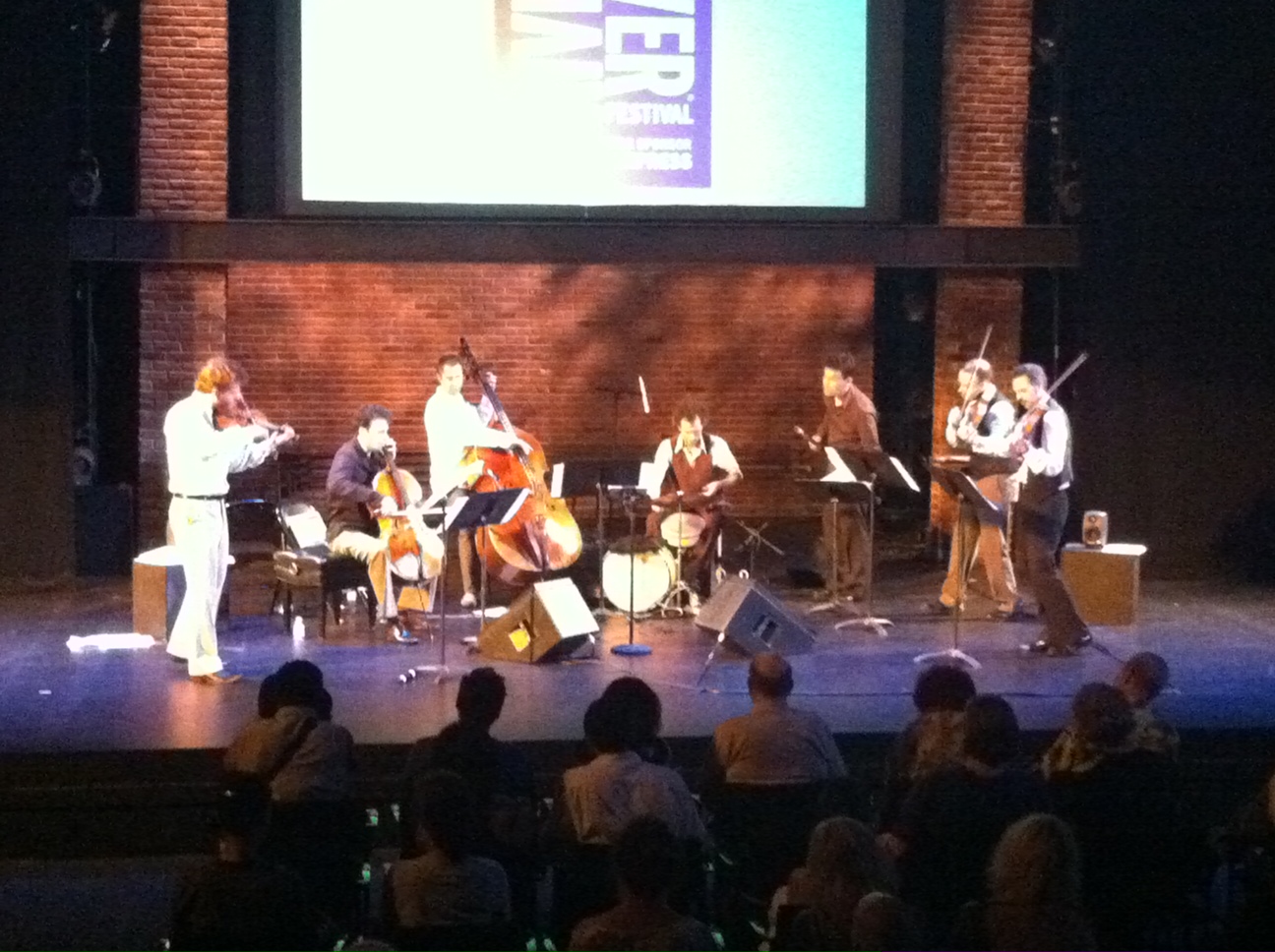
Kojiro Umezaki, a master of the shakuhachi, took the stage alone to open the second part of the concert. He explained that his piece, ...as if none of this had ever happened..., was based on a work commemorating the victims of the 1923 earthquake in Tokyo (100,000 people died) and related it to the recent disasters in Japan. The gorgeously anguished breath of the flute competing with (and almost overwhelmed by) the glitchy electronics coming off his iPad made for a haunting meditation. The quartet returned for a beautiful rendition of Lullaby From Itsuki, a traditional Japanese melody that translated perfectly to this most untraditional combination of instruments. Another Umezaki piece, (Cycles) what falls must rise (which appears on Dominant Curve), brought the iPad back into the fold for another glitchy, powerful excursion.


Umezaki, who has worked extensively with Yo Yo Ma and the Silk Road Ensemble, is a triple threat - a great player, an intriguing and emotional composer and a natural communicator.


The last part of the trip was a suite of music of the Roma, which touched on a variety of aspects of that tradition, from melancholia to gypsy jazz that would have had Stephane Grappelli tapping his feet and itching to join in. 


Each piece was met with louder cheers by the audience, who, whatever their travel plans were walking in, would happily hitch a globe-trotting expedition with Brooklyn Rider any time.