Showing posts with label Bang On A Can. Show all posts

Thursday, April 04, 2019

2019 First Quarter Report: Concerts


An unpredictable schedule this year meant that every concert I've seen except one has been in the realm of contemporary classical music. But within that, much variety - read on!

No Filler At The Miller I was speaking with Melissa Smey, Executive Director of the Miller Theatre, and she was relating the challenge they're going to have capping off their 30th anniversary next season. A challenge because their programming has been so strong in 2018-19 that it's hard to know how they can top it in 2019-20! From the Du Yun Composer Portrait I saw last November to the three shows I've been to so far this year, they are hitting all the marks - and there's still more to come.

On February 21st, I took in the Wang Lu Composer Portrait, giving me another opportunity to hear Urban Inventory, last performed in New York back in 2016 by Third Sound, who also recorded it on Wang Lu's stunning 2018 debut album. Here, the International Contemporary Ensemble worked their magic on the piece, also playing the witty Childhood Amnesia (2017) and Siren Song (2008), which found Stravinsky barreling into a Chinese opera house and causing quite a commotion. There was also A-PPA-Aratus, a world premiere played by Yarn/Wire and a stunning addition to their repertoire for two pianists and two percussionists. I hope they record this spectacular 21st century poéme mecanique very soon.
Yarn/Wire performing A-PPA-Aratus
Photo by Rob Davidson for Miller Theatre
A week later I was back to see Third Sound themselves, making their Miller debut at one of the theatre's innovative Pop-Up concerts. These are the free shows where the audience sits on the stage and enjoys free beer along with the music. They also usually last just about an hour, so Third Sound, founded in 2015 by composer Patrick Castillo with violinist Karen Kim, cellist Michael Nicolas, pianist Orion Weiss, flautist Sooyun Kim and clarinetist Romie de Langlois, programmed a set that had enough variety to show what they can do while also keeping it concise.

Ingrid Arauco’s Fantasy Quartet was a perfect opener - sparkling, astringent and colorful, it gave many opportunities for the musicians to shine. Next was Music For Four composed by the group’s founder, Patrick Castillo, and inspired by watching his young son at play. It was a piece infused with warmth and joy, making equally canny use of repetition and surprise. Finally, in keeping with their mission to embrace to whole sweep of chamber music, they stormed through Webern’s imaginative reduction of Schoenberg’s Kammersymphonie, Op. 9. All of the work’s angst and artfulness was brilliantly exposed by their passionate playing, earning them an enthusiastic ovation. I think they'll be asked back.

My last visit to the Miller was just this past Thursday, when they presented a Composer Portrait of Tyshawn Sorey to a buzzing and packed house. The excitement was more than justified by what followed as were treated to an embarrassment of riches in two sets of music presented seamlessly, without applause or space between works. This was similar to the first half of the Du Yun concert and if anyone else is putting on shows like this I’d love to know about it. Special note should be made of Isabella Byrd's lighting, which helped immeasurable with all the transitions and lent a sense of atmosphere and occasion.

One theme of the night was how to pay homage to your mentors while speaking in your own voice. The first piece, In Memoriam Muhal Richard Abrams (2018), paid tribute to the founder of the AACM with a meditation for violin (Jennifer Curtis) and celesta (Cory Smythe). It was a gorgeous combination of sonorities that both quieted and engaged the mind. Sorey’s lyrical gifts were much in evidence as they would be later in the night. The next piece, Ornations (2014) provided a welcome and witty shock to the system as flautist Clair Chase faced off with clarinetist Joshua Rubin. The word “puckish” may be overused when it comes to Chase, but as she danced opposite Rubin, who was anchored in place by his contrabass clarinet, it was impossible not to think of Shakespeare’s sprite. The music matched the mood resulting in tremendous fun that was not without an edge of aggression. The JACK Quartet closed the first half with the NY premiere of Everything Changes, Nothing Changes, a work requiring tremendous concentration as they passed around sustained notes creating an unbroken canvas of sound. I look forward to hearing it again so I can just let it happen without wondering what would happen next. 


Claire Chase faces off with Joshua Rubin in Ornations
Photo by Rob Davidson for Miller Theater
After a brief intermission, Sorey and Chase sat down for an illuminating discussion that amplified some of the material in Lara Pellegrinelli’s superb program notes, chiefly the distinction between hybridity and mobility. Sorey sees the former as a tired trope about "jazz" musicians writing "classical music," "crossing over," etc. Instead of a hybrid composer, he sees himself as a mobile one, able to do what he wants with whatever instrumentation he wants in whatever setting he chooses. Amen. They also reminisced about their first meeting, about a decade ago, a tribute to the tight relationship between composer and musicians of the International Contemporary Ensemble. That connection would come in handy in the world premiere presented in the second half of the concert, but first we heard For Harold Budd (2012), a gleaming trio for piano, flute and vibraphone that had Smythe and Chase working with percussionist Levy Lorenzo. It really was beautiful, with some of Budd's painterly qualities, but the brushstrokes were all Sorey's. 

Autoschediasms (2019), a Miller Theatre commission followed. It was scored for "Creative Chamber Orchestra," an ensemble seemingly entirely flexible as the program listed seven musicians to which was then added one more - plus the four members of the JACK. This piece builds on an idea from Butch Morris about "conducted improvisations" that had Sorey leading the group with a series of very specific hand gestures as well as instructions written on a small whiteboard. The players were well-drilled, moving from section to section without hesitating, and the sounds were consistently engaging. My western brain was seeking crescendos, the kind of tension and release we're so conditioned for, but what I heard was more of a continuous tapestry. The effect was a little like listening to a radical remix of a song you never heard before and I'm curious how different it will sound the next time it's performed.
Tyshawn Sorey (right) conducts ICE in Autoschediasms
Photo by Rob Davidson for Miller Theatre
As Autoschediasms was fading out, Chase came to the front of the stage with her flute and Sorey stepped off the podium and sat down at a conventional drum kit so they could play Bertha's Lair (2016), a piece that's become a bit of a signature for the duo. Here came the release, the crescendos and so much more as I was witness to some of the greatest drumming I've ever heard, in the same class as Art Blakey, Tony Williams and Leon Parker. But Sorey went further, nearly into a kind of performance art, as he removed a ride cymbal, put it on the floor tom for some intriguing effects - and then stacked it on the other ride cymbal and kept going from there. This was all while Chase was making an action painting in platinum, playing a piccolo flute and an enormous contrabass flute in addition to her standard concert model. It was the perfect ending to a night that earned Sorey and his collaborators a standing ovation and had the audience buzzing once again.

Tales Of Talea Even if I wasn't a board member, I would try to get to as many shows by the estimable Talea Ensemble as possible. This season they have not only been presenting wonderful music, but have made big strides in opening up important conversations about the role of music in our lives, how music works, and what it means to be part of the "new music" community. Much of those discussions happen at their iNSIDE Out series at The Flea Theater, and the one I attended on February 24th was a perfect example. Called Side By Side, the afternoon began with music for duos, kicked off by Vasko Dukovski (clarinet) and Chris Gross (cello) playing Iannis Xenakis' thorny Charisma (1971), which portrayed the instruments as isolated individuals pursuing their own paths. Catherine Lamb's In Passing / PARALLEL (2008), played by the violins of Emilie-Anne Gendron and Anna Kridler, was more of a joint effort - and a bit of an endurance test - as they passed long lines in a continuous tone that somehow created tension. Hearing them follow it up with some choice Bach, with its dance rhythms and folk melodies, threw everything we had already heard into stark relief. 
Performers & Panel at The Flea Theater
After a brief intermission, we reconvened for a very engaging panel discussion featuring Gross, Marcos Balter, Lauren Ishida, Eun Lee and Victoria Chea - and the audience. As these things are wont to do, perhaps more questions were raised than were answered, but we all left with a lot to think about, including my own musings about how Talea’s identity as a premiere presenter of European avant-garde composers meshed with the need for inclusivity on both sides of the concert stage. 

The next time I caught up with Talea, they were kicking off a residency at The Stone, John Zorn's performance space at The New School. There, we were also treated to more spare sounds, mostly solo works played by Adrian Morejon (bassoon) and Marianne Gythfeldt (clarinet). A link to the Flea concert was a piece by Eun Lee, a brief and action-packed world premiere called Yun (2018) for solo bassoon and played with real flair by Morejon. He also gave first performances of Edward Jacobs' Concentre (2014), filled with a sense of spontaneity, and Triplum (2014) by Filippo Santoro. The last was a trio, with two prerecorded bassoons played off an iPhone, which kept Morejon on his toes in a rhythmic, angular and witty piece. 

Gythfeldt also thrilled in Mikel Kuehn's signature piece Rite of Passage (2014), which had every last sound made by her bass clarinet picked up and manipulated and played back along with her live instrument - fantastic! She also gave a flawless performance of George Aperghis's Simulacre (1991-95) and then joined Morejon for the bouncy groove of Black (2018) by Mark Mellits. If you’re starting to feel FOMO - and you should be - I will point you to Gythfeldt’s marvelous 2018 collection, Only Human, which includes the Kuehn and other intriguing music. 

You can also trigger my own fear of missing out by attending Talea’s Tenth Anniversary celebration on April 20th. I can’t go, but it promises to be a memorable night revisiting many pieces from Talea's past and also presenting the world premiere of Hans Thomalla's Harmoniemusik 1 (2019) and the U.S. premiere of Framing... (2018) by Georg Friedrich Haas.

Switched On At Areté If any world is a small world, it’s the world of contemporary classical. So I was invited to this New York appearance by Boston’s [Switch~ Ensemble] by Zach Sheets, who used to work with Talea as our development and communications person. Something was in the air on February 28th as I had the choice of about eight concerts, but I decided on this one because it brought me to a venue I’ve never entered to hear pieces by unfamiliar composers. Risk, as Captain Kirk told Bones, is what it’s all about. Areté proved to be a small space arrived at through an arcade in a multi-use building in Williamsburg. The vibe is friendly and scrappy but not disorganized - the concert started right on time as the group launched into the electro-acoustic maelstrom of Adrien Trybucki's Infinite Extension (2017), a world premiere of a piece they commissioned. It was a wonderful introduction to their tight ensemble and excellent taste.

The next piece was Sivan Eldar's sleekly mysterious Tarr (2014), almost a series of notated sighs and whispers - and very beautiful. Third was a surrealistic audio collage by Esaias Järnegard called Songs For Antonin (2017), as in Artaud. It was wacky and gripping in equal measure, with bits of an old radio play mixed in. I don't doubt that Järnegard studied with Pierluigi Billone, as it had some of his absurdist spirit. Switch closed the concert with Timothy McCormack's karst survey, a dark journey indeed, which had T.J. Borden grinding at his cello like a Norwegian black metal guitarist. Overall, the concert showed off Switch to excellent effect - I would keep an eye out for the next time they come to your town.

BOAC Takes Off In PCF I try to never miss the People’s Commissioning Fund concerts by Bang On A Can, where their All-Stars present world and U.S. premieres as part of the Ecstatic Music Festival. There are also usually some classics from their repertoire to fill out the night, which this year included a Glenn Branca work they hadn’t performed for 20 years. The new pieces came first, however, beginning with Henry Threadgill's With Or Without Card, fractured and flamboyant, with a throughline that linked Jimmy Giuffre to Ornette Coleman and gave clarinetist Ken Thomson a lot to chew on. Next was Josué Collado Fregoso's lovely, evanescent Joi de Vivre, which put Mariel Roberts' cello and Robert Black's bass in the foreground. Black also blew some minds in the uncanny notated funk of Trevor Weston's Dig It - it somehow managed to avoid being a "crossover" pastiche. More please. This is where the night's theme of "dance music" truly came into focus, an emphasis that continued in Nicole Lizée's Dancist, a delightfully witty work that was accompanied by her fascinatingly messed up film. I would happily watch - and listen - to it again.
Scenes from the BOAC PCF Concert at Merkin Hall
The highlights of the second half were Annie Gosfield's fabulously imaginative - and furiously complex - The Manufacture Of Tangled Ivory (1993), which pushed pianist Vickie Chow to new heights of synthesizer magnificence, and Branca's Movement Within, a microtonal masterpiece that had Merkin Hall throbbing like the Mudd Club on an average Saturday night in 1980. John Schaefer of New Sounds was on hand to introduce each piece and interview the creators and the discussion with guitarist Mark Stewart and producer Adam Cuthbért about the reclamation of Branca's piece was a gripping tale indeed. Let's just say that recreating Branca's samples, which were stored on Zip Discs, was not a task for the faint of heart. But the All-Stars are a brave bunch and the whooping audience was all too eager to follow them wherever they journeyed. Try to be there in 2020!


Marissa Nadler
Coming Together At MoMA PS1 For the third year in a row, the Museum of Modern Art's Long Island City outpost held an incredible two-day festival called Come Together, created in collaboration with Other Music. Just like the first year, it was filled with a label fair, panel discussions, film screenings and live performances. Of the latter, I was able to see Marissa Nadler, whose 2018 album, For My Crimes, was one of the best folk albums of the year. It was short but intense solo performance, with Nadler creating a web of sound, either fingerpicking on an acoustic or looping a 12-string electric. At the center of it all was her gorgeous voice, which had emotional range enough to cover her dark originals and a cover of Fred Neil's bittersweet Just A Little Bit Of Rain. I was happy to see her earning new fans among the diverse crowd.
Negroclash: Prince Language, Duane Harriott and DJ Lindsey
It was chilly outside when we left the VW Dome, but DJ Duane Harriott was spinning so there was no question about how we were going to warm up. He already had the crowd in a Dionysian frenzy when he was joined by Prince Language and DJ Lindsey for a reunion of their collective Negroclash, which first performed at PS1 almost 20 years ago. Even while dancing, it was impossible not to be stunned at their synchronized routine, with each playing a song (and often manipulating it) before ceding the decks to the next DJ for a sumptuous flow of incredible beats, from disco to funk to electro. It was a high-wire act - and highly musical. They ended the set perfectly, too, with Sylvester's classic (You Make Me Feel) Mighty Real, sending us off happy and exhausted into the Queens evening.
Duane Harriott, man at work
And what live music have you enjoyed in 2019?

You may also enjoy:
MATA's Bad Romance At The Kitchen
Bon Iver's Dance Music
Moment Of Palm
Bang-Up World Premieres

Friday, May 26, 2017

Cage Tudor Rauschenberg MoMA

Pianist & composer David Tudor on the program cover
"Both those who love 4'33"and those who hate it probably agree there's something provocative about it," composer David Lang (co-founder of Bang On A Can) told the audience at MoMA, referring to John Cage's most notorious piece. He's certainly right, and as I don't mind being provoked by art, I am firmly in the "love" camp. Another point he made was that Cage created the piece for avant-garde piano virtuoso David Tudor, which gave the unheard music far greater potential than if just anyone had sat down at the Steinway for four minutes and change. This was the perfect introduction to the performance by another virtuoso, violinist Todd Reynolds, which was part of a two night series focusing on music related to the Robert Rauschenberg retrospective at the museum. 

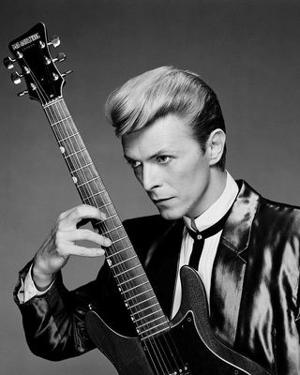
Reynolds did a remarkable job, striking a different pose for each of the work's three movements, dignified at all times but not without a puckish wit. I was put in mind of how someone like David Bowie could create unheard music in a still picture, like the unusual Hollywood-style portrait he had made for the Sound + Vision retrospective in the early 90's. It was not only a new look for Bowie, but it also seemed to refer to songs yet unwritten. 
Todd Reynolds, surrounded by the "silence" of 4'33"
Of course Cage, with his acknowledgement of the role of chance in his compositions, meant for us to pay attention to the sounds we do hear during 4'33", as no space is perfectly silent. In Titus Theater 1, two stories below West 53rd Street, there was plenty of listening to do. The periodic rumble of the subway was a lead "instrument," underpinned by the buzz of some electronics or lighting behind and to my left. There was a brief chorus of voices outside one of the fire exits, and the rhythm of my heart, which sped up for some reason during the first movement. It's not always easy to be in the moment, I guess. 

One brilliant way Cage dealt with that anxiety was to make it perfectly clear how long the piece will be. It went by surprisingly quickly, an appropriate appetizer for what was to follow. First up was After David Tudor (Homage To Fluorescent Sound), a tribute by Lang and Jody Elff to Tudor's composition for fluorescent lights, which can never be performed again. As Lang explained, not only is there no audio, video, or score, fluorescent lights have seen some improvements since 1964 and no longer make the humming and clicking sounds Tudor was amplifying. 

What they came up with was an assortment of fluorescent light fixtures, artfully arranged on the stage, and activated by Lang and Elff from a central console. Buzzing sounds of slightly different timbres began and ended, lights went on and off, my retinas got a workout. Sonically it had a slightly retro feel, which was appropriate, although I may have been the only one going all the way back to Franz Waxman's 1935 score for The Bride of Frankenstein, which featured some interesting "electricity" effects. It was a little unclear whether Lang and Elff were improvising or following some kind of plan, but there was a sense of build-up and finale as the piece came to a close. All told, it was a fun and affectionate acknowledgment of Tudor's pioneering work. 

Cage's Atlas Eclipticalis (1961), which "translates star charts into musical instructions," was up next and began without pause. Members of The New School's Ensemble 4'33", making their performing debut under Reynolds' direction, were arrayed around the perimeter of the room, giving us an immersive experience. The music, as fragmented as a pulverized mosaic, was made all the more satisfying for being the most melodic thing we had heard all night, even if the lights continued to buzz throughout.

The human ear seeks to organize sound, first by assigning a direction and source (bassoon at 3:00!), and then structure. There was none of the latter that I could discern until I realized that the atomization is the structure and relaxed into the randomness. Taken that way, Cage's conception is flawless and the performance could not have been better. The subtlety of some of the sounds, whether from electric guitar, percussion, cello or trumpet, was astonishing and quietly moving as the players coaxed it from their instruments. There is a great deal of flexibility in how this work is performed, and some recordings (James Levine, I'm looking at you) seem to conventionalize the music. I think I prefer Ensemble 4'33"'s approach, which seems somehow truer to Cage. I'm also sure I would hear more in a repeat performance, but I don't think it's in the stars.

You can watch the first night of the series, featuring music of Morton Feldman, Bryce Dessner, and others, here. The Rauschenberg show continues through September 17, 2017. 

You may also enjoy: 
BOAC At MMOCA: The Eno Has Landed
THE [KĀJ] ENSEMBLE’S 100 WALTZES FOR JOHN CAGE 
Pianos In Context
Bang-Up World Premieres

Sunday, August 07, 2016

BOAC At MMOCA: The Eno Has Landed


That there is a pipeline from indie rock to modern classical has been firmly established. What is less clear is the ultimate value of the music emitting from that spigot. My suspicion is that, as time tells its tale, the pieces produced by what might be called "rock informed" composers (Missy Mazzoli, Daniel Wohl) will prove more lasting than what those rockers have created for the concert hall. Or it may just be that if I don't like your band, I'm also not going to like your string quartet.

There is an interesting tangent to this rock-classical dialogue, represented by works like the trio version of Lou Reed's Metal Machine Music, or symphonic takes extrapolated from The Beatles' Revolution #9 or Brian Eno's Music For Airports, the last of which sucked us north up Route 8 from Stockbridge, MA to North Adams a few weeks ago. North Adams is a classic plot of small-town New England whose faded industry bequeathed us Mass MOCA, one of the most vibrant modern art venues in the northeast. 

Mass MOCA also hosts two major annual music festivals, Wilco's Solid Sound and Bang On A Can's Summer Music Festival. Wilco's event is always scheduled around the last day of school in NYC, a less than auspicious time for us to get out of town. Our reasons for missing the BOAC event are less clear-cut but let's just say that the words "Eno" and "live" in an email had my wife excited enough for her to insist I make a plan this year. It was even on my honey-do list. So I got it done, honey. 

Just to keep things simple, we treated ourselves and our daughter to dinner at Gramercy Bistro, the white-tablecloth restaurant that is right in the Mass MOCA complex. It was utterly worth it, with clever cocktails, sushi-grade tuna, and outrageous desserts providing a delicious prelude to what lay ahead. After dinner we ambled down to the building that holds the exhibition spaces, the excellent gift shop, and the performance hall, a large space ideal for any number of live events. 

Soon after we sat down, six members of the All-Stars came on stage for the first half of the show, which consisted of four pieces from their Field Recordings project, some of which were released last year on a collection of the same name. The first, by Pulitzer Prize winner Caroline Shaw is brand new, however. Called Really Craft When You, the field recording element came from interviews with quilters Shaw found in the Library of Congress archives, which she set to a fascinatingly fractured impression of jazz, featuring stellar work by drummer David Cossin, cellist Ashley Bathgate, and guitarist Mark Stewart. While she would occasionally repeat a phrase from the interview, there wasn't any Scott Johnson-style melodicism going on, more of a sense of weaving/overlay between words and music. Quilting, if you will. It was a deeply engrossing, and fully successful, piece, which I hope they record soon. Until then, you can hear its world premiere here.

Even with the mandate of the field recordings project, any composer would be up against it incorporating bird song into their music, what with classic works of musical ornithology like Cantus Arcticus by the (sadly newly late) Finnish composer Einojuhani Rautavaara or works by Olivier Messiaen, many of which are inspired by bird song, and which are among the greatest music ever written. Considering all that, Gabriella Smith did an admirable job with Panitao, which was pleasant enough but lacked staying power for me. That I forgot it almost as soon at it finished may also have something to do with what came next. 

The third piece was Icelandic composer Jóhann Jóhannsson's lapidary Hz, which used beautiful black and white footage and sounds of a hydroelectric plant as its pre-recorded element. It wasn't surprising that Johannsson included inspiration from the visual realm when you consider his recent sideline composing excellent soundtracks like the gloriously doomy Sicario. Hz is like time suspended, a sound that seemed to hover at the nexus of the performers, turning this way and that for our observation, almost a drone but with more dimension. Fortunately it's included on the album because I was ready to hear it again as soon as possible. 

Would that the intermission came next. Instead we were subjected to Rene Lussier's so-not-funny Nocturne, with a field recording of his wife snoring. Not for me, but fortunately not too long, either. 

The intermission was infinitely more entertaining, as I listened in on some music students chatting in the row behind me. I held my tongue until one of them said: "I just don't know about minimalism. I love Steve Reich but Philip Glass?" I had to weigh in: "Reich beats Glass every time!" They were amused and essentially in agreement. Since music is not a game of Rock-Paper-Scissors, if I had wanted to say more I might have talked up Glass's film scores for Koyaanisqatsi and Mishima, or mentioned that I've never seen Einstein on the Beach, which is apparently an essential experience. It also occurred to me later that Reich is a composer who uses minimalist techniques. Glass is simply a minimalist. Somewhere in there lies the difference. 

This discussion was an interesting thing to have inform BOAC's performance of Music For Airports, which they launched into after the stage was filled to capacity with musicians and singers. There was also a brief intro by Mark Stewart, which let us know that Eno approved of their rework but had little to do with its creation, and that because of the structure of the music we should feel free to let our minds drift more than we would if we were listening to, say, Schubert.

As soon as the music started I fell in love again with Eno's drifting soundscape, with its Satie-esque melodies that crop up now and again and overall mood of intelligent melancholy. Also, BOAC's adaptation of his electronic textures sounded uncannily right without being mere mimicry. It could be the intermission discussion influencing me, but listening to Music For Airports in this way made me recognize anew the minimalist principles behind Eno's conception. 

Naturally there is repetition as the piece was assembled from tape loops. There are even repeating cells, just as Reich might use, it's just that Eno's are so long and slow that it takes a while to see them as such. This made the music completely riveting for me as I thirsted for this arpeggio or that trill to recur. Barring a performance of Winterreise, my mind would probably drift more during a Schubert concert! Besides minimalism, Eno's ambient recordings also brush up against New Age, a relationship that came a little too close during one of the noodly clarinet interludes Evan Ziporyn composed for the last section, beautifully played here by Ken Thomson. It was only a brief lapse, however, and without lasting effect.

I can't speak for the rest of the audience, but as someone whose foundational music is rock, I'm primed to take Eno's music seriously. Even so, I'm skeptical enough of these kinds of transformations that I was holding what I heard at Mass MOCA to a very high standard. I'm happy to report that Music For Airports can withstand any scrutiny as a magnificent work of art. Is it "classical music" of even a contemporary stripe? I think the answer is somewhere between "Why not?" and "Who cares?" 

While I would love to hear how Arthur C. Danto would break down the aesthetic philosophy behind what happens when you take an artwork completely out of the context in which it was conceived, in this case a recorded work never intended for the concert hall, and rebuild it elsewhere, I think listening to the sheer beauty we heard that night is enough of a justification for BOAC's project. I would also say that while their recording of Music For Airports is lovely, it's not as essential as seeing them do it live. Get there next time and don't miss your flight. 

Sunday, March 16, 2014

Bang-Up World Premieres

Shara Worden (center) and the BOAC All Stars
Whenever I hear world-premiere performances - which almost can't be often enough - my first hope is that something new and beautiful will be introduced to the world. My second hope is that there will be more performances of the work(s). In the case of Bang On A Can's recent performance at the Ecstatic Music Festival, which featured three new works from their People's Commissioning Fund, I will be very surprised if there isn't a clamor from other new music ensembles to get their hands on at least one or two of these pieces.

First up at Merkin Hall, however, was an older piece, Lick, composed by BOAC co-founder Julia Wolfe. Its punky energy, big block chords and squealing soprano sax warmed up both the audience and the Bang On A Can All Stars. Reed player Ken Thomson's feet barely touched the ground during the performance. When the applause died down, WNYC's John Schaefer introduced Alvin Lucier, whose piece Firewood was the first of the evening's new works, which were all based on the theme of field recordings. I'm not sure if Lucier has read David Rothenberg's wonderful Bug Music, but he is already living it: The composition was inspired by the trails of insects under the bark of a piece of word - a field recording of a very different kind!

The meandering trail of the bugs is represented in sound by the cello, guitar and bass sweeping up and down the scale while interacting with pulses and tones from the clarinet, piano and vibraphone. The effect is of a sustained tone, inexorable and intense, with rhythmic beats occurring when the harmonies vibrated together. Schaefer pointed out beforehand that the piece did not contain any of Lucier's signature electronics. Lucier responded that he only used them when necessary "and after 50 years of composing electronic music, that's still my attitude." In any case, those vibrations were a whole new kind of synthesis. At just over six minutes, Firewood induced a state of concentration that was almost palpable in both players and listeners alike.

"Richard Reed Parry," I said to my friend, "That sounds familiar." "He's a member of Arcade Fire." "Oh, right," I mumbled, preparing to rid my mind of all the negative associations I have with that band. I'm not a fan, but that's not something I wanted to hold against Parry, so I listened with open ears as the musicians began his entry, The Brief And Neverending Blur.

Speaking of ears, those of the All Stars were occupied by stethoscopes, which were pressed against their chests so they could sync their individual playing with their own heartbeats. This was a nice, if slight, bit of theater that the musicians seemed to embrace, although its effect on the performance was hard to gauge. In any case, Parry's piece was lovely and wistful, evoking the music of Satie and the absorbing melancholy of watching rain stream down a window. Appearing in the background were the wobbly sounds of a dictaphone recording of Parry's piano music, which was left in an unheated shed in Canada for the better part of a year. John Cage would have approved of both the element of chance and the witty approach to the "field recordings" theme. When it comes to Parry's extra-Arcadian exploits, I say "more please."

The last of the premieres was Holographic by Daniel Wohl, composer of last year's Corps Exquis, which was on many "best-of" lists including my own. Part of his gift is alchemical, combining instruments - both acoustic and electronic - to create new and wondrous sounds. For Holographic, he "processed and stacked" recordings of instruments and vocals, in order to create an aural double image when accompanying the live performance of the musicians. The end result is beguiling and seductive, like fantasies projected on smoke, but not insubstantial. There is real melodic invention and compositional development in Holographic and I'm sure it will reveal even more delights upon further listening. It also ended with a satisfying thump, signaling the completion of the first half of the concert.

After a brief intermission, we returned for a performance of David Lang's Death Speaks, in an expanded arrangement for soprano with a sextet instead of the original trio. Completed in 2012, the half hour piece takes as its text various lines from Schubert songs where death himself speaks to the audience or another character in the song. The other stream of inspiration Lang drew on was the intimacy of "indie pop" as performed in small spaces, the way Schubert lieder were once heard. As in the original performances (and the 2013 recording) the vocalist was Shara Worden, whose ubiquity at the intersection of contemporary classical and indie rock can hardly be overstated. She is much admired for her crystalline voice whether performing her own music under the name My Brightest Diamond or collaborating with a host of composers.

I admit finding Worden and her cult just a bit precious, but she sang with deep engagement, flawlessly unspooling Lang's tear-stained libretto as the band played hypnotic, unresolved arpeggios. While I would have liked a little more articulation in the words, Worden has clearly taken ownership of this piece. Lang's incorporation of the additional instruments was very well conceived, especially the way the percussion linked up to the piano. The sound world occupied by Death Speaks seems closer to John Dowland than Schubert, but since Dowland nearly invented the melancholy pop song that only seems fitting.

It had been a demanding night, so I welcomed the chance to revisit Death Speaks and the other fascinating music we heard on Q2 Music's stream of this remarkable concert. Let's hope these important new compositions find continued life in concert halls as well.