Showing posts with label Laura Cocks. Show all posts

Friday, December 23, 2022

Best Of 2022: The Top 25

Another tumultuous year on the world stage, another triumphant year for musicians, who battled seeming impossibilities to deliver an embarrassment of riches to my ears and my life. The first half of the year was so strong that it was a challenge to hone things down to incorporate the albums that came on like a flood in the second half. None of the albums that didn't make the transition from the July list will be forgotten, however - keep an eye on this space for the genre-specific lists to come. And while I agree to a certain extent with those who have said "genre is over," I still believe that you can group albums in a way that allows you to quickly find the experience that most closely matches your taste or mood. As always, this list combines all genres, at least in theory. 

Conspicuous by its absence is hip hop, which has been represented on every "Top" list since 2010. Up until almost the last minute, Pusha T's remarkable It's Almost Dry was a lock for the top 10 but when the rubber hit the road it did not sit well with me to so elevate a record with Kanye West as a featured performer. Irrational as it might seem, if he had just lent his still brilliant production talents to the album I think I could have gone with it. But his continuing hateful idiocy along with recent revelations about praise for Hitler going back a decade or more just made it a bridge too far. So apologies to Pusha, who definitely helmed the hip hop album of the year - watch for it on a future list. 

Since I've already written about all of these albums but one, click through to find the original posts - and also press play on this playlist or below to listen while you read. Numbers 12 and 17 are only available on Bandcamp but I assure you they are worth the micron of effort it will take to hear them. 

1. Florist - Florist 

2. Angel Olsen - Big Time


22. Palm - Nicks And Grazes It's been an eventful four years since Rock Island, their genius sophomore album, with forces both within and without putting immense pressure on the quartet of Eve Alpert, Hugo Stanley, Gerasimos Livitsanos, and Kasra Kurt. But rather than giving up, they took the opportunity to both hone and explode their sound, with instant Palm classics like Parable Lickers (those rhythms! the electro-steel drums!)  sitting alongside the mostly washy Away Kit and almost pure expressions of musique concrete like Suffer Dragon, which itself resolves into a sentimental chord sequence out of a Miyazaki film. Ultimately, Palm's greatest strength may be in converting the outer edges of avant garde sound-making - including both digital and physical manipulation of their instruments - into actual songs that deliver pop satisfaction once you've absorbed all their twists and turns. One of our great live bands, too - hope to seem them again in 2023!


Let me know if any of these brought you joy!

From the archives:

Sunday, July 03, 2022

The Best Of 2022 (So Far)


While the news keeps finding new ways to be terrible, music keeps finding new ways of bringing joy,  inspiration, energy, calm, and even a satisfying dose of mirrored despair, to our lives. Here are 25 of the best ways its done that in 2022. Much gratitude to all the artists pushing through and delivering these remarkable albums to my ears!

As usual, anything that's been reviewed previously is linked to those earlier words. You can listen to selections from most of these albums in this playlist or below. Otherwise, find them on Bandcamp - and consider paying for the privilege of listening.

1. Angel Olsen - Big Time This magnificent album is a dream come true for me. Pairing Olsen's glorious voice and incisive, informed songwriting with the genius production of Jonathan Wilson is an idea so delicious that I never even thought to hope for it. They both outdo themselves, too. Olsen cuts to the bone over and over again as she processes the recent grief of losing both her parents, the painful process of becoming ever more herself, and the overwhelming joy of finding true love. When she sings "Never thought the day would come/When I would find someone/To love me only," it's impossible not to believe her and root for her new relationship with Beau Thibodeaux, who also co-wrote the soaring title track. Wilson, who plays drums on every song, marshals some of the same deep knowledge of Americana he displayed on his last album, Dixie Blur, even lending a "countrypolitan" grandeur to some tracks, like This Is How It Works with its weeping pedal steel. But Olson and Wilson are not tied to any particular genre, giving each song just what it needs. When they bring on Drew Erickson and Dan Higgins, for string and horn arrangements respectively, the widescreen approach is reminiscent of All Mirrors, Olsens's 2019 epic. There's no better example of this than the stunning Go Home, which starts out dead simple, just two chords from Erickson's piano and Emily Elhaj's bass, and Wilson's ticking percussion. Olsen first enters quietly: "The world is changing/You can't reverse it," but soon pushes her voice into the stratosphere: "I wanna GO HOME/Go back to SMALL THINGS" and the music gathers itself to catch up, with sweeping strings, stentorian horns, and Wilson's fuzz guitar bringing the hammer down. When the song returns to earth and Olsen sings, almost to herself, "Forget the old dream/I got a new thing," all you can do is agree. It's a wonderful thing, too.


5. Hollie Cook - Happy Hour When someone's mission statement is pure delight, each new album becomes more and more like a high-wire act: how can she keep it up? Which makes Cook's big, bold fourth album even more thrilling. While still sticking to her patented blend of lovers rock and sunshine pop, she does expand that fabulous formula a little. Whether it's the strings on Gold Girl, which should be the next James Bond theme, the guest spot on Kush Kween from Jah9, whose florid style shows off Cook's clean soprano perfectly, the hints of dancehall on Love Is A Losing Game, or the 90s dance rhythms of Move My Way, she pushes the envelope with aplomb. My favorite characters on the recent Pistol miniseries were Paul Cook's parents, who were loving and warmly supportive of their son's musical ambitions. With them as her grandparents, Cook's bounteously beauteous spirit must run deep in her blood. Get a transfusion here.


10. Jascha Narveson - Flash Crash + Remixes According to his notes, Narveson "...crafted Flash Crash especially for internationally acclaimed cellist Ashley Bathgate out of raw stock market data culled from high-frequency trading bots" - a sentence that tickles my mind the same way the music here excites my ears. The main piece finds Bathgate carving a gorgeous line through Narveson's electronics, like an expert skier cutting through the trees. It's a rich, deeply involving piece on its own, then all hell breaks loose - in the best way - when Narveson's collaborators get their hooks into things. And the word "hooks" is especially appropriate for Lorna Dune's remix, which finds catchy bits in the original and bolts them to a four-on-the-floor beat, cooking up a killer groove. It's the perfect follow up to Matthew D. Gantt's take, which adds percussion and clarinet samples to create a type of artificial chamber music. Lainie Fefferman manipulates the sound of the cello to create a character study she calls Repairbot Q Sent To Engine Room 3, Working Through The Loneliness, which is as good a description as any for the fun and feeling to be found throughout the album. Angelica Negron sends Bathgate deeper into space, with pulsing beats moving through like debris from a dead satellite. Then Vadislav Delay - a "Finnish electronic music legend," apparently - drops the hammer with serrated power chords and breaking glass, treating Narvson's original like a trash compactor treats a robot. What a way to go! 

11. Horsegirl - Versions Of Modern Performance Smashing debut from a Chicago-based trio (Penelope Lowenstein (guitar, vocals), Nora Cheng (guitar, vocals), and Gigi Reece (drums)) who know exactly what they want from their sound. Picking up on 90's alt, 80's indie, 70's post-punk, and even a touch of 60's psych as they blast through their songs, their division of labor finds guitars acting as basses and (maybe) basses acting as guitars. Occasionally, they pause for an artfully fractured instrumental but with Reece pummeling away in the engine room, it's a very unified sound. Veteran producer John Agnello may have helped give the guitars a burnished quality that comforts even as it energizes. Deadpan but melodic vocals complete the picture to deliver lyrics that are allusive, elusive, and often mantric, like the repetition of "How does it breathe?" from Beautiful Song. Pleased to meet them and I think you will be, too.

12. Sarah Plum - Personal Noise In 2015, I worried that I would have trouble keeping up with Plum’s boundless curiosity and tireless efforts to expand the violin repertoire. Then I had to wait seven years for her next album, although she has been busy as a performer, teacher, and commissioner of new works. Thankfully, this colorful, varied, and passionate album was worth the wait. It kicks off with Eric Moe’s Obey Your Thirst (2014), which opens with a synthetic exhalation as if to say, “Now, where was I?” before launching in to a spiky dialog between Plum’s strings and his electronics. It’s a rhythmic piece, with digital percussion that seems to be driving the violin at a breathless pace. Eric Lyon’s Personal Noise With Accelerants (2015) follows, continuing the jagged rhythmic feel and high tempo. It’s fully acoustic, but features a structure determined by white noise. Kyong Mee Choi’s Flowering Dandelion (2020) slows things down a bit, filling the space with starlit electronics that occasionally remind me of the transporter on Star Trek. Sarahal (2013) by Mari Kimura adds Yvonne Lam on second violin and interactivity to the electronics for a flight into even deeper space. Several of these pieces were written for Plum and are featured here in their world-premiere recordings, including After Time: A Resolution (2013) by Jeff Harriott and Il Prete Rosso (2014) by Charles Nicholls. Both works also feature interactivity and a bit of randomness but feel fully realized in these performances even as they search for resolution. Mari Takano’s Full Moon (2008) literally ends the album with a bang, or at least several explosions of pounding sound. Plum sails through it all flawlessly, once again proving that close collaboration with composers and deep engagement with the work is a recipe for artistic success.


14. String Orchestra Of Brooklyn - Enfolding String orchestras of America! Those intrepid folks at the String Orchestra Of Brooklyn have given you your season-opening program right here! You don't even need to add the Barshai Shostakovich arrangement, which I'm sure you've played hundreds of times - and I love Shostakovich! First you get Scott Wollschleger's Outside Only Sound, specifically commissioned by the orchestra to be ready to play with minimal rehearsal and to work well outdoors. With each player operating semi-independently and added spice from percussion instruments, this live recording from Fort Greene Park works a treat, with "outside" noises - laughter, chatter, sirens - integrating but not interfering with the skirling storm of sound. There's no reason why it can't be played in the concert hall, however, so don't try to worm out of it that way. Then you get Anne Leilehua Lanzilotti’s expansive With Eyes The Color Of Time, which was a finalist for the 2022 Pulitzer Prize in Composition. Based on pieces in The Contemporary Museum in her native Honolulu, there is a strong narrative thrust to the eight parts. Starting with the long, exhaling lines of The Bronze Doors and taking you through the dense scrapes and scratches of Les Sortilèges and on to the warm resolution of Enfolding, it adds up to a very satisfying whole. With both pieces coming in at a little under an hour, this program will leave you enough time for cocktails with your subscribers, who will throw money at you for the next season. Just don't try to claim bragging rights for the world-premiere recordings - the String Orchestra Of Brooklyn already beat you to it on this excellent album.

15. Tomberlin - I Don't Know Who Needs To Hear This... Who knew sonic adventure could be so quiet? In the four years since her debut, At Weddings, Sarah Beth Tomberlin has maintained utter control over the dynamics of her songs, but manages to fill them with exquisite details that deepen the experience. A perfect example is Tap, with its ticking percussion (Kenny Wollesen, from Sylvie Courvoisier's trio), plucked cello (the great Gyða Valtýsdóttir), and gentle woodwinds (Stuart Bogie and Doug Wieselman), all combining into a little miracle of a musical engine. Tomberlin coproduced the album with Philip Weinrobe so I don't mention all those notable musicians to remove any agency from her achievement here, but rather to add to it. The strength of her songwriting is what attracts players like that and the strength of her vision is what has them combining to make such specific sounds. Her voice is even more wondrously light and supple than in the past, delivering the deeply felt poetry of her lyrics with a gossamer ease. The words will repay your attention, too. This line, also from Tap, is one of my favorites: "Do you think about the trees in the breeze/How they swing and scream and talk and breathe/I wish I was so tall and green/ Swing my branches only sing for me." Thank goodness Tomberlin sings for us, too.


17. Soccer Mommy - Sometimes, Forever Sophie Allison, who records as Soccer Mommy, pushed the sound and passion of her indie rock into new places on her last album, 2020's richly dynamic Color Theory. Rather than repeat herself on this, her third official album, she made the genius decision to work with Daniel Lopatin, who records electronic music as Oneohtrix Point Never and also made the brilliant soundtrack for Uncut Gems. This doesn’t mean Allison has made an electronic album, however, although there are more synthetic textures woven in than in the past. Rather, the collaboration has created a sleek and powerful album, gleaming with sonic jewel tones, where every sound seems placed deliberately in the mix. "...I want perfection/Tight like a diamond," she sings in Unholy Affliction, putting her cards on the table. Yet even if nothing here is casual, there's still plenty of heat generated by Allison and her band mates, especially drummer Rollum Haas, who pushes and pulls the rhythm in original ways. The key track for me is Darkness Forever, which has some of the hypnotic wash of I Want You (She's So Heavy) from Abbey Road but addresses the seduction of suicide as a relief from the pain of mental illness rather than the search for an elusive lover. Images of fire and water throughout the album lend elemental strength to the struggle within, but the ultimate triumph - ambiguous as it is - is the transformation of all this hurt into art. As long as she can keep doing that, she'll keep the devil on his leash - and keep us listening, raptly.

18. Revelators Sound System - Revelators There was a taste of this new project from Hiss Golden Messenger’s M.C. Taylor on last year’s The Sounding Joy, a selection of dub versions from his anti-holiday-album holiday album. O Come All Ye Faithful. That collaboration with Spacebomb magus Cameron Ralston slowed and stretched the songs, creating a warm bath of healing music that doubled down on the premise of the album itself. Rather than building on previous recordings, however, the four long tracks here make their own way, meandering in a most wonderful way through the minds of musicians who have absorbed the atmospheric majesty of Lee “Scratch” Perry and Miles Davis. But everything here is infused with the distinctive tang of Richmond, VA and Asheville, NC, adding a wonderful dimension to both the Hiss and Spacebomb projects, and creating a place of comfort where ever you happen to be.

19. Wilco - Cruel Country I'm not sure Jeff Tweedy has thrown down a songwriting masterclass like this since Sukirae in 2014. Across the 21 songs here he finds words and melodies that make classic themes seem new. The album is filled with gentle acoustic sounds and some songs have a strong country music inflections, the title is a clever feint incorporating the band's insider/outsider relationship with America and American music. "I love my country," Tweedy sings in the title track, as the band plays jauntily, "Stupid and cruel." While Tweedy wrote the songs, the arrangements were ginned up live in the studio, with all players contributing in a way that hasn't happened since The Whole Love in 2011. So, while there's lots of breezy strumming, and even pedal steel, the old adventurousness is still there in subtler form, as in the psychedelic shimmer of Bird Without A Tail/Base Of My Skull or the slightly dissonant French horn in Darkness Is Cheap. Lyrically, the songs mostly address either national politics or personal politics, which can each serve as metaphors for the other. But there are also a number of literally cosmic moments, such as The Universe and Many Worlds, which center the album in bigger themes. The song I keep going back to, however, is Falling Apart (Right Now), which might just be the best song Buck Owens or Roger Miller never wrote. Witty and perfectly constructed, it features stellar playing that would rival any Nashville session band. On their 12th album, Wilco has offered up quite a feast and even if Tweedy is preaching to the choir on songs like Hints, with its refrain of "There is no middle when the other side/Would rather kill than compromise," I'm happy to sing along.


23. Bakudi Scream - Final Skin Albums like Barry Adamson's Moss Side Story pioneered the soundtrack in search of a movie. Now, Rohan Chander, under his new Bakudi Scream alias, has given us a soundtrack in search of a video game, not unlike what Phong Tran gave us on The Computer Room. The first hint of what was to come on this startling, immersive, and, heartfelt new collection came at the height of lockdown, when pianist Vicky Chow premiered The Tragedy of Hikikomori Loveless on one of many spirit-rescuing online marathons from Bang On A Can. The video confused and delighted viewers as Chow triggered synthetic sounds from a MIDI-enhanced piano and voices popped in and out of the mix. Unsurprisingly for a COVID-era piece, a central theme here is loneliness, building on documentary Chander watched about hikikomori, a form of extreme withdrawal which has young Japanese people living reclusively with their parents, unable work, attend school or participate in society in any meaningful way. Just as the bad guys get all the best lines in movies, a villainous character called Somnus has some of the richest music in a three-part piece that's the heart of the album. Part 1, Nightmusic, sparkles and shimmers seductively, sucking you in to a reverie only to boot you out of the game with the sampled voice of a blues singer saying: "What I wanna know, is why don't you love me like you used to do?" It's just one of many moments where Chander stuns you with his deep humanity, putting real flesh and bone under this final skin. 


You may also enjoy:

Saturday, May 28, 2022

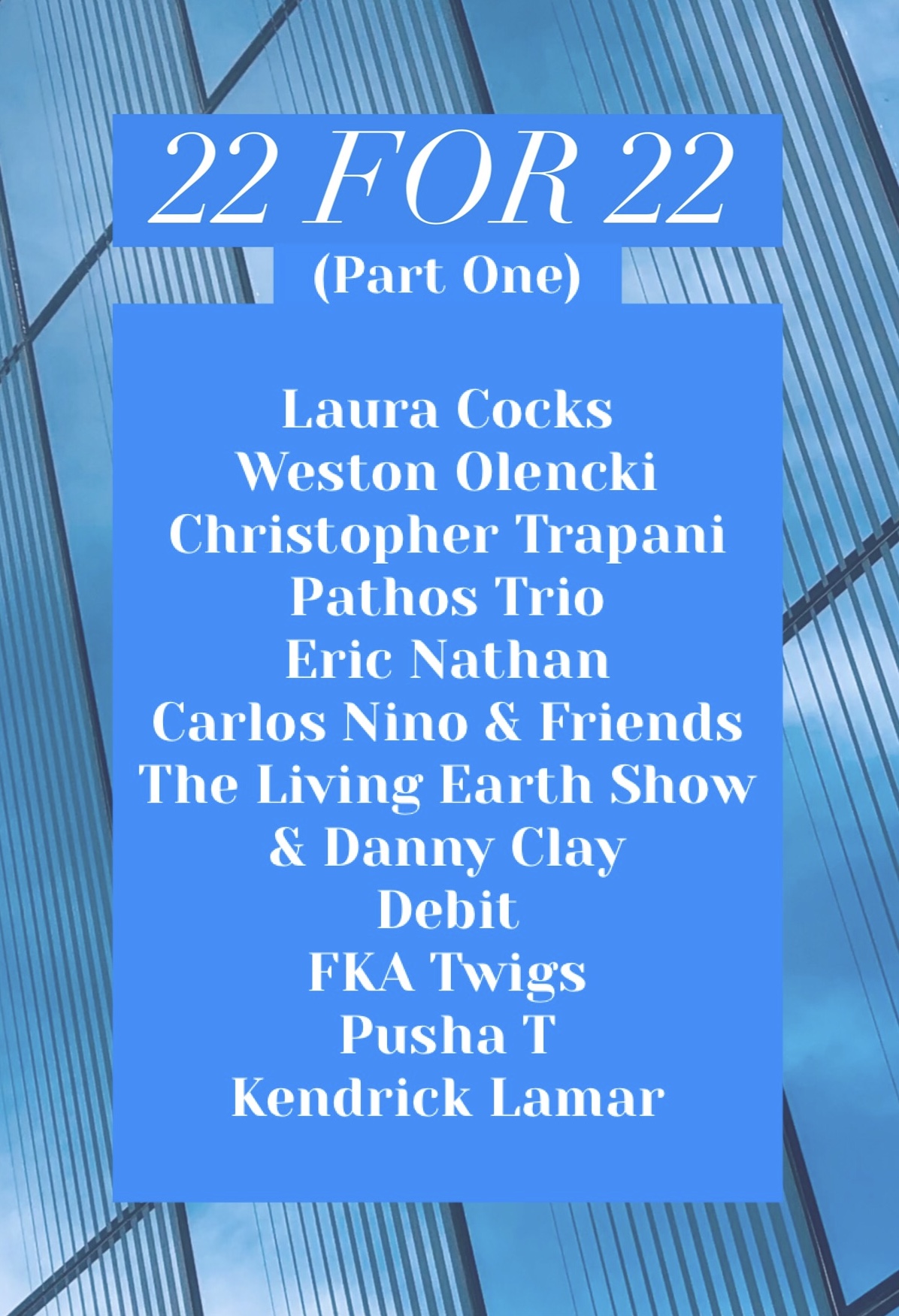
Record Roundup: 22 for 22 (Part 1)


There's no single reason why it took me so long to complete my "Best Of 2021" series, just life - in all its stress, strife, wonder, and joy. But all throughout everything that was going on and while I was doing my darnedest to put some shape to the music of last year, I was listening - passionately - to music from this year. And there has been plenty of brilliant stuff, more than enough to fill a dozen roundups. In order to keep myself (and you) from getting overwhelmed, I'm starting off with 22 albums across all genres, split in two parts. Future posts will drill down further into each genre. 

Find songs from most of these albums (some are only on Bandcamp) and follow along with my 2022 listening in these playlists:

Classical

Laura Cocks - Field Anatomies It's only fitting that an album of "blisteringly physical works for flutes" comes in an exquisite package, hand-collaged with dried flowers and decorated with beeswax. The beauteous outside, however, belies the often fierce sounds inside, as Cocks (known for their work with the ever-questing Tak Ensemble), goes toe to toe with some very extreme conceptions of what can be done with a flute, breath, the body, electronics - and some even less expected sources of sound. Bethany Younge's Oxygen And Reality, for example, was composed for piccolo, electronics, balloons, and hardware, and includes at least as much rhythmic breathing as anything else. It also features Cocks in seeming conversation with theirself, as half-heard spoken sentences cross the soundscape. That's the second track; the first is David Bird's Atolls for solo piccolo and 29 spatialized piccolos, which kicks things off with what sounds like someone taking oxygen from the flute before eventually exploding in dazzling swirls of gleaming sound. 

Jessie Cox, whose work was recently heard on the excellent Wavefield Ensemble album Concrete And Void, contributes Spiritus for solo flute, which alternates meditative tones with busy flurries of melody. "Contributes" is the wrong word, however, as the collaboration between composer and performer is as deep as it gets on Field Anatomies, beautifully detailed in the conversations on episode 22 of the Tak Editions podcast. The two other pieces are You'll See Me Return To The City Of Fury for glissando flute and electronics by DM R (Diana Marcela Rodriguez), both jarring and space-age sleek, and Produktionsmittel I for amplified flute, aluminum foil, glass bottle, and fixed media by Joan Arnau Pàmies, frantic and animalistic even when its just the sound of crinkling foil. All of these works are fully formed and as rewarding as they are demanding. Field Anatomies is a remarkable piece of art, which will cause emotion and inspiration to sprout faster than the packet of seeds that comes with the special edition CD.  Act fast, in any case: only five copies remain.

Weston Olencki - Old Time Music The Tak Editions podcast also gave me the opportunity to focus on the mind of Olencki, which was perfect (though not required) prep for their music, as represented by this monster of a tape from Tripticks. The three works here astound in their invention, conceptual gravitas, and sheer listenability. Wittily titled Tenor Madness, the opener puts sax player Anna Webber through more changes than a dozen fake books as she interacts with some very messed up electronics derived from  short extracts of over 300 albums spanning recordings of the (improvising) tenor saxophone from 1939 to the present. And that should give YOU an idea of how Olencki's mind works! A Vine That Grew Over The City And No One Noticed is a four-part work for "two electro-mechanically controlled banjos, homemade magnetic resonators, solenoid motors, AM radio transmitters, vintage transistor and tube radios, railroad spikes, mason jars, carriage bolts, South Carolina red clay distortion unit, 60Hz ground hum, field recordings, and neural net re-synthesis of seminal old-time repertoire and Markov-driven Scruggs-style banjo picking." I swear I hear a snippet of John Lennon's Well Well Well in there, too...but for all that it's compulsively listenable, a drone that sounds as old as Appalachia and as new as the Boeing Starliner that just connected to the International Space Station. The last piece, Charon Guiding The Weary 'Cross The Long River (Or, How To Care For A Dying Instrument), is comprised of a similarly baffling array of source material, including "hydrophonic recordings made of the Connecticut River transduced through found slate roofing tiles," and would probably give the titular hell-bound oarsman a chill up his demonic spine.  Kudos to Olencki for putting as much thought into how the end products sound as he did into making them. Drastically original and staggering stuff.

Christopher Trapani - Horizontal Drift On the title track of Trapani's latest portrait album, Dan Lippel plays a quarter-tone guitar through software of the composer's own design called LoopSculptor. The piece incorporates tropes from Delta blues and other genres native to Trapani's hometown of New Orleans, resulting in a 10-minute trip through museum of hazy half-memories. The title seems to do double duty, referring both to American expansion and the interactions of various loops across the software's grid layout. The unusual instrument, the engineer's approach to sound, and the emotionally resonant results are paradigmatic of the whole album, which opens with Targul, a piece for vioara cu goarna, a horn-enhanced instrument similar to a Stroh violin. Played with seemingly casual mastery by Maximilian Haft, the sound is not unlike a gramophone, with a sharp, tinny edge that blends perfectly with the sketchy, truncated phrases of the music. Haft also finds himself in a sort of duet/competition with electronics played through megaphones, adding immersive depth to the attenuated sounds. Trapani also puts new-music piano maven Marilyn Nonken through her paces in Lost Time Triptych, a piece for scordatura-tuned instrument that manages to be inspired by both Gerard Grisey and Bob Dylan. The other works, including Linear A, for microtonal clarinet (Amy Advocat) and electronics, Forty-Nine, Forty-Nine, for a MIDI-controlled equal-tempered Fokker organ, and Tesserae, for viola d’amore (Marco Fusi) grab the attention as well. Trapani continues to prove himself to be smart, playful, and fearless explorer on this triumphant collection.

Pathos Trio - When Dark Sounds Collide The first thing that struck me upon listening to this was how richly it was recorded, with the percussion of  Felix Reyes and Marcelina Suchocka fairly leaping out of my speakers and taking up space in my living room like blow-up furniture. The piece, Evan Chapman's Fiction Of Light, begins with Alan Hankers delicate (and delicately enhanced) piano, which only gives the drums more presence. Two-thirds of the way in, things get glitchy and pulsating and we're in the realm of a Radiohead remix. The group's versatility is further proven by Alison Yun-Fei Jiang's Prayer Variations, which includes some very subtle work from Reyes and Suchocka, letting Hankers takes center stage, before they drop the "boom." It's a dynamic and satisfying piece, as are works by Alyssa Weinberg and Finola Merivale. Hankers' own Distance Between Places ends the album on a brooding note. Each work was commissioned by Pathos and has an accompanying video by Four/Ten Media (Chapman is a co-founder), lending even more of a sense of occasion to this excellent debut.

Eric Nathan - Missing Words I got a great sense of kissenkühlelabsal from Whitacre Hill's horn in the first part of Missing Words, performed by the Boston Modern Orchestra Project. And in case you think I've lost my mind, "kissenkühlelabsal" is a word Ben Schott invented to describe "the ineffable pleasure and instant relief of a cool pillow." Every movement of this six-part work is in fact based on one of Schott's words from his Schottenfreude project, which turns into a great excuse for Nathan to produce reams of chamber music, from sparkling to introspective, and have it performed to a fare-thee-well by BMOP, the American Brass Quintet, cellist Parry Karp and pianist Christopher Karp, the International Contemporary Ensemble, the Neave Trio, and Hub New Music. Whether you know the words or not, this is a delight to listen to, although it did require some fingerspitzentanz ("tiny triumphs of nimble-fingered dexterity") to get the booklet out of the CD package so I could read the liner notes!

Electronic

Carlos Nino & Friends - Live At Commend, NYC For some reason it took me years to find out that the innovative label RVNG had a performance space and store in lower Manhattan. Now sadly on hiatus, at least I got to spend one blissful night in that jewel-box of artistry back in 2019, listening to sets by Phong Tran and Adam Cuthbért. But I wasn't there on November 16, 2021, when Nino assembled this crack lineup to make peaceful, yet intricately textured music. Adding to Nino's bells, chimes, and percussion were the great Laraaji (electric kalimba, vocals, and iPad), Surya Botofasina (keyboards), Photay (Buchla, 808, and electronic drums), and Will Logan (drum set). That should give you an idea of the sound dimension you can enter when you press "Play" - and I hope you do.

The Living Earth Show and Danny Clay - Music For Hard Times Composed/organized by Clay as "calming strategies" for musicians stuck at home, these 15 gentle, twinkling tracks find Living Earthers Andy Meyerson (percussion) and Travis Andrews (guitar) and, in Book Two, a cast of dozens including the San Francisco Girls’ Chorus and students from the San Francisco Conservatory (who sent in tracks via Dropbox) finding their way towards the light. Let it shine on you.

Debit - The Long Count Just in case your existential dread has been too well alleviated by the sweet sounds above, here comes Delia Beatriz using machine learning to process the "ancestral technology" of Mayan wind instruments, creating a disquieting dreamscape that pays homage to a culture that has not so much been forgotten but "purposefully erased." Whether the Mayans would find anything to recognize in these sounds is unknown, but I think they would appreciate the effort - and we can enjoy the spare, spectral beauty either way.

Hip Hop & RnB

FKA Twigs - Caprisongs As someone who has championed Twigs since before she was FKA but was disappointed in both her long-form releases (LP1 and Magdelene), this album - she calls it a mixtape - is a balm to my ears. While still on the leading edge of electronic RnB, there's a sense of play and lightness on these 17 tracks that's a far cry from the overly considered work on those earlier releases. Whether it's the presence of new collaborators like producer El Guincho, who worked on most of the album, or just the fact that she considered it a mixtape rather than an album allowed her to fly more freely. A breezy, but deeply creative, caprice.

Pusha T - It's Almost Dry Four years after the perfection of Daytona (my #3 album of 2018), "cocaine's Dr. Seuss" is back with his fourth album, collaborating almost equally with his two greatest partners, Pharrell Williams and Kanye West - and nearly hits those same heights. The album starts with three knockouts, the first two produced by Williams and the third by West. Brambleton opens the album with a door-knock snare drum and spooky keyboards as Pusha details his sense of betrayal after his former manager claimed credit for his stories. Let The Smokers Shine The Coupes deals out a deeply funky groove as Pusha once again finds new ways to be the king of coke rap, saying "If kilograms is the groove/I done sold the golden goose." 

Then, in a masterstroke only West could come up with (and that Pusha T begged for), Dreaming Of The Past drops the hammer with a slightly sped-up sample of Donny Hathaway's take on John Lennon's Jealous Guy. The ice-cold vibe warms right up as Pusha practically duets with Hathaway while reminiscing about the good old days when "We hollowed the walls in back of bodegas" and "Gun stutter, make the drumline like Grambling." Even as he relitigates his old life, he's self-aware enough to point out that he "Didn't have to reinvent the wheel, just a better design." But even so he tries out some new things, like the way he floats his voice over Williams' nagging groove on Call My Bluff. The final track, Pray For You, combines old and new as Pusha T takes a "side step back into the duo/The kings of the Pyrex," by having his brother Malice (aka No Malice) join him on the song. Over a churchy track by producer/singer Labrinth that flashes back to Prayer, which opened Clipse's unreleased debut album (finally available!), Malice brings the heat like the old days, which has me both dreaming of the past and eager for the future.

Kendrick Lamar - Mr. Morale & The Big Steppers In one of the instantly busy hot-take threads that popped up when this eagerly awaited album dropped - Lamar's fifth and first since the Pulitzer prize-winning Damn in 2017 - a friend of a friend said, "I like the rapping but I wish the music was more hip hop." This reminded me of another exchange where someone asked if Revolution #9 was a Beatles song. My response was that, while it's an unwieldy sound collage, it is a Beatles song by virtue of being on a Beatles album. Mr. Morale comes from a similarly imperial view: it's all hip hop because Lamar is a hip hop artist, and one of such creativity and stature that he can bend whole genres to his will. To be clear, there are sonic references to reggae, jazz, r&b, and, of course, many sub-genres of hip hop - but like iron filings on a magnet, they all adhere to Lamar's wiry form, moving the genre along rather than leaving it behind. 

Lyrically, Lamar is on another plane than most rappers, dishing out a memoir's worth of tangled reflections, observations, stories, and histories. The dense firehose of words is often challenging to sort through and revealing enough to occasionally cross into "TMI" territory. But as Lamar himself says on Worldwide Steppers: "I am not for the faint of heart." He then continues with a few lines that give a hint of the micro and macro concerns of the album: "My genetic build can build multi-universes, the man of God/Playin' "Baby Shark" with my daughter/Watchin' for sharks outside at the same time/Life as a protective father, I'd kill for her." The cover depicts him with a child in his arms, a crown of thorns on his head, and a gun in his waistband, all signifiers for the world's weight, which he feels heavily on his shoulders. In Mother I Sober, which features featherweight vocals from Portishead's Beth Gibbons, Lamar remarks, "I'm sensitive, I feel everything, I feel everybody/One man standin' on two words, heal everybody." That sense of responsibility may have led him to overstuff the album, which runs an hour and 13 minutes. But Lamar is a visionary artist and incapable of being less than fascinating at this point in his career. It's still early days for my relationship with Mr. Morale - for all I know a song that now feels half-baked might prove to be a favorite in a few months. An essential listen.

Next time: Latin, rock, folk, pop, etc.