Showing posts with label Concert Review. Show all posts

Sunday, June 06, 2021

Concert Review(!): Hymn To The City


There was a sound. It was coming from over there, traveling through air to me, here. It was music and it was LIVE, being played right in front of me. The fact that it was a quintet made up of players from the New York Philharmonic and they were engaged in a delightful arrangement of Aaron Copland's Simple Gifts was almost immaterial. But it was the ideal way to begin my first live concert since March 2020, the light, lilting refrain giving voice to my gratitude for the opportunity to be there.

And where was there? We were in Green-Wood Cemetery, one of the jewels of Brooklyn on a guided musical tour arranged by the visionaries at Death Of Classical with the grand title of Hymn To The City. By the time we got to the Pilot's Monument, we had already been treated to a spirits tasting that included mezcal, whiskey, tequila, and gin along with some snacks, lending a convivial atmosphere even as we all sought to remain distanced and masked when not eating or drinking. It felt quite luxurious to be sipping on an extraordinary rye from Coppersea, a complex gin from Appalachian Gap, or Madre's full-bodied Mezcal while the sun set. Never let it be said that DOC doesn't know how to take care of people!

Death Of Classical's Andrew Ousley welcomes the audience.

Our next stop was the Brooklyn Theatre Fire Monument, where we were treated to a lovely reading by our tour guide of James Weldon Johnson's My City, a moment that also paid tribute to the first responders and health care heroes who are so critical to the life of the Big Apple. Then, we were off to hear music in a peripatetic journey through locations and styles. Scroll through the following commentary and pictures to get the flavor of the experience. 

The audience on the move.

Along with the sweet strains of Simple Gifts, we also heard a very brief arrangement of Sergio Ortega's El Pueblo Unido Jamás Será Vencido!, which increased the feeling that we were all in this together. 
On Battle Hill, near the grave of Leonard Bernstein, a brass quintet played selections from West Side Story. The setting and occasion thawed my antipathy to Bernstein slightly and I also enjoyed watching the audience take delight in the familiar tunes. 
The Hill Of Graves is Green-Wood's version of a potter's field, with many first-wave immigrants of no social standing buried there. It was a moving place to hear Paul Simon's American Tune, slightly dated though it is, and Marco Foster brought both restraint and open-hearted sincerity to his performance. 
Café Damas, commissioned by the NY Phil from composer Kinan Azmeh in 2019, is an intriguing piece, in a style that might be called "Silk Road Ensemble," with moods and methods of his native Syria blending with classical rigor. A dancer, who may have been costumed as a 19th century immigrant, lent atmosphere as the sun set.
The preceding rains had moved the next location from the Chauncey Family Mausoleum to this evocative spot, framed by weeping beech trees. The second movement of Florence Price's String Quartet in G Major was a lovely representation of her quintessentially American style and gorgeously played. Baritone Paul Grosvenor sang Over My Head, the traditional spiritual, a cappella, in a commanding if somewhat rhythmically rigid performance. It resonated nicely with Price's melodicism still hanging in the hair.
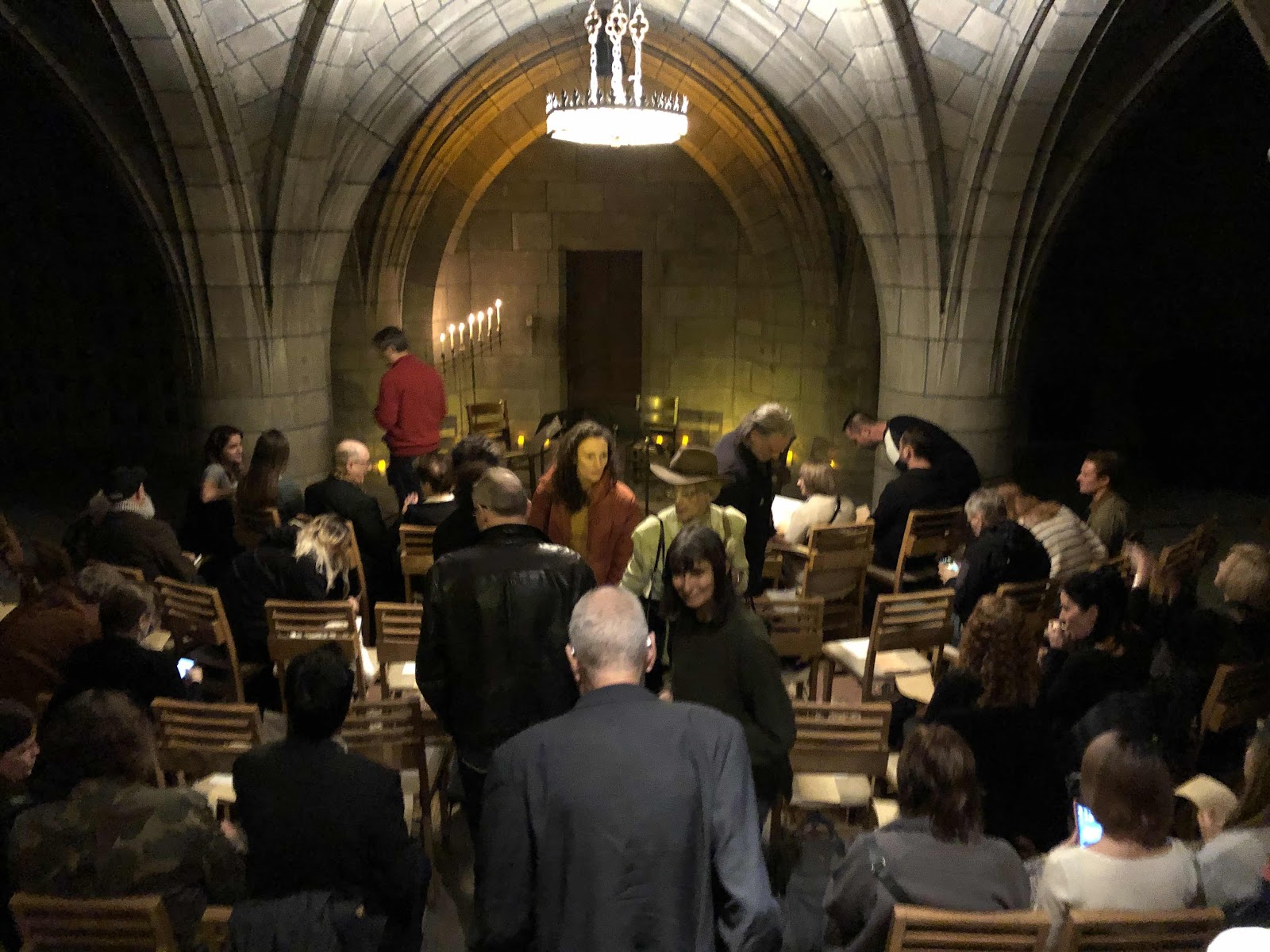
It was nearly full dark when we arrived at the entrance to The Catacombs, a sort of apartment house mausoleum for the middle class. 
Within was a long narrow corridor with folding chairs set up along its length. Once we were seated, Adam Tendler launched into his astonishing arrangement of George Gershwin's Cadenza on Rhapsody in Blue. He managed to encapsulate all that makes Gershwin's piece so compelling, while moving it firmly into the 21st century with some extended techniques. The man can PLAY and his piano sounded magnificent in the space. 
Next, Lucy Dhegrae, one of the great singers of our time, emerged from a side door to sing Sarah Kirkland Snider's How Graceful Some Things Are, Falling Apart, a rawly emotional homage to New York's resilience after 9/11. As Dhegrae's magisterial voice filled the space, I had a feeling of coming full circle, as she had sung at my last concert in 2020, a shattering U.S. premiere of Toshio Hosokawa's Futari Shizuka with the Talea Ensemble. It seemed only right that she would be a part of my road back to live music 16 months later. The Catalyst Quartet emerged next and played Credo, a piece by Kevin Puts that seemed to put the world right as it stacked consonance upon consonance, building something of limpid beauty in the air. By this point, I really felt I was at a concert and it was glorious. Pure cake icing arrived in the performance of Goin' Home, the song by William Arms Fisher with a melody from Antonin Dvorak's New World Symphony. In the arrangement by Noah Luna, with quartet, piano, and Dhegrae all shooting for the stars, it was a masterstroke to end the evening. 
There was still the walk back to the entrance, with iPhone flashlights flickering along the path, which was a nice opportunity to chat with one of my neighbors and contemplate all I had seen and heard. 

With Hymn To The City, Death Of Classical once again proved what an incredible asset they are to the musical life of our city, employing a touch of theater and a sure curatorial touch to put together a truly memorable experience. If you're looking to ease back into concert going, their upcoming events could be just the thing. Long may they reign!

You may also enjoy: 
2 Nights 4 Trios 1 Duo
Jack In The Crypt
Best Of 2018: Three Concerts

Saturday, November 02, 2019

Shamans Of North Sixth


One night, two venues, and two very different approaches to channeling the charismatic in music.

Part One: Carolina Eyck at National Sawdust

Leon Theremin’s pioneering electronic instrument just hit its century mark, having made its debut in 1919, and there are probably only two or three people alive who both see beyond its novelty value and have the technique to exploit it fully. One of them is Carolina Eyck, who first came to my attention in 2016 on Fantasias for Theremin and String Quartet, a collaboration with the American Contemporary Music Ensemble. That remarkable album was a constant listen and found a home on my Best Of 2016 (Classical) list. 

However, while I’ve had the files for her latest album, Elegies for Theremin & Voice for some time in advance of its release about a month ago, I’ve been finding it hard to fully connect to the music. While the surface is shiny and bright and the textures - both electronic and vocal - are wonderful throughout, there also seemed to be static quality to the songs. Such is my respect for Eyck, however, that I jumped the chance to see her perform at National Sawdust on Friday, October 25th. 

The rows of seats were almost full when I arrived and sank into mine, already grateful for the intro music, which was Eno’s Music For Airports played on NatSaw’s superb sound system. Eyck’s theremin was center stage accompanied by a table with a laptop, an MPC, and some other gear. Her confidence immediately commanded my attention when she strode on stage, resplendent in crushed velvet and jewel tones, a touch of face-paint lending a ritual aspect to her appearance. 

She sat at her instrument and...made magic. The astonishing control of her right hand (which controls the pitch) allowed the notes to take shape in the air, becoming a physical as well as aural reality. The first piece had the sense of an overture, all swoops and glides and echoing drama. While I dismissed my mind’s initial attempt to place it adjacent to the fat analog synth tones of Steve Miller Band’s Space Intro in my mental library, as the evening progressed and Eyck put her humor and pop skills into the mix, I thought, Why not? 

When she played songs from the album, witnessing the layering and looping of her vocals exposed the solid architecture that I was having trouble discerning. She also gave a little background to some of the songs, such as Remembrance, which pays homage to a school friend who died too soon. But rather than just lamenting her death, Eyck celebrates her life with some light and playful sounds, sharing this special person with us. She also gave a brief tutorial on the workings of the theremin, describing how she visualizes a string in the air, which she plucks with her right hand, while the left hand controls the volume by gesturing around the looped horizontal element. 
Eyck getting into the rhythm of a new song
We were also privileged to hear a “very new” song called After The Sun Went Down, which, with its propulsive bass line and bright melody, is one canny remix away from the dance floor - it’s a banger in the making! After a brief interlude of “fairy” sounds and what sounded like another new song, Eyck ended the night with Commemoration from Elegies, its massed choir of her own voice sounding heavenly. Based on other reviews I’ve read of Elegies, it is unlikely that you will need a live performance to gain entry into its many charms. Either way, if Eyck comes to your town I would not hesitate to take advantage of an opportunity to spend some time in the presence of this supremely talented and heartfelt musician.  

Part 2: Starcrawler at Music Hall Of Williamsburg 

The night was still youngish when I left National Sawdust and ran into a friend who invited me to join him at the Starcrawler show. As this is a band I’ve wanted to see since last year, when I called their debut album, “Pure filth, sloppy, grinding, filth, but tuneful,” I jumped at the chance. A rigorous security check presaged the dramatically different experience I was about to have as we entered the familiar confines of MHOW. The opening act was still on, which I would have been happy to skip in favor of a drink in the basement bar, but my friend, having seen Starcrawler before, wanted to get prime position near the front of the stage.

I got a cup of Old Broadhorn for me and a water for him and met him in the main room. We listened to the opening band, a lumpy stew of psychedelia and The Clash, for just a few minutes before he turned to me and said, “This is really bad.” Indeed, it was. Everything about it was terrible, in fact, from their stage presentation and the over-miked drums, to the shit guitar tones and pretentious jamming. I worked mightily in my mind not to lose the mood of excellence imparted by Eyck, holding it in my cortex as these knuckleheads thrashed away. I was mostly successful and it was, thankfully, over soon. Bizarrely enough, they had fans, who had been dancing maniacally and singing along and were now calling for an encore. “The opening act does NOT get an encore,” I spat out loud enough for people to hear. That felt good!

We had a little time to wait so I caught up with my friend, whom I had never before met in person, and made some new ones. During the banter I was surprised that no one had heard of Frankie & the Witch Fingers, who are another band from L.A., very different but they rock just as hard as Starcrawler. Finally, just as we natives started getting restless, the house lights went down and Starcrawler’s drummer, Austin Smith, entered stage left, sat down at his kit and started pounding out the rolling glam stomp that opens Lizzy, the first song on their terrific new album, Devour You. The crowd started to move to the beat but it was when guitarist Henri Cash, looking fab in an imitation Nudie suit, came out and unleashed his wicked right hand that we exploded. It was like rock & roll lightning had struck us all, with Tim Franco’s bass the only thing keeping us from frying to a glorious crisp.

Then Arrow de Wilde, in the first of many well-informed theatrical gestures, oozed down the few stairs from the stage door before settling in a heap near her mic. The knowledge that the explosion was coming did nothing to reduce its effectiveness when she sprang up and began assaulting the mic with a variety of screams while showing off moves that found a through-line between Cotton Club shimmy dancers, ballet, and the snake-hipped antics of Iggy Pop and Jim Morrison. In short, de Wilde was a high voltage electromagnet for our attention, riveting in her every twitch. Her outrageousness only seemed to inspire Cash to his own pursuit of the guitar-player posture hall o’fame, which included pulling outrageous and hilarious faces.
The Cash and de Wilde show.
The amazing thing about both de Wilde and Cash as performers is that there was absolutely nothing studied about any move they made - everything they did grew organically out of the sounds they were making. As my friend warned me, de Wilde can also be a provocateur, flipping one fan’s hat off his head on more than one occasion, putting a foot on the shoulder of another, drooling fake blood, and inevitably leaving the stage to writhe on the floor and then be carried around by the audience. When we chatted with Cash after the show and wondered if she had ever gotten in trouble due to her behavior, he said no before explaining, “When Arrow is on stage, there’s nothing here” - he pointed at his forehead - “it’s all here” - he indicated his body. Fair enough! Cash also turned out to be an eager student of rock history. My friend had sent him a DVD of The Rolling Stones Rock and Roll Circus, which gave us a opportunity to geek out briefly about The Dirty Mac.

Cash's collection of guitars also betrayed a deep knowledge of the sounds he wished to achieve, including playing several songs on not one but two guitars with only three strings. The band’s energy never flagged as they thundered through their set like a runaway train. Even if only some of the variety and, yes, subtlety (There's a ballad!) of Devour You showed up on stage, as the first half of my evening proved, your recorded personality need not match what you do in a live setting. Another way to look at it is that it’s almost like having two Starcrawlers - to which I can only say: What a time to be alive. I’ll let more pictures tell the rest of the story - and I hope to see an even bigger crowd the next time Starcrawler swings through NYC. Will you be there?


Arrow de Wilde assaulting the mic.

Henri Cash, unleashing his right hand.

Austin Smith and Tim Franco, holding down the bottom.

Cash spraying notes from one of his three-stringed guitars.


Cash feeds off the energy of the crowd.

De Wilde becomes one with the audience.
Who was this guy? Unknown - but he finished the show!
You may also enjoy:

Saturday, October 26, 2019

Concert Review: JACK In The Crypt


“It’s kind of spooky - but fun!” said a woman to her friend as we took our seats in The Crypt of the Church of the Intercession, beneath the streets of Hamilton Heights. I found it a suitably contemplative space for a concert of music by John Luther Adams but could see her point, with the candles flickering and the memory of having passed a shadowy graveyard on the way from the wine and cheese reception to the performance space. 


Descending Into The Crypt
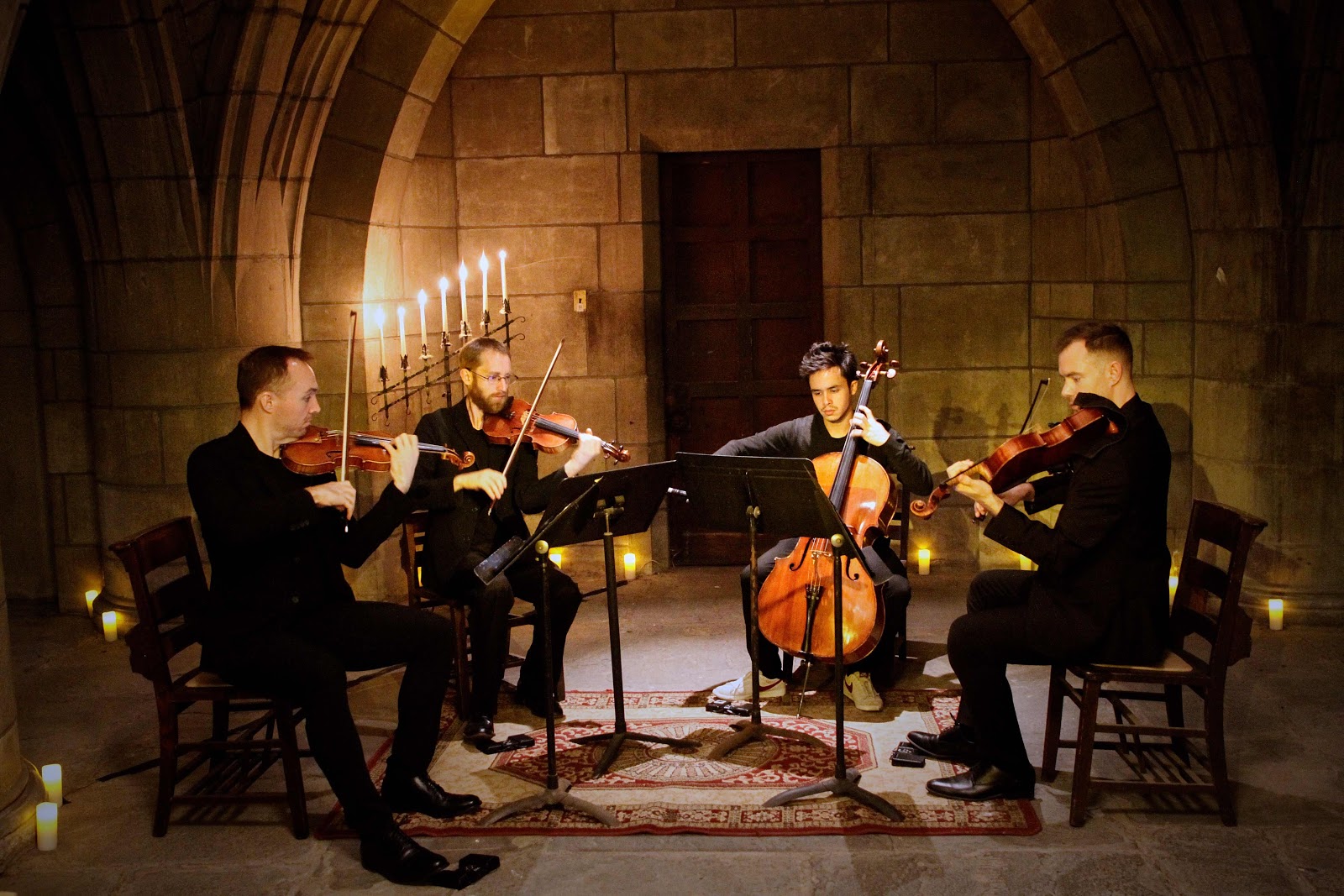
We were there for another entry in The Crypt Sessions, a series produced by Death Of Classical, which is the brainchild of Andrew Ousley, a voluble impresario who invited us take advantage of the intimate setting to seek communion with the music, with ourselves, and with our fellow audience members. He also mentioned what a treat it was to have the JACK Quartet perform in such a context and I couldn’t agree more - the group’s sense of adventure is only matched by their sheer excellence of technique. And as this is the second time I saw them in a brief span of time, I can happily report that they are as tight and communicative as they were before their lineup changed a few years ago.  

The first work they played, The Wind In High Places, is one with which I am intimately familiar from their 2015 recording, part of a beautiful album of the same name focusing on music by Adams. But right from the opening of the first movement, a four-note phrase of high harmonic notes, I sensed a greater shapeliness to the performance. It was a feeling that remained throughout that wispy first movement and into the second, an extraordinary combination of tinkling glass chimes and bird calls. As these sounds were all made by the two violins, viola, and cello, this could be considered synthetic music of the highest order. The music took shape in the air, aided immeasurably by the warm acoustic of the environment. The third movement inspired me to jot down the phrase “radical consonance” in my notes, so strong and rich was the sense of harmony among the instruments. Structurally speaking, that third movement, and the piece as a whole, felt as solid as the Gothic arches by which we were surrounded. 

JACK Quartet In The Crypt (Photo by Andrew Ousley)
After rapturous applause, the four men got to work on Adams’s String Quartet No. 5, Lines Made By Walking. This was the New York premiere of the piece, which was first played this past August in Fishtail, Montana at Tippet Rise. Death Of Classical didn’t print the movement names or numbers on their minimalist program, but I wondered from the start if Adams would once again use the three-part format that seemed so right in the previous piece. A brief introduction from JACK violinist Austin Wullman let us know that Adams was inspired to create a “sculpture” in sound based on long walks in Wyoming. 

The first movement - which, I learned later, is called Up The Mountain - had a sense of constant ascension with repeating melodic loops seeming to move ever upward. The content of those melodies also struck me as quintessentially American, as if the essence of Aaron Copland was extracted and distilled into an ambient Americana. There was a crescendo of sorts to end the first movement, a bit of a magic trick showing how minimal gestures can create drama. The second movement (Along The Ridges) was elegiac and almost lush. Time felt suspended along its long threads even as it retained a sense of slow forward motion. Down The Mountain, movement three, was just that: "Descent," as I wrote in my notes. It followed a similar architecture as the first movement, including the quickening, almost-crescendo at the end, with lots of eye contact between the players as they brought this new piece home. 

There was a brief pause and then a long, generous and well-deserved ovation. I looked at my watch and it was barely 9:00 PM, a nice bonus on a Monday night. On the way out, I chatted briefly with Wullman and asked him if the greater comfort with The Wind In High Places was a result of having played it many times or just my own impression. He agreed that playing it often had made it more their own, but also put the difference down to “not being under the microscope” of the recording studio. 

While I certainly hope the JACK records this new Adams piece ASAP, that’s as good an argument for attending the Crypt Sessions as any: hearing our finest musicians playing excellent music in an environment that evinces their greatest sense of comfort. In short, it’s a special occasion. The word is out, however, and shows sell out almost instantaneously. So subscribe to the newsletter and be prepared to jump when they announce their next concerts!

You may also enjoy:
Concert Review: A Braxton Spectacular At Miller
Concert Review: Shadows And Hope At Zankel Hall
Tristan Perich's Divine Violins
MATA's Bad Romance At The Kitchen


Thursday, September 26, 2019

Concert Review: A Braxton Spectacular At Miller


“Music is not just that which happens on stage. Music is part of the vibrations that happen between people.” - Anthony Braxton

There likely would have been a sense of occasion - and a packed house - at the Miller Theatre last Wednesday night no matter whose music was being featured. It was the opening concert of their 20th season of Composer Portraits, an event worthy of celebration even in the abstract. But an evening of music by Anthony Braxton is also not as common as it should be so I welcomed the opportunity for immersion. 

A glance at the program and a read through Lara Pellegrinelli's typically incisive and captivating notes promised a well-conceived evening, moving chronologically from 1968’s Composition No. 1 to Composition No. 358 from 2006. Also, with Either/Or and JACK Quartet involved I knew there would be no question about the excellence of the players. But there was much I didn’t know, as when Melissa Smey revealed that after performing the first three pieces in sequence, the final six works would be played simultaneously. Without understanding exactly how that would work, I settled in, alert to whatever may come. 

Richard Carrick, director of Either/Or, assayed the first piece, which was for solo piano. A fragmented shuffle or palimpsest of lyricism and cacophony, with the barest hint of ragtime, it kept me on the edge of my seat. Knowing that Braxton often uses unconventional notation, I kept an eye on Carrick’s iPad Pro to see what the sheet music promised. The boldest gesture there - a giant black X across several bars - was equally bold on the keyboard as Carrick crossed his hands to continue an especially dazzling run. Some of the big block chords spoke to me as exemplars of the frustration Braxton may have felt in 1968, whether with the state of the world or his need to break free of free jazz. In any case, this fully formed piece draws quite a line in the sand as Braxton’s first numbered composition and promised great things ahead. 

Next up was the JACK taking on Composition No. 17 from 1971, which offers much freedom to the players as far as which part is played by each instrument and for how long. With subtle hand gestures from violist John Pickford Richard to keep them on track, three distinct movements emerged encompassing various levels of wooziness, static, and turbulence. Whether it was the JACK’s approach or built in, there was a sense of structure that was at least adjacent to the string quartet literature making for a very satisfying and adventurous piece. 

Either/Or then took the stage, expanded to 11 players with the addition of two of Braxton’s close collaborators, James Fei (saxophone) and Chris McIntyre (trombone). Both of them, especially the latter, had a lot to do in Composition No. 46, which occasionally mingled Boulezian elegance with suspense straight out of a Lalo Schifrin score. As it went on, I found my mind drifting and wondered if the piece wasn’t a bit aimless. This led to thoughts about what it means for music to have an “aim” in the first place. Was such criticism more about me than about Braxton? Was it actually criticism at all, or just acknowledgement? Before I knew it the piece had ended. 

Then, after a brief reset of the stage, came the piece de la resistance, one of those “only at Miller” blockbuster experiences that will have people saying “I was there” for years - and some of them might be lying. Yes, it was THAT incredible. Either/Or, now boasting a seriously tricked out percussionist, and JACK filled nearly the entire stage and sallied forth into the breach to play (deep breath): Compositions No. 17, 18, 40(O), 101, 168, and 358, spanning 35 years of work from 1971 to 2006. My impressions were as follows:
  • Brawny swagger, led by the reeds and brass, mallets on bongos lending a faint whiff of 50’s “exotica.”
  • Furious flute and bassoon jam (maybe No. 168?) with stunning playing by Margaret Lancaster and Sarah Schoenbeck, respectively. Other sounds faded away. 
  • Most of JACK having a great time, gesticulating with bows, pointing at each other’s music stands to stay focused (unclear if this was staged behavior, especially when they began shouting in unison); cellist Jay Campbell looked miserable for a few minutes, like a teenager forced to play poker with his parents, but soon brightened up. Many glissandi, swooping up and down the necks of their instruments.
  • Cubist strains of Gershwin-esque melodies kept seeking air above the clamor, with a glorious lack of success.
  • James Fei taking command once in a while on alto or soprano sax, the collective blend unable to hide his obvious brilliance.
  • Muted trumpet galore, played beautifully by Jonathan Finlayson, but not the cool, airy Miles Davis mute, more like Louis Armstrong 1920's mute, all sharp commentary.
  • Playful, even pranky at times, with echoes of Joseph Byrd's balloon music, or a Pere Ubu song about walking or feet.
  • Occasionally able to zoom in from the totality and pick out an individual work, like Composition No. 101 (1981) for piano and trombone, Carrick and McIntyre synching up beautifully.
  • Bassist James Ilgenfritz and percussionist Russell Greenberg driving things ever onward, with the latter equally facile on the side drum, the vibes, or those delightful bongos. They had me tapping my toes and dancing in my seat a little.
  • Devolved into insect sounds, everyone seemingly on the same page, making dry, rustling noises, eventually going quiet. The end.
The audience caught their collective breath and then issued forth a long ovation. As we stood, a woman to my left asked if I had heard it before. "No one has," I said, nearly crowing. "Well, you were tapping your fingers..." "It had a pulse," I responded, smiling, "and I reacted accordingly." I'm still not sure if she was annoyed or a little bit jealous. On my way out, I shook Miller director Melissa Smey's hand and congratulated her on a spectacular start to the season. Get to this page to find out what the rest of the series looks like and make a plan to be there.

You may also enjoy: 

Monday, April 15, 2019

Concert Review: Shadows And Hope At Zankel Hall


Programming a concert has many challenges. First of all, it’s commonplace for it to be at least two hours of music, which gives the audience their money’s worth but requires much preparation. If you’re presenting a new piece, that might eat up a disproportionate amount of your rehearsal time. Playing an unfamiliar work might also lead you to want to give the audience some comfort food, in the forms of a warhorse or other frequently performed piece. Fortunately, the American Composers Orchestra did not fall into that trap last Thursday, when they played in Zankel Hall as part of Carnegie Hall’s massive and ambitious festival, Migrations: The Making Of America. But they did struggle a bit to connect works that were musically disparate and resonated with each other only on a strictly cerebral level. But that was the only issue I had with the concert, which was played both immaculately and with a generosity of feeling. 

The first piece was Morton Feldman’s Turfan Fragments (1980) which was inspired by bits of 1,500-year-old knotted carpet from Turkestan and, as such, was designed to be a series of unresolved parts. For a first hearing of this slippery work I was immediately struck by how resolute it was in its very irresolute-ness, as if Feldman was determined that it not come together in a way we expect from an orchestral piece. There were many sonic delights within, however, like the pizzicato section that came about five minutes in. And there may have been no harder working man in New York that night than conductor George Manahan, whose precise baton movements hinted at the challenge Feldman designed for those who dare to assay these “fragments” - a challenge more than met by him and the ACO. 

Next we were treated to a some brief remarks from Gloria Coates, describing how her Symphony No. 1, “Music on Open Strings,” took shape between 1971, when it was commissioned by the Rhinelander Chamber Orchestra, and 1974, when it was completed. She wasn’t able to finish her whole tale of artistic discovery, and it is a gripping story, but it was also well-told by her in the program notes. Coates, who turned 80 last year, was born in Wisconsin but traveled from her home in Germany to witness her piece’s Carnegie Hall debut. It was also my introduction to her work, as she has been in the “I know the name but that’s all” category for some time. Now I'm kicking myself because I know what I've been missing!

I was quickly sucked into the unique sound world she creates, with bows swooping and gliding across strings and sometimes tapping them. Knuckles were also knocked against wood for dramatic effect, just one reason I was on the edge of my seat. Part of the work’s distinctive quality comes from Coates’s idea to have the players re-tune their instruments periodically throughout, which was a great opportunity for the ACO and Manahan to show how well they communicate. A nod of the head from one of the bassists toward the podium was all the conductor needed to know that the musician was ready. Ultimately, the brooding intensity of the piece, which reminded me of Shostakovich at times, was more important than the mechanics of how Coates got there. I’m looking forward to learning more about her catalogue and hope we don’t have to wait for her centenary for it to be celebrated and highlighted in the musical life of NYC. 

Instead of an intermission, there was a panel discussion featuring the collaborators who created the evening’s main event, the New York premiere of Where We Lost Our Shadows (2019). Composer Du Yun was joined by filmmaker Khaled Jarrar, ACO Artistic Director Derek Bermel, and vocalist Ali Sethi. Du Yun talked about how she crafted the work with these specific soloists in mind, instead of casting them later. Having already decided that ragas would be incorporated into the piece, Sethi became a real asset as he guided her through 800 years of music from the Indus region. Sethi also demonstrated some of the basic Qawwali forms he would be using, giving the audience a sneak preview of his wondrous voice. Jarrar described his way of embedding himself with immigrant communities, gaining their trust and getting a view of the extremes of their experiences. Author Didier Fassin, whose book, Life: A Critical User's Manual, informed some of the thinking behind the piece, was also on hand to offer some sobering facts about migrant mortality: It has been on the rise worldwide for decades and many deaths go uncounted with even the names of the dead unknown or unrecorded. 

L-R: Didier Fassin, Ali Sethi, Du Yun, Khaled Jarrar & Derek Bermel
Photo by Jennifer Taylor
According to the program notes, “Where We Lost Our Shadows is a piece for orchestra, video, and soloists that focuses on human migration as a question of perpetual movement and exodus that repeats throughout history, passing on collective and individual traumas and rejuvenations from generation to generation.” That measured explanation barely hinted at the deeply emotional combination of sound and vision that transpired over the half hour of the piece, which literally started with a BANG, struck by percussionist Shayna Dunkelman on an enormous side drum. I know Dunkelman as a member of avant-rock band Xiu Xiu but was unaware of the breadth of her musicianship, which became stunningly apparent during the heart-stopping solo that began the work. 

When the orchestra came in, accompanied by what I believe was an electronic tanpura (Sethi seemed to be holding one during the panel discussion), it was almost a relief from the tension built up by the drums. Sethi began singing in his rich, slightly husky voice, seeming to craft his ancient melodies out of the air with his hand gestures. There was a chaotic darkness on the screen, which eventually gave way to an interview on the streets of Turkey with a family overjoyed because they had just gotten their authorization to travel to Europe, where they would find a new home after leaving Syria. They kept smiling even when saying they had been living in the streets while waiting for their papers. Their sweet, shining faces stood as a testament to the indomitable human spirit - and an indictment of what people do to other people. 

"Where do you sleep?" "In the streets." Photo by Jennifer Taylor.

Helga Davis, the third soloist and an incredible singer and performer, then stood up and unleashed all the pain and sorrow that lay behind those smiles. There was another percussion interlude, even more intricate than the first, and further explorations of Qawwali, leading to a stunning duet between Sethi and Davis. Just as there are no easy answers to the refugee crisis, ...Shadows ended without a sense of closure - it just stopped. The audience caught their breath and then stood for a generous standing ovation. While it’s hard to be entirely sure based on one performance, I feel fairly certain that the music, in which I sensed a new level gravitas for Du Yun, will more than hold its own without the visuals. I urge the powers that be to record it as soon as possible!

You may also enjoy:
Focus On: Contemporary Classical
Three Portraits: Cheung-Trapani-Du Yun
Mata's Bad Romance At The Kitchen

Thursday, April 04, 2019

2019 First Quarter Report: Concerts


An unpredictable schedule this year meant that every concert I've seen except one has been in the realm of contemporary classical music. But within that, much variety - read on!

No Filler At The Miller I was speaking with Melissa Smey, Executive Director of the Miller Theatre, and she was relating the challenge they're going to have capping off their 30th anniversary next season. A challenge because their programming has been so strong in 2018-19 that it's hard to know how they can top it in 2019-20! From the Du Yun Composer Portrait I saw last November to the three shows I've been to so far this year, they are hitting all the marks - and there's still more to come.

On February 21st, I took in the Wang Lu Composer Portrait, giving me another opportunity to hear Urban Inventory, last performed in New York back in 2016 by Third Sound, who also recorded it on Wang Lu's stunning 2018 debut album. Here, the International Contemporary Ensemble worked their magic on the piece, also playing the witty Childhood Amnesia (2017) and Siren Song (2008), which found Stravinsky barreling into a Chinese opera house and causing quite a commotion. There was also A-PPA-Aratus, a world premiere played by Yarn/Wire and a stunning addition to their repertoire for two pianists and two percussionists. I hope they record this spectacular 21st century poéme mecanique very soon.
Yarn/Wire performing A-PPA-Aratus
Photo by Rob Davidson for Miller Theatre
A week later I was back to see Third Sound themselves, making their Miller debut at one of the theatre's innovative Pop-Up concerts. These are the free shows where the audience sits on the stage and enjoys free beer along with the music. They also usually last just about an hour, so Third Sound, founded in 2015 by composer Patrick Castillo with violinist Karen Kim, cellist Michael Nicolas, pianist Orion Weiss, flautist Sooyun Kim and clarinetist Romie de Langlois, programmed a set that had enough variety to show what they can do while also keeping it concise.

Ingrid Arauco’s Fantasy Quartet was a perfect opener - sparkling, astringent and colorful, it gave many opportunities for the musicians to shine. Next was Music For Four composed by the group’s founder, Patrick Castillo, and inspired by watching his young son at play. It was a piece infused with warmth and joy, making equally canny use of repetition and surprise. Finally, in keeping with their mission to embrace to whole sweep of chamber music, they stormed through Webern’s imaginative reduction of Schoenberg’s Kammersymphonie, Op. 9. All of the work’s angst and artfulness was brilliantly exposed by their passionate playing, earning them an enthusiastic ovation. I think they'll be asked back.

My last visit to the Miller was just this past Thursday, when they presented a Composer Portrait of Tyshawn Sorey to a buzzing and packed house. The excitement was more than justified by what followed as were treated to an embarrassment of riches in two sets of music presented seamlessly, without applause or space between works. This was similar to the first half of the Du Yun concert and if anyone else is putting on shows like this I’d love to know about it. Special note should be made of Isabella Byrd's lighting, which helped immeasurable with all the transitions and lent a sense of atmosphere and occasion.

One theme of the night was how to pay homage to your mentors while speaking in your own voice. The first piece, In Memoriam Muhal Richard Abrams (2018), paid tribute to the founder of the AACM with a meditation for violin (Jennifer Curtis) and celesta (Cory Smythe). It was a gorgeous combination of sonorities that both quieted and engaged the mind. Sorey’s lyrical gifts were much in evidence as they would be later in the night. The next piece, Ornations (2014) provided a welcome and witty shock to the system as flautist Clair Chase faced off with clarinetist Joshua Rubin. The word “puckish” may be overused when it comes to Chase, but as she danced opposite Rubin, who was anchored in place by his contrabass clarinet, it was impossible not to think of Shakespeare’s sprite. The music matched the mood resulting in tremendous fun that was not without an edge of aggression. The JACK Quartet closed the first half with the NY premiere of Everything Changes, Nothing Changes, a work requiring tremendous concentration as they passed around sustained notes creating an unbroken canvas of sound. I look forward to hearing it again so I can just let it happen without wondering what would happen next. 


Claire Chase faces off with Joshua Rubin in Ornations
Photo by Rob Davidson for Miller Theater
After a brief intermission, Sorey and Chase sat down for an illuminating discussion that amplified some of the material in Lara Pellegrinelli’s superb program notes, chiefly the distinction between hybridity and mobility. Sorey sees the former as a tired trope about "jazz" musicians writing "classical music," "crossing over," etc. Instead of a hybrid composer, he sees himself as a mobile one, able to do what he wants with whatever instrumentation he wants in whatever setting he chooses. Amen. They also reminisced about their first meeting, about a decade ago, a tribute to the tight relationship between composer and musicians of the International Contemporary Ensemble. That connection would come in handy in the world premiere presented in the second half of the concert, but first we heard For Harold Budd (2012), a gleaming trio for piano, flute and vibraphone that had Smythe and Chase working with percussionist Levy Lorenzo. It really was beautiful, with some of Budd's painterly qualities, but the brushstrokes were all Sorey's. 

Autoschediasms (2019), a Miller Theatre commission followed. It was scored for "Creative Chamber Orchestra," an ensemble seemingly entirely flexible as the program listed seven musicians to which was then added one more - plus the four members of the JACK. This piece builds on an idea from Butch Morris about "conducted improvisations" that had Sorey leading the group with a series of very specific hand gestures as well as instructions written on a small whiteboard. The players were well-drilled, moving from section to section without hesitating, and the sounds were consistently engaging. My western brain was seeking crescendos, the kind of tension and release we're so conditioned for, but what I heard was more of a continuous tapestry. The effect was a little like listening to a radical remix of a song you never heard before and I'm curious how different it will sound the next time it's performed.
Tyshawn Sorey (right) conducts ICE in Autoschediasms
Photo by Rob Davidson for Miller Theatre
As Autoschediasms was fading out, Chase came to the front of the stage with her flute and Sorey stepped off the podium and sat down at a conventional drum kit so they could play Bertha's Lair (2016), a piece that's become a bit of a signature for the duo. Here came the release, the crescendos and so much more as I was witness to some of the greatest drumming I've ever heard, in the same class as Art Blakey, Tony Williams and Leon Parker. But Sorey went further, nearly into a kind of performance art, as he removed a ride cymbal, put it on the floor tom for some intriguing effects - and then stacked it on the other ride cymbal and kept going from there. This was all while Chase was making an action painting in platinum, playing a piccolo flute and an enormous contrabass flute in addition to her standard concert model. It was the perfect ending to a night that earned Sorey and his collaborators a standing ovation and had the audience buzzing once again.

Tales Of Talea Even if I wasn't a board member, I would try to get to as many shows by the estimable Talea Ensemble as possible. This season they have not only been presenting wonderful music, but have made big strides in opening up important conversations about the role of music in our lives, how music works, and what it means to be part of the "new music" community. Much of those discussions happen at their iNSIDE Out series at The Flea Theater, and the one I attended on February 24th was a perfect example. Called Side By Side, the afternoon began with music for duos, kicked off by Vasko Dukovski (clarinet) and Chris Gross (cello) playing Iannis Xenakis' thorny Charisma (1971), which portrayed the instruments as isolated individuals pursuing their own paths. Catherine Lamb's In Passing / PARALLEL (2008), played by the violins of Emilie-Anne Gendron and Anna Kridler, was more of a joint effort - and a bit of an endurance test - as they passed long lines in a continuous tone that somehow created tension. Hearing them follow it up with some choice Bach, with its dance rhythms and folk melodies, threw everything we had already heard into stark relief. 
Performers & Panel at The Flea Theater
After a brief intermission, we reconvened for a very engaging panel discussion featuring Gross, Marcos Balter, Lauren Ishida, Eun Lee and Victoria Chea - and the audience. As these things are wont to do, perhaps more questions were raised than were answered, but we all left with a lot to think about, including my own musings about how Talea’s identity as a premiere presenter of European avant-garde composers meshed with the need for inclusivity on both sides of the concert stage. 

The next time I caught up with Talea, they were kicking off a residency at The Stone, John Zorn's performance space at The New School. There, we were also treated to more spare sounds, mostly solo works played by Adrian Morejon (bassoon) and Marianne Gythfeldt (clarinet). A link to the Flea concert was a piece by Eun Lee, a brief and action-packed world premiere called Yun (2018) for solo bassoon and played with real flair by Morejon. He also gave first performances of Edward Jacobs' Concentre (2014), filled with a sense of spontaneity, and Triplum (2014) by Filippo Santoro. The last was a trio, with two prerecorded bassoons played off an iPhone, which kept Morejon on his toes in a rhythmic, angular and witty piece. 

Gythfeldt also thrilled in Mikel Kuehn's signature piece Rite of Passage (2014), which had every last sound made by her bass clarinet picked up and manipulated and played back along with her live instrument - fantastic! She also gave a flawless performance of George Aperghis's Simulacre (1991-95) and then joined Morejon for the bouncy groove of Black (2018) by Mark Mellits. If you’re starting to feel FOMO - and you should be - I will point you to Gythfeldt’s marvelous 2018 collection, Only Human, which includes the Kuehn and other intriguing music. 

You can also trigger my own fear of missing out by attending Talea’s Tenth Anniversary celebration on April 20th. I can’t go, but it promises to be a memorable night revisiting many pieces from Talea's past and also presenting the world premiere of Hans Thomalla's Harmoniemusik 1 (2019) and the U.S. premiere of Framing... (2018) by Georg Friedrich Haas.

Switched On At Areté If any world is a small world, it’s the world of contemporary classical. So I was invited to this New York appearance by Boston’s [Switch~ Ensemble] by Zach Sheets, who used to work with Talea as our development and communications person. Something was in the air on February 28th as I had the choice of about eight concerts, but I decided on this one because it brought me to a venue I’ve never entered to hear pieces by unfamiliar composers. Risk, as Captain Kirk told Bones, is what it’s all about. Areté proved to be a small space arrived at through an arcade in a multi-use building in Williamsburg. The vibe is friendly and scrappy but not disorganized - the concert started right on time as the group launched into the electro-acoustic maelstrom of Adrien Trybucki's Infinite Extension (2017), a world premiere of a piece they commissioned. It was a wonderful introduction to their tight ensemble and excellent taste.

The next piece was Sivan Eldar's sleekly mysterious Tarr (2014), almost a series of notated sighs and whispers - and very beautiful. Third was a surrealistic audio collage by Esaias Järnegard called Songs For Antonin (2017), as in Artaud. It was wacky and gripping in equal measure, with bits of an old radio play mixed in. I don't doubt that Järnegard studied with Pierluigi Billone, as it had some of his absurdist spirit. Switch closed the concert with Timothy McCormack's karst survey, a dark journey indeed, which had T.J. Borden grinding at his cello like a Norwegian black metal guitarist. Overall, the concert showed off Switch to excellent effect - I would keep an eye out for the next time they come to your town.

BOAC Takes Off In PCF I try to never miss the People’s Commissioning Fund concerts by Bang On A Can, where their All-Stars present world and U.S. premieres as part of the Ecstatic Music Festival. There are also usually some classics from their repertoire to fill out the night, which this year included a Glenn Branca work they hadn’t performed for 20 years. The new pieces came first, however, beginning with Henry Threadgill's With Or Without Card, fractured and flamboyant, with a throughline that linked Jimmy Giuffre to Ornette Coleman and gave clarinetist Ken Thomson a lot to chew on. Next was Josué Collado Fregoso's lovely, evanescent Joi de Vivre, which put Mariel Roberts' cello and Robert Black's bass in the foreground. Black also blew some minds in the uncanny notated funk of Trevor Weston's Dig It - it somehow managed to avoid being a "crossover" pastiche. More please. This is where the night's theme of "dance music" truly came into focus, an emphasis that continued in Nicole Lizée's Dancist, a delightfully witty work that was accompanied by her fascinatingly messed up film. I would happily watch - and listen - to it again.
Scenes from the BOAC PCF Concert at Merkin Hall
The highlights of the second half were Annie Gosfield's fabulously imaginative - and furiously complex - The Manufacture Of Tangled Ivory (1993), which pushed pianist Vickie Chow to new heights of synthesizer magnificence, and Branca's Movement Within, a microtonal masterpiece that had Merkin Hall throbbing like the Mudd Club on an average Saturday night in 1980. John Schaefer of New Sounds was on hand to introduce each piece and interview the creators and the discussion with guitarist Mark Stewart and producer Adam Cuthbért about the reclamation of Branca's piece was a gripping tale indeed. Let's just say that recreating Branca's samples, which were stored on Zip Discs, was not a task for the faint of heart. But the All-Stars are a brave bunch and the whooping audience was all too eager to follow them wherever they journeyed. Try to be there in 2020!


Marissa Nadler
Coming Together At MoMA PS1 For the third year in a row, the Museum of Modern Art's Long Island City outpost held an incredible two-day festival called Come Together, created in collaboration with Other Music. Just like the first year, it was filled with a label fair, panel discussions, film screenings and live performances. Of the latter, I was able to see Marissa Nadler, whose 2018 album, For My Crimes, was one of the best folk albums of the year. It was short but intense solo performance, with Nadler creating a web of sound, either fingerpicking on an acoustic or looping a 12-string electric. At the center of it all was her gorgeous voice, which had emotional range enough to cover her dark originals and a cover of Fred Neil's bittersweet Just A Little Bit Of Rain. I was happy to see her earning new fans among the diverse crowd.
Negroclash: Prince Language, Duane Harriott and DJ Lindsey
It was chilly outside when we left the VW Dome, but DJ Duane Harriott was spinning so there was no question about how we were going to warm up. He already had the crowd in a Dionysian frenzy when he was joined by Prince Language and DJ Lindsey for a reunion of their collective Negroclash, which first performed at PS1 almost 20 years ago. Even while dancing, it was impossible not to be stunned at their synchronized routine, with each playing a song (and often manipulating it) before ceding the decks to the next DJ for a sumptuous flow of incredible beats, from disco to funk to electro. It was a high-wire act - and highly musical. They ended the set perfectly, too, with Sylvester's classic (You Make Me Feel) Mighty Real, sending us off happy and exhausted into the Queens evening.
Duane Harriott, man at work
And what live music have you enjoyed in 2019?

You may also enjoy:
MATA's Bad Romance At The Kitchen
Bon Iver's Dance Music
Moment Of Palm
Bang-Up World Premieres