Showing posts with label Laraaji. Show all posts

Saturday, May 28, 2022

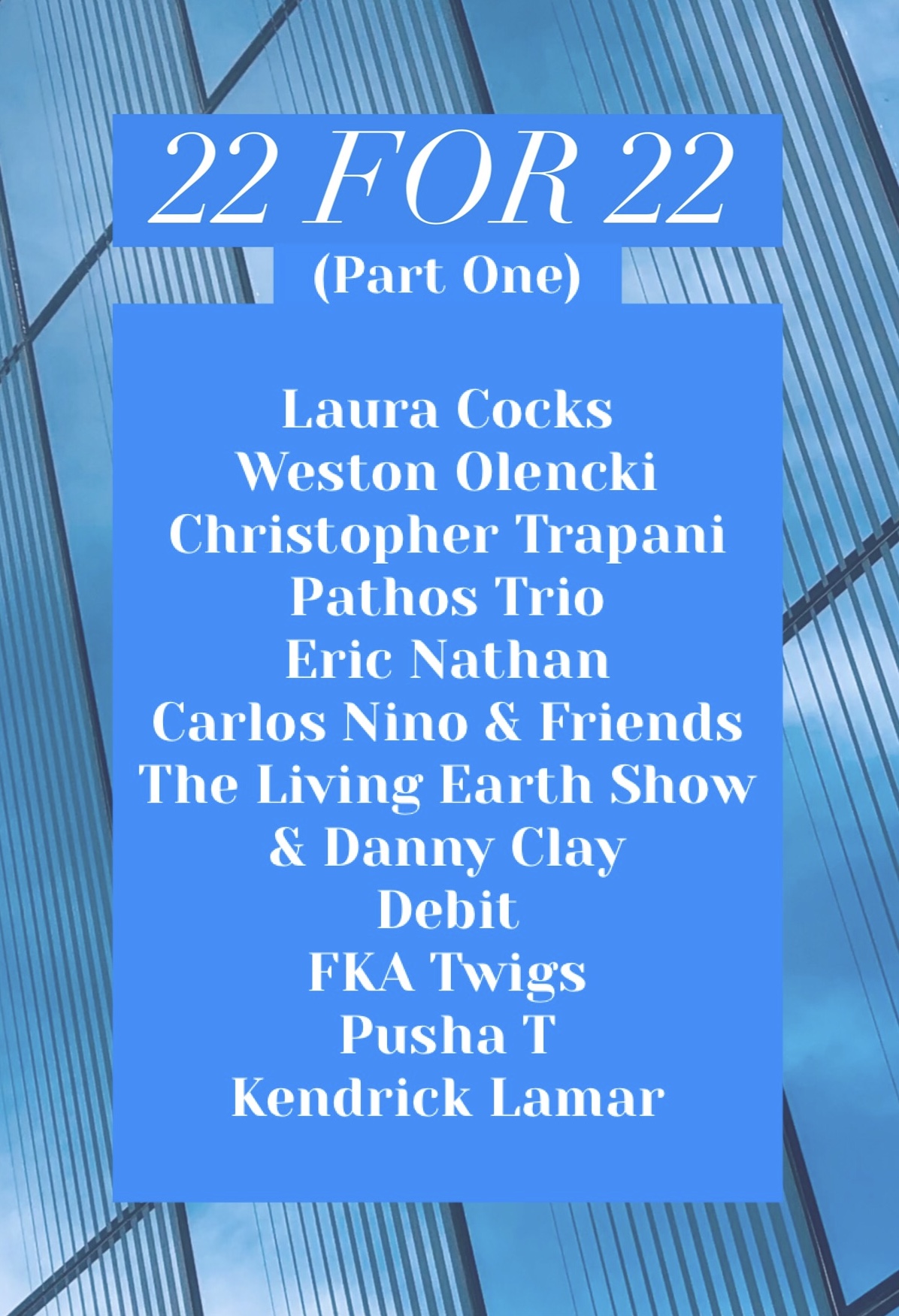
Record Roundup: 22 for 22 (Part 1)


There's no single reason why it took me so long to complete my "Best Of 2021" series, just life - in all its stress, strife, wonder, and joy. But all throughout everything that was going on and while I was doing my darnedest to put some shape to the music of last year, I was listening - passionately - to music from this year. And there has been plenty of brilliant stuff, more than enough to fill a dozen roundups. In order to keep myself (and you) from getting overwhelmed, I'm starting off with 22 albums across all genres, split in two parts. Future posts will drill down further into each genre. 

Find songs from most of these albums (some are only on Bandcamp) and follow along with my 2022 listening in these playlists:

Classical

Laura Cocks - Field Anatomies It's only fitting that an album of "blisteringly physical works for flutes" comes in an exquisite package, hand-collaged with dried flowers and decorated with beeswax. The beauteous outside, however, belies the often fierce sounds inside, as Cocks (known for their work with the ever-questing Tak Ensemble), goes toe to toe with some very extreme conceptions of what can be done with a flute, breath, the body, electronics - and some even less expected sources of sound. Bethany Younge's Oxygen And Reality, for example, was composed for piccolo, electronics, balloons, and hardware, and includes at least as much rhythmic breathing as anything else. It also features Cocks in seeming conversation with theirself, as half-heard spoken sentences cross the soundscape. That's the second track; the first is David Bird's Atolls for solo piccolo and 29 spatialized piccolos, which kicks things off with what sounds like someone taking oxygen from the flute before eventually exploding in dazzling swirls of gleaming sound. 

Jessie Cox, whose work was recently heard on the excellent Wavefield Ensemble album Concrete And Void, contributes Spiritus for solo flute, which alternates meditative tones with busy flurries of melody. "Contributes" is the wrong word, however, as the collaboration between composer and performer is as deep as it gets on Field Anatomies, beautifully detailed in the conversations on episode 22 of the Tak Editions podcast. The two other pieces are You'll See Me Return To The City Of Fury for glissando flute and electronics by DM R (Diana Marcela Rodriguez), both jarring and space-age sleek, and Produktionsmittel I for amplified flute, aluminum foil, glass bottle, and fixed media by Joan Arnau Pàmies, frantic and animalistic even when its just the sound of crinkling foil. All of these works are fully formed and as rewarding as they are demanding. Field Anatomies is a remarkable piece of art, which will cause emotion and inspiration to sprout faster than the packet of seeds that comes with the special edition CD.  Act fast, in any case: only five copies remain.

Weston Olencki - Old Time Music The Tak Editions podcast also gave me the opportunity to focus on the mind of Olencki, which was perfect (though not required) prep for their music, as represented by this monster of a tape from Tripticks. The three works here astound in their invention, conceptual gravitas, and sheer listenability. Wittily titled Tenor Madness, the opener puts sax player Anna Webber through more changes than a dozen fake books as she interacts with some very messed up electronics derived from  short extracts of over 300 albums spanning recordings of the (improvising) tenor saxophone from 1939 to the present. And that should give YOU an idea of how Olencki's mind works! A Vine That Grew Over The City And No One Noticed is a four-part work for "two electro-mechanically controlled banjos, homemade magnetic resonators, solenoid motors, AM radio transmitters, vintage transistor and tube radios, railroad spikes, mason jars, carriage bolts, South Carolina red clay distortion unit, 60Hz ground hum, field recordings, and neural net re-synthesis of seminal old-time repertoire and Markov-driven Scruggs-style banjo picking." I swear I hear a snippet of John Lennon's Well Well Well in there, too...but for all that it's compulsively listenable, a drone that sounds as old as Appalachia and as new as the Boeing Starliner that just connected to the International Space Station. The last piece, Charon Guiding The Weary 'Cross The Long River (Or, How To Care For A Dying Instrument), is comprised of a similarly baffling array of source material, including "hydrophonic recordings made of the Connecticut River transduced through found slate roofing tiles," and would probably give the titular hell-bound oarsman a chill up his demonic spine.  Kudos to Olencki for putting as much thought into how the end products sound as he did into making them. Drastically original and staggering stuff.

Christopher Trapani - Horizontal Drift On the title track of Trapani's latest portrait album, Dan Lippel plays a quarter-tone guitar through software of the composer's own design called LoopSculptor. The piece incorporates tropes from Delta blues and other genres native to Trapani's hometown of New Orleans, resulting in a 10-minute trip through museum of hazy half-memories. The title seems to do double duty, referring both to American expansion and the interactions of various loops across the software's grid layout. The unusual instrument, the engineer's approach to sound, and the emotionally resonant results are paradigmatic of the whole album, which opens with Targul, a piece for vioara cu goarna, a horn-enhanced instrument similar to a Stroh violin. Played with seemingly casual mastery by Maximilian Haft, the sound is not unlike a gramophone, with a sharp, tinny edge that blends perfectly with the sketchy, truncated phrases of the music. Haft also finds himself in a sort of duet/competition with electronics played through megaphones, adding immersive depth to the attenuated sounds. Trapani also puts new-music piano maven Marilyn Nonken through her paces in Lost Time Triptych, a piece for scordatura-tuned instrument that manages to be inspired by both Gerard Grisey and Bob Dylan. The other works, including Linear A, for microtonal clarinet (Amy Advocat) and electronics, Forty-Nine, Forty-Nine, for a MIDI-controlled equal-tempered Fokker organ, and Tesserae, for viola d’amore (Marco Fusi) grab the attention as well. Trapani continues to prove himself to be smart, playful, and fearless explorer on this triumphant collection.

Pathos Trio - When Dark Sounds Collide The first thing that struck me upon listening to this was how richly it was recorded, with the percussion of  Felix Reyes and Marcelina Suchocka fairly leaping out of my speakers and taking up space in my living room like blow-up furniture. The piece, Evan Chapman's Fiction Of Light, begins with Alan Hankers delicate (and delicately enhanced) piano, which only gives the drums more presence. Two-thirds of the way in, things get glitchy and pulsating and we're in the realm of a Radiohead remix. The group's versatility is further proven by Alison Yun-Fei Jiang's Prayer Variations, which includes some very subtle work from Reyes and Suchocka, letting Hankers takes center stage, before they drop the "boom." It's a dynamic and satisfying piece, as are works by Alyssa Weinberg and Finola Merivale. Hankers' own Distance Between Places ends the album on a brooding note. Each work was commissioned by Pathos and has an accompanying video by Four/Ten Media (Chapman is a co-founder), lending even more of a sense of occasion to this excellent debut.

Eric Nathan - Missing Words I got a great sense of kissenkühlelabsal from Whitacre Hill's horn in the first part of Missing Words, performed by the Boston Modern Orchestra Project. And in case you think I've lost my mind, "kissenkühlelabsal" is a word Ben Schott invented to describe "the ineffable pleasure and instant relief of a cool pillow." Every movement of this six-part work is in fact based on one of Schott's words from his Schottenfreude project, which turns into a great excuse for Nathan to produce reams of chamber music, from sparkling to introspective, and have it performed to a fare-thee-well by BMOP, the American Brass Quintet, cellist Parry Karp and pianist Christopher Karp, the International Contemporary Ensemble, the Neave Trio, and Hub New Music. Whether you know the words or not, this is a delight to listen to, although it did require some fingerspitzentanz ("tiny triumphs of nimble-fingered dexterity") to get the booklet out of the CD package so I could read the liner notes!

Electronic

Carlos Nino & Friends - Live At Commend, NYC For some reason it took me years to find out that the innovative label RVNG had a performance space and store in lower Manhattan. Now sadly on hiatus, at least I got to spend one blissful night in that jewel-box of artistry back in 2019, listening to sets by Phong Tran and Adam Cuthbért. But I wasn't there on November 16, 2021, when Nino assembled this crack lineup to make peaceful, yet intricately textured music. Adding to Nino's bells, chimes, and percussion were the great Laraaji (electric kalimba, vocals, and iPad), Surya Botofasina (keyboards), Photay (Buchla, 808, and electronic drums), and Will Logan (drum set). That should give you an idea of the sound dimension you can enter when you press "Play" - and I hope you do.

The Living Earth Show and Danny Clay - Music For Hard Times Composed/organized by Clay as "calming strategies" for musicians stuck at home, these 15 gentle, twinkling tracks find Living Earthers Andy Meyerson (percussion) and Travis Andrews (guitar) and, in Book Two, a cast of dozens including the San Francisco Girls’ Chorus and students from the San Francisco Conservatory (who sent in tracks via Dropbox) finding their way towards the light. Let it shine on you.

Debit - The Long Count Just in case your existential dread has been too well alleviated by the sweet sounds above, here comes Delia Beatriz using machine learning to process the "ancestral technology" of Mayan wind instruments, creating a disquieting dreamscape that pays homage to a culture that has not so much been forgotten but "purposefully erased." Whether the Mayans would find anything to recognize in these sounds is unknown, but I think they would appreciate the effort - and we can enjoy the spare, spectral beauty either way.

Hip Hop & RnB

FKA Twigs - Caprisongs As someone who has championed Twigs since before she was FKA but was disappointed in both her long-form releases (LP1 and Magdelene), this album - she calls it a mixtape - is a balm to my ears. While still on the leading edge of electronic RnB, there's a sense of play and lightness on these 17 tracks that's a far cry from the overly considered work on those earlier releases. Whether it's the presence of new collaborators like producer El Guincho, who worked on most of the album, or just the fact that she considered it a mixtape rather than an album allowed her to fly more freely. A breezy, but deeply creative, caprice.

Pusha T - It's Almost Dry Four years after the perfection of Daytona (my #3 album of 2018), "cocaine's Dr. Seuss" is back with his fourth album, collaborating almost equally with his two greatest partners, Pharrell Williams and Kanye West - and nearly hits those same heights. The album starts with three knockouts, the first two produced by Williams and the third by West. Brambleton opens the album with a door-knock snare drum and spooky keyboards as Pusha details his sense of betrayal after his former manager claimed credit for his stories. Let The Smokers Shine The Coupes deals out a deeply funky groove as Pusha once again finds new ways to be the king of coke rap, saying "If kilograms is the groove/I done sold the golden goose." 

Then, in a masterstroke only West could come up with (and that Pusha T begged for), Dreaming Of The Past drops the hammer with a slightly sped-up sample of Donny Hathaway's take on John Lennon's Jealous Guy. The ice-cold vibe warms right up as Pusha practically duets with Hathaway while reminiscing about the good old days when "We hollowed the walls in back of bodegas" and "Gun stutter, make the drumline like Grambling." Even as he relitigates his old life, he's self-aware enough to point out that he "Didn't have to reinvent the wheel, just a better design." But even so he tries out some new things, like the way he floats his voice over Williams' nagging groove on Call My Bluff. The final track, Pray For You, combines old and new as Pusha T takes a "side step back into the duo/The kings of the Pyrex," by having his brother Malice (aka No Malice) join him on the song. Over a churchy track by producer/singer Labrinth that flashes back to Prayer, which opened Clipse's unreleased debut album (finally available!), Malice brings the heat like the old days, which has me both dreaming of the past and eager for the future.

Kendrick Lamar - Mr. Morale & The Big Steppers In one of the instantly busy hot-take threads that popped up when this eagerly awaited album dropped - Lamar's fifth and first since the Pulitzer prize-winning Damn in 2017 - a friend of a friend said, "I like the rapping but I wish the music was more hip hop." This reminded me of another exchange where someone asked if Revolution #9 was a Beatles song. My response was that, while it's an unwieldy sound collage, it is a Beatles song by virtue of being on a Beatles album. Mr. Morale comes from a similarly imperial view: it's all hip hop because Lamar is a hip hop artist, and one of such creativity and stature that he can bend whole genres to his will. To be clear, there are sonic references to reggae, jazz, r&b, and, of course, many sub-genres of hip hop - but like iron filings on a magnet, they all adhere to Lamar's wiry form, moving the genre along rather than leaving it behind. 

Lyrically, Lamar is on another plane than most rappers, dishing out a memoir's worth of tangled reflections, observations, stories, and histories. The dense firehose of words is often challenging to sort through and revealing enough to occasionally cross into "TMI" territory. But as Lamar himself says on Worldwide Steppers: "I am not for the faint of heart." He then continues with a few lines that give a hint of the micro and macro concerns of the album: "My genetic build can build multi-universes, the man of God/Playin' "Baby Shark" with my daughter/Watchin' for sharks outside at the same time/Life as a protective father, I'd kill for her." The cover depicts him with a child in his arms, a crown of thorns on his head, and a gun in his waistband, all signifiers for the world's weight, which he feels heavily on his shoulders. In Mother I Sober, which features featherweight vocals from Portishead's Beth Gibbons, Lamar remarks, "I'm sensitive, I feel everything, I feel everybody/One man standin' on two words, heal everybody." That sense of responsibility may have led him to overstuff the album, which runs an hour and 13 minutes. But Lamar is a visionary artist and incapable of being less than fascinating at this point in his career. It's still early days for my relationship with Mr. Morale - for all I know a song that now feels half-baked might prove to be a favorite in a few months. An essential listen.

Next time: Latin, rock, folk, pop, etc. 

Friday, June 05, 2020

Black Voices Matter


For most of my life, I've used music as my voice when I was too shy to speak, whether it was finding community at shows or being welcomed at parties because I had a killer mixtape. Needless to say, a good portion of that music was created - or influenced - by Black musicians, songwriters, singers, and producers. I think about growing up with Stevie Wonder's Living For The City speaking truth from my AM radio - or waiting to hear Bad Luck by Harold Melvin & The Blue Notes because of how it made me feel. Not to mention the Jackson 5, with their resident superstar who was just six years older than me! I think about my high school band, the Young Aborigines, and how we incorporated elements of salsa and dub into our weird art rock - and then danced our asses off to Thriller, Bob Marley's Uprising, and The Message after rehearsal. My gratitude for all that these artists have given me is humbling, especially considering the challenges and obstacles this country has thrown at Black people going back at least to 1619. 

Since launching AnEarful, I have used my voice to celebrate the greatest music of our time but today I am using it to say, unequivocally, Black Lives Matter. I stand in solidarity with the families of those, like George Floyd, Ahmaud Arbery, and Breonna Taylor, whose lives have been destroyed by racial violence. More power to all the protesters who have risked life and limb - not to mention their health in this time of COVID-19 - to amplify their voices and push for social change. It would be easy for me to assume that everyone is doing their part and already knows about the ways to support this movement. But just in case, here's a list of organizations I've supported or vetted who are all helping in their way. 

The Bail Project
Black Visions Collective
Black Youth Project 100
Campaign Zero
The George Floyd Memorial Fund
Know Your Rights Camp
Movement for Black Lives
Reclaim the Block
Southerners On New Ground

Also, since this is a music blog, I would like to encourage you to support organizations, like Black Art Futures or the others listed here, which help Black creators of all stripes. 

Naturally, another way to help is to buy music by Black musicians or from Black-owned labels. One of the best ways to do that is on Bandcamp, either today when many are waiving fees, passing on all funds to artists, or supporting organizations like those above, or on June 19th when Bandcamp will donate its share of sales to the NAACP Legal Defense Fund. 

If you need suggestions, check out this mega-list of over 1,000 Black artists, producers and labels, or look for releases by Laraaji, Smoke DZA, or Beverly Glenn-Copeland, a Black trans man who is currently homeless, just to name a very few.

Black voices matter, too, and in the aftermath of last week's eruption, a number of songs have been swirling around my head, so much so that I decided to put them in a playlist because that's what I do. I hope you enjoy this mix of familiar and less well-known tracks that seem to speak to our current moment. 


Monday, January 07, 2019

Best Of 2018: Electronic


The music I put in this category is not always primarily synthetic or computer-driven yet evinces a certain artistic stance that makes it fit. My Top 25 included three albums along these lines: You Were Never Really Here by Jonny Greenwood, Zebra by Arp, and Quilt Jams by Elsa Hewitt, but there were quite a number of other excellent releases that kept me coming back for more. Find out about them in this unordered list, starting with some I covered in a post early in the fall.

Record Roundup: Electronic Excursions
Good Luck In Death - They Promised Us A Bright Future, We Were Content With An Obscure Past
I-VT - BLOC
Novelty Daughter - Cocoon Year

Various Artists - S&S Presents: Dreams Intrigued by the gorgeous packaging and the promise of an unheard track by Mutual Benefit, I picked this up at their concert at Park Church Co-Op last month. What I ended up with was entree into another world. Although I was familiar with many of the artists (Sea Oleena, Julie Byrne, Kaitlyn Aurelia Amith, etc.) the compilers, who run a blog called Stadiums & Shrines, had not crossed my radar before. Based on their series Dreams, for which they commissioned favorite artists to step slightly outside of their lanes and compose ambient tracks inspired by collages created by S&S co-founder Nathaniel Whitcomb from images clipped from one vintage travel book, they know what they're doing. As expected, Bali, the Mutual Benefit song, is a standout, a pure distillation of their current approach into instrumental form - but there is no filler on Dreams. Stream the album and you will find yourself sinking slowly into a transporting continuous experience - but if you buy it on vinyl or digital you can also lose yourself in those wonderful collages along with writings by Dave Sutton and Matthew Sage. Now leave me alone as I have to catch up on a decade of Stadiums & Shrines!

Enofa - Arboretum Displaying a command of structure not so common in this genre, Ross Baker’s 42-minute suite masterfully blends electronic and acoustic instruments with field recordings for a cinematic journey in sound. His album Melkur, which came out late in the year, finds him bringing the same approach to shorter pieces, mostly with success. Another release, the 15-hour compilation 2T: Experimental Works 1995-2017, explains why he’s so good - he’s put in the work for decades.

Masayoshi Fujita - Book Of Life Composer and virtuoso vibraphonist Fujita has a way of creating sound images that feel as natural as breathing. The use of nouns related to nature and weather (fog, snow, clouds and mist all make appearances) in the song titles is perfect for the atmosphere that will be created while you play this lovely music. There's also sense of melancholy and exploration, which keeps things from becoming too precious.

Laraaji/Arji OceAnanda/Dallas Acid - Arrive Without Leaving Just when we needed him, the man born Edward Gordon has been having a major moment for the last couple of years, from reissues and remixes to concert appearances and now this album. A collaboration with OceAnanda, his longtime partner in leading meditation workshops, and a synth trio from Texas, this album finds his trademark autoharp combining perfectly with they synths and OceAnanda’s mbira to create swirling clouds of sound that warm your heart and soothe your mind. All these years later, you can still hear the beauty and humanity that stopped Brian Eno in his tracks on a New York street corner before he invited Laraaji into the studio to create Ambient 3: Day Of Radiance.

Tim Hecker - Konoyo Almost a decade ago, Hecker corralled my consciousness (and that of many others) with Ravedeath 1972, but nothing really grabbed me since then. Until Konoyo, that is, which puts his supremely beautiful textural combinations on full display in a seven-song suite that is not so much cinematic as novelistic, with certain sounds almost becoming characters to be followed as you listen. The emotions here - wistfulness, sorrow, acceptance - are deep and deeply nuanced. It would be easy to assume Hecker is running on some kind of extraordinary series of instincts in putting this stuff together, but more likely there's a load of craft and experimentation behind it all. Either way, the end result feels completely inevitable without a hint of contrivance.

Rival Consoles - Persona Compared with Tim Hecker and some of the other items on this list, this project of Ryan Lee West's almost seems to be delivering pop songs, although of a brooding and moody variety. Take the title track, which uses a subdued dance beat to push sweeping chords through time and space, with a central hook that echoes in my mind for days. 

Nils Frahm - All Melody The vinyl package of this is so fantastic that it took me a while to reconcile it with how wildly uneven the album is. The first two tracks, for example, are almost completely forgettable, but then we get magic like A Place, My Friend The Forest and Harm Hymn. If he could have kept the quality at that level, it would have been extraordinary. The duff songs are more than made up for by an accompanying EP called Encores 1, which is all top notch stuff. Sometimes even someone as talented as Frahm might not know what his best work sounds like.

Kuuma - Level This is another collage-like blast from the mind of Adam Cuthbért (I-VT - see above, slashsound,etc.), this time purporting to the "the origin story of Kuuma, a databorne algorithm," which is fun to think about while you listen. Get the picture here - or just listen and let your imagination write your own story.

Viberous - Splintered This queasy and claustrophobic trip into sonic degradation was introduced to me by Cuthbért, who remixed the last song, Nettle, and could be seen as of a piece with Kuuma and I-VT. Do I sense a movement? Sign me up!

Ian William Craig - Thresholder Speaking of sonic degradation, no one does the "machines breaking down with film burning in the projector accompanied by Gregorian chant" like this classically trained singer, songwriter and producer. Of course, he's been doing his thing since at least 2014 when he released the stunning A Turn Of Breath. This album finds him in top form, so if you're still unfamiliar feel free to start here.

Frederic D. Oberland - Labyrinth In addition running Nahal Recordings, who released the epic Good Luck In Death album mentioned above, and his work as a photographer, Oberland is also a producer, composer and multi-instrumentalist. Labyrinth is his second album and manages to somehow be both pitch black and optimistic. With inspiration coming from Dante and the "anguish and ecstasy" of George Bataille's Inner Experience, I suppose that's to be expected!

E Ruscha V - Who Are You There is also optimism to be found here, in the latest work by Ruscha who has a large collection of vintage gear and knows how to use it. Ruscha knows how to have fun, too, such as on the title track, which would be the perfect accompaniment to an underwater robot ballet. Some of the delight to be found here may have a genetic origin, as Ruscha is the son of one of my favorite artists, Ed Ruscha. Book a flight on Guacamole Airlines if you need to know more.

Narducci - Break The Silence Matthew Silberman, who made one of the best jazz albums of the decade a few years ago, is the main man behind Narducci and one of these days I need to ask him why that name? But for now, I'm too busy being fascinated by all the ideas behind the four tracks on this EP, which feature electronics, sax, vocals and even a speech by Martin Luther King, Jr. There is enough ambition here, and (dare I say) spirituality that listening is a deeply involving experience. Sometimes I play it on repeat, which is a sure sign that I want more.

Saariselka - Ceres I've been waiting for something new from Marielle V. Jakobsons ever since Star Core came out in 2016 and just recently became aware of this shimmering collaboration between her and Chuck Johnson, a pedal steel player. The combination of his treated guitar with her Fender Rhodes and other keyboards is just sublime. If another year must go by without a follow up to Star Core, additional music like this would make the passing of time completely painless.  

Elizabeth Joan Kelly - Music For The DMV Isn't it funny that most of the artistic children of Brian Eno's Ambient 1: Music For Airports are for much less mundane uses (meditation, primarily) than visiting a transportation hub? Kelly, a composer from New Orleans, has taken her inspiration in the opposite direction, to a destination even more reviled than JFK or LGA: the Department of Motor Vehicles. While one would think that relaxing sounds would be the best thing to help survive another license renewal, Kelly uses a variety of shiny textures and bright melodies to instead provide distraction. And there's plenty of that to be found here, as well as charm, especially in the three tracks classed as Gymnopedies. Best of all, however, is Call My Number, which has an almost comical sense of yearning and absolutely reminds me of that time when the scheduling system crashed at the DMV and I lost my place in line.

Brian Eno - Music For Installations There are few artists who loom larger in the field of electronic music than Eno and even fewer that could credibly release something like this five hour behemoth of a set. Stretching back as far as 1985, the set collects nearly everything Eno created for his installation work or other visual projects like 77 Million Paintings, which combined software and sound art. The penultimate "disc" is called Making Spaces and was originally sold at installations. Featuring short pieces, including a beauteous number for guitar called New Moon, it showcases a different side of the artist, closer to the concision of Music For Films Volume II than the rest of the set. There are also four tracks for "future installations," which qualifies as a new Eno album of gleaming subtlety and proves once again that nobody does it better. 

Find tracks from all these releases, except Cocoon Year and Splintered, in this playlist or below. Want more? Check out the Archive, which has several additional hours of electronic intrigue to explore! What did I miss?


You may also enjoy:
Best of 2018: The Top 25
Best of 2018: Classical 
Best of 2017: Electronic
Best of 2016: Electronic

Thursday, July 19, 2018

Record Roundup: Out Of The Past


My cup of new music runneth over, but there are also many extraordinary sounds from the past that are making my ears happy in 2018. Here are some quick takes on a few reissues and “lost” albums.

Dennis Coffey - One Night At Morey’s If you’ve been following closely, you know I’m a huge fan of this Detroit legend. While I still hope for new music from him, this trio session from 1968 is, like last year’s Hot Coffey In The D, pure catnip. Coffey and Co. burn their way through covers and originals, taking what were then new classics like Eleanor Rigby and Cissy Strut to new heights of exploration and interaction. Melvin Davis's phenomenal drum solo in Burning Spear and the opening groove of It’s Your Thing - featuring a fuzz tone that would blow Norman Whitfield’s mind - are ripe for sampling. Just make sure you check with Mr. Coffey, first!

Malo - Latin Bugaloo: The Warner Brothers Singles While he never had his “supernatural” moment, Carlos Santana’s brother Jorge was also an excellent guitarist and his band Malo made a lot of great records in the early 70’s. This concise compilation features both sides of seven singles released over a two year period and it’s a blast from end to end, even if it gets occasionally as slick as Chicago on a couple of the later songs. Suavecito is probably the one you remember - and it’s still as good as you thought - but skip ahead to Café for the astonishing twin lead guitars of Santana and Abel Zarate. The ideal place to listen is in the car and the punchy mastering had the busy, detailed arrangements fairly leaping out of my speakers as I drove up the Taconic.

Eula Cooper - Let Our Love Grow Higher The bulk of releases from Numero Groups are compilations featuring obscure labels or regional scenes. So, when they focus on an individual artist, it’s usually something special. Eula Cooper was a southern belle of merely 14 when she waxed her first single for Atlanta’s Tragar Records in 1968, and they gave her the full treatment with strings, horns and a driving rhythm section. Cooper’s winsome ways sometimes bring the great Irma Thomas to mind and if she doesn’t cut as deeply as her (or Martha Reeves, whom she covers), this is still a fine slab of soul that should be more familiar to everyone who loves the music. 

Laraaji - Vision Songs, Vol. 1 Another standout release from Numero Group is this collection of songs by Laraaji recorded in 1984, just a few years after his groundbreaking collaboration with Brian Eno. Intersecting somewhere between New Age, gospel and a cassette sold at the airport, the sense of one man’s true self being revealed is palpable. Casio keyboards, along with his signature zither, provide rhythmic and melodic support for Laraaji’s slightly stilted but warm voice. If you enjoyed his cameo on Jonathan Wilson’s Rare Birds, this album is just what the shaman ordered. All of a sudden, I'm waiting for Vol. 2!

The Choir - Artifact: The Unreleased Album Shortly before making this album, 70’s soft-rocker Eric Carmen auditioned for this Cleveland act, which had made some waves locally opening for the likes of The Who and The Yardbirds. He didn’t make the cut but in an odd reversal, four of The Choir’s members became HIS band, The Raspberries. That left these recordings from 1969 crushed by the wheels of history - until now, thanks to the ministrations of Omnivore Recordings. While their baroque rock sometimes seems in search of a personality, these guys were loaded with instrumental talent and when they pushed themselves, prog rock seemed just around the corner. Check out the slamming breakdown in If These Are Men or the furious organ and guitar explorations of Have I No Love To Offer for a sense of what could have been. Aside from a redundant cover of David Watts by The Kinks, Artifact is an exciting transmission from an alternate past. 

Doug Clifford - Doug “Cosmo” Clifford If you’ve gone deep into the history of Creedence Clearwater Revival, you’ll know ‘twas democracy killed the band, as John Fogerty’s supremacy was challenged by his brother Tom and the rhythm section of bassist Stu Cook and drummer Doug Clifford. The man who “wrote a song for everyone” was forced to include songs BY everyone on what became CCR’s last album, Mardi Gras. That record was disappointing enough that had I come across this album at a garage sale, I would probably have given it a once over, chuckled, and put it back. In CCR’s heyday Clifford was a groove merchant of the highest order, making their many Top Ten hits dance with gutbucket rhythms and plenty of cowbell. It also turns out Clifford had a bit more to offer as a bandleader than I thought and was smart enough to know his limitations, providing plenty of cover for his laconic vocals on this assortment of covers and originals. Punchy horns (from members of Tower Of Power), organ and twangy guitar all serve as elements to be goaded on by Clifford’s superbly swinging drums, which are locked in tight with Donald “Duck” Dunn’s bass. While it doesn’t all work, I found myself nodding along and not thinking too hard while listening to much of this extremely enjoyable coda to the CCR story. 

David Sylvian & Holger Czukay - Plight & Premonition Flux & Mutation Perhaps it’s because he wrote such satisfying synth pop in Japan that critics and fans are often impatient with David Sylvian’s ambient explorations. But I think they’re wonderful, with more of a narrative intrigue than the genre’s godfather, Brian Eno. On these two albums, thankfully returned to the catalog, Sylvian collaborates with Czukay, a founder of German art rock avatars Can, and the results are often sublime. Each album consists of two long tracks that seem like sonic representations of the state of creative flow Sylvian and Czukay were in when working together. Let them inspire your own creativity, even in just letting your mind wander throughout the permutations of keyboards, guitar and the occasional field recording. 

Ursula K. Le Guin & Todd Barton - Music And Poetry of The Kesh Now, this is something I never expected to resurface. Originally released as a cassette packaged with Always Coming Home, Le Guin’s masterpiece of pastoral speculative fiction (I still have my copy), the idea was that this was art made by the Kesh, who were the protagonists of the story. At the time, while it helped create an immersive experience in combination with the book, the cassette also seemed so purpose-built that I didn’t listen to it once I had finished reading. But there's enough actual music here to justify this beautiful edition from RVNG Intl. Heron Dance, River Song and A Music of The Eighth House are the most fully realized compositions and are simply lovely. Some of the instruments were built by Barton under Le Guin's direction and seem to speak of a society deeply in tune with the natural world, a sensation also amplified by the "field recordings" and spoken word pieces on the album, some recorded by a creek near Le Guin's house. While the full credits are slightly mysterious, the pure a capella singing on Dragonfly Song will have you wishing you could track down more by the vocalist. Here's music of an imagined past that is now over 30 years old itself and somehow manages to seem surprisingly relevant to our current times. Or maybe not so surprising when the book is filled with prescient nuggets like this: “In a State, even a democracy, where power is hierarchic, how can you prevent the storage of information from becoming yet another source of power to the powerful—another piston in the great machine?”

John Coltrane - Both Directions At Once: The Lost Album That subtitle is a bit disingenuous because this release, in either standard or deluxe editions, is not as cogent as any of the other albums or live recordings released by the sax legend and his classic quartet. But that to the side, it's hard to imagine not getting extremely excited by 90 minutes of unheard music by one of the true geniuses of American music playing with three of his most sympathetic collaborators. And there is plenty to get excited about here, from Coltrane's flights of fancy to the sparkling interplay between him, McCoy Tyner (piano), Jimmy Garrison (bass) and Elvin Jones (drums). Slow Blues is an unexpected magnum opus of a jam session and Untitled Original 11386 has a melodic line with real potential. Take 2 is especially dazzling, with Elvin Jones threatening to take control, pushing Coltrane hard. The day after these sessions, the band was back in Rudy Van Gelder's NJ studio to lay down a few tracks with vocalist Johnny Hartman. You might have heard some of those tunes...all in a day's work!

Miles Davis & John Coltrane - The Final Tour: The Bootleg Series, Vol. 6 It would be easy to take this release, featuring five European concerts from 1960, for granted. For one thing, some of these have been released before, or bootlegged, and for another, the Miles Davis posthumous release train has been running for a long time. But that would be unwise, as not only does everything sound fantastic in these new masters, crisp and spacious, but the music is just too good. Davis and Coltrane are in top form as are Wyn Kelly (piano), Jimmy Cobb (drums) and especially Paul Chambers (bass), who was nearing the end of his strongest period before heroin became more important to him than swinging like a mutha. He was one of the best bassists in the entire history of jazz and there's plenty of evidence for that here. But the fire and ice counterpoint between Trane and Miles is the set's raison d'etre and you might find yourself jumping out of your chair and applauding from time to time as they go at it.

The Allman Brothers Band - Cream Of The Crop 2003 Speaking of things with a potential to be taken for granted, how about eight concert recordings (excerpted here, but you can also listen to the complete shows) by The Allman Brothers from a period well after the time when their legend was born? But consider the fact that this lineup ran from 2000 to 2014, making it the longest lasting in the group's 45 year history. Also, having fired founding member Dickie Betts a few years earlier,the band had something to prove again and sounded like it. Listen to the fiery funk of Rocking Horse, a now forgotten track from their last studio album, or the way they launch into Statesboro Blues, not sounding remotely like they had played it hundreds of times before. Having both Warren Haynes and Derek Trucks on guitars is certainly a part of why it all works so well, but if Gregg Allman wasn't so into it, ripping off his vocals with an authoritative growl and displaying a complete history of American music on piano and organ, then the whole thing would probably sink under its own weight. I don't suggest listening to all five hours of this compilation in one sitting, but dip in anywhere for all the bluesy and soul-drenched mastery you need.

Horace Andy - Every Day People No reissue roundup would be complete without some reggae, a form of music that's forgotten more than it knows. Featuring excellent production by Lloyd “Bullwackie” Barnes at his studio in The Bronx, this 1987 album found Andy, who has one of the most distinctive voices in reggae, in top form on some new songs and a few recuts, most notably the titanic Girl I Love You, originally made in 1974. It might be this version that gave Massive Attack the idea to take the song even further on Heligoland in 2010. Barnes keeps the digital drums restrained and the bass heavy, which contributes to the timeless feel of this album, not something you can say for some reggae from the 80s. Very nice to see this one back in the fold, liberated from overpriced vinyl copies. If you're unfamiliar with Andy's 80s work, Dance Hall Style (1982) is another essential album and features the original Spying Glass, another tune he remade with Massive Attack.

Find tracks from these albums and many other reissues in this playlist or below. 


You may also enjoy:
Best Of 2017: Out Of The Past
Record Roundup: Spirits Of The Past
Best Of 2016: Reissues
Best Of 15: Out Of The Past
Best Of The Rest Of 14: Out Of The Past

Thursday, April 26, 2018

#RSD2018: Iris Blooms In Jersey City


When it comes to Record Store Day, I’m in it for the music not the promise of eBay resales or collecting some gussied up version of an old favorite just to pin it down like an asphyxiated butterfly. This is why I’m at least as excited about the used CD I tracked down this past Saturday during my observation of the 11th annual celebration of record store culture. 

Yes, I’ve heard all the complaints and read all the amusing think pieces (“The 10 Most Reprehensible People You’ll Meet On Record Store Day,” etc.), but for me it’s an opportunity to use the calendar to force me off my beaten path and check out a new spot. This year was similar to 2013, in that I had a few other hard-scheduled things I had to do, one of which involved using my car, which is why I ended up going out to Iris Records in Jersey City, which has been around off and on for about 20 years. 

I confess that I was also influenced by their canny Facebook advertising, which kept their existence front of mind for the last few months and also informed me that they would be opening at noon, just like any other Saturday. This would fit perfectly with my errand to Bay Ridge, even if it meant spending enough on tolls to fill a couple of potholes! Iris is run by Stephen Gritzen, with whom I have been acquainted for at least a couple of decades through our mutual friend, nightlife photographer extraordinaire, Catherine McGann. Steve is a such a stand-up guy that about 10 years ago when I mentioned to Cathy that I was desperate to find a copy of Basement 5 In Dub, he found it in his crates and had her pass it on at no charge. So, my visit would also be a chance to thank him in person for completing my collection of one of the most misunderstood bands of the 80’s. 
Lining Up For Goodies
I arrived a few minutes before noon and got on a line with about 30 other people. Besides the fact that I was adjacent to three smokers (including a cigar - yuck!), it was a congenial crowd, including at least a few people making Iris their second stop for RSD. I kept an ear out to hear what other people were looking for so I could help them if I spotted it first. Eventually the line started moving and I could see that Steve had two tables set up on the sidewalk with crates full of this year’s exclusive releases. I had already read though lists of what was coming out this year and had my antenna up for a couple of things. Due to budgetary concerns, it was important for me to stay focused and not get distracted by shiny objects that might not provide the musical satisfaction I needed. 

By the end of my perusal of the outdoor crates I had a small stack of items to sort through, including two items on my must-have list, Un Esercito Di 5 Uomini, one of three Ennio Morricone soundtracks out this year, and An Evening With Ornette Coleman Vol. 2. There was also an album of Laraaji remixes by the likes of Ras G, Dntl and others, a seminal punk album by The Lurkers recommended by Billboard’s Ron Hart, and a record of Mozart sonatas played by Florian Fricke of krautrock legends Popol Vuh. I decided to take a look around the rest of Iris before making my final cut. 

Located in an old apothecary shop, Iris has loads of atmosphere and plenty of nooks and crannies to explore, with almost an equal amount of used and new LP’s plus a solid supply of 45’s and CD’s. There are  also some videos, books and memorabilia scattered about and the back counter has been converted into a DJ booth. I flipped through quite a few sections and found things to be fairly priced and often in excellent condition. New arrivals are conveniently segregated and there are also bins of budget vinyl where you can take your chance on a ragged obscurity or two. 
Digging In The Crates
As far as I remember, all CD’s are $4, which is more than fair and led me to take a cursory look through what Steve had. Bingo - a copy of The Moon Looked Down And Laughed, the second (and last) album by Virgin Prunes, which came out in 1986 and was hard to find in the U.S. even then. As I am a huge fan of theirs and lead singer Gavin Friday, this was a real thrill. The Moon... is a gorgeously gloomy (and occasionally wayward) album that can be seen as the missing link between Friday’s art-goth provocations and the brilliant song craft and interpretive genius of his solo career, which started three years later with Each Man Kills The Thing He Loves. I now see that Mute Records did a whole Virgin Prunes reissue campaign in 2004 that I somehow missed - I'll have to get the rest!

Now it was time to decide and pay before my hunger for lunch interfered with my judgement. It turned out not to be all that difficult. The Fricke album was a beautiful package but in the end it was Mozart and that’s just not a priority for me right now. Since I wasn’t familiar with all the remixers, I worried that the Laraaji album could end up being hit and miss. Also, I wouldn’t be surprised to see some or all of it on Spotify at some point. At that point, it was easy to relinquish The Lurkers to keep my costs down while sticking to my original Morricone and Coleman plans. I consider myself lucky to find two exclusives, which is more than I usually get on RSD. 

Now that I’ve had a chance to listen, I’m even happier with my decision. Un Esercito Di 5 Uomini (Five Man Army) is quintessential Morricone, with all the rich melancholy and unusual contrasts that implies. Side Two is particularly staggering and this reissue replicates the Italian cover perfectly while using translucent blue vinyl for extra pizzaz. The Ornette Coleman, recorded live in 1965 and briefly issued 10 years later, features a lineup that was unfamiliar to me, with David Izenzon on bass and the great Charles Moffett on drums. Coleman himself plays more violin and trumpet than usual, almost making it sound like a quintet. Side One is dense and filled with raging fury, while Side Two is spacious and filled with the joyful melody-making that is one of his greatest characteristics, especially on the song called Happy Fool. Lots to unpack and the clear vinyl was a nice touch. 
My RSD Finds
I enjoyed my visit to Iris and even had a chance to thank Steve for the Basement 5 EP. I plan to make a return visit soon and also wouldn’t mind going back to Skinner’s Loft, where I had a fine lunch. On my way there I saw a freshly coiffed rock & roll dude in a leopard print jacket come out of a hair salon, towing a guitar and amp on a luggage cart. Next thing I know, he’s playing classic rock covers in the middle of Newark Street, where a block party was taking place. Apparently he’s a regular fixture known for his Bowie covers. Maybe I’ll see him again on my next trip to Jersey City. 

Coda:  On my way back to the car, I noticed that the hair salon also sold records so I thought “why not” and went in. After flipping a bit I realized that Iris was supplying these records, too! I found a pristine copy of Be Bop Deluxe’s The Best Of And The Rest Of, which has never been reissued and has a few tracks not found elsewhere. Call me an axe victim, but I like Bill Nelson in most of his incarnations so I picked that up, too. It was that kind of day. 

If you went out on RSD, how did you fare?


Friday, April 06, 2018

Jonathan Wilson Takes Flight


The last time I saw Jonathan Wilson he was hundreds of feet away from me, across the Barclay’s Center, playing the role of the “Resident Hippie” in Roger Waters’s band on a night of his excellent Us + Them tour. Now, he was close enough to touch on the stage of Music Hall Of Williamsburg, leading his own band in a rendition of Trafalgar Square, the lead track from his new album, Rare Birds. Mere seconds into the mini-epic, the blowing snow and howling winds outside felt like a distant memory, as did the Pink Floyd jukebox in which he so expertly participated last November. Well, not entirely, as there’s a touch of Floyd in Wilson’s new music, along with bits of Beatles, country rock, Avalon-era Roxy Music and even New Age textures. But it’s all turned to his own ends in what is his most personal and original collection to date.
Dan Horne, Wilson, Josh Adams and Jason Roberts
His all-new band could not have been more perfect both visually and musically. There was Dan Horne, the bassist, a refugee from The Stooges in denim and a graphic Tee, holding down the bottom with weighty finesse. Jason Roberts, the guitarist, stylish in a buttoned-up jacket, doing the George Harrison shuffle as he levitated the room with his precise and passionate lead and rhythm work. The drummer, Josh Adams, was equally at home in spirited dialogue with Wilson in an explosive version of Dear Friend from the last album, or keeping metronomic time on a drum pad for Over The Midnight from the new one. Brooding and bearded, keyboard player Peter Remm added sweep and scope with synthetic sounds or more naturalistic organ and piano. All of them were brave even to audition for this gig as Wilson can play circles around most professionals on all of their chosen instruments. The fact that they made it is further testament to their prowess.

Roberts sharing a moment with Peter Remm
At the center of it all was Wilson himself, who owned the room whether on guitar or piano, his confident presence a world away from the first time I saw him on an even smaller stage, the Mercury Lounge, back in 2012. A contributing factor to his increased assurance may be his voice, which has become more flexible and expressive since the slightly tentative vocals on 2011’s Gentle Spirit. That his songwriting has also grown was illustrated when he swung into Desert Raven from that album, so satisfying with that twin-lead riff, but also checking the “classic rock” boxes with high fidelity. New songs like Me or Sunset Blvd mix things up in ways that take more chances, confusing some of his fans who reject his turn toward a more richly textured sonic palette, with swaths of electronics and tracks deeply stacked with collage-like touches that only an intuitive genius would even think to add. 

Laraaji and Wilson entering a new age
One brilliant leap he makes on Rare Birds is the aforementioned embrace of new age textures and attitudes, picking up threads from collections like Light In The Attic’s I Am The Center and (The Microcosm), along with reissues of albums by StairwayAlice Coltrane and Laraaji. The latter is one of the most prominent guests on the album, lending his warm yet rough-hewn vocals and hypnotic zither to Loving You. Laraaji was a special guest at MHOW, too, and one of the reasons I trekked out in the nor’easter to see the show, having missed the last time they performed together in 2014. He took the stage almost as if he were on his way somewhere else - and maybe he was - wearing an orange jumpsuit and carrying a matching shoulder bag along with his zither. Taking a seat at stage right, he and Wilson exchanged a brief glance before starting the song.

Laraaji’s calm, centered presence lent a sense of occasion to the performance and harmonized with the loopy Eighties-digital ashram feeling of the rear-screen projections perhaps better than anything else. As mesmerized as I was by Laraaji, I was also left baffled by an electronic instrument Roberts played on Loving You, a small board with a zigzag of caution tape on the side facing us. I imagine the other side had some kind of touchpad, as he was using his thumbs to cause a wondrous array of squirrelly and squelchy sounds to emit from his amp. He never let us see that side, however, and was careful to carry the thing offstage with him at the end of the night. On his set list he notated “T” or “J” for the Fender Telecaster Deluxe or Jazzmaster guitars he used on most songs; for Loving You it was just an inscrutable “I.” Feel free to weigh in if you know what the heck that thing was!

Roberts with the mystery instrument
 In the case of the title track from Rare Birds, however, the concert rendition was like an X-Ray of the song, with Roberts breaking down the multiple guitar parts into a series of statements, using a multitude of pedals with precision to create the necessary sounds, from pretty, chorused strumming to ripping, distorted lead lines. It was his (and, presumably Wilson’s) ingenuity that solved the guitar part, but it was his wicked joy in playing it that gave it life. When I listen to the song now, one of my pleasures is peeling part the mix in my mind to appreciate those guitar parts again. 

Roberts, playing all his parts with precision (on a Jazzmaster)
Wilson has always been unafraid to go to some odd places lyrically, putting over lines like “Wait, can we really party today?” with a glazed sincerity that makes them work. On Rare Birds, maybe due to the influence of longtime collaborator Father John Misty, he takes even more chances than usual, with varying results. 49 Hairflips, for example, runs the gamut from the bonkers to the sublime. The opening lines had me questioning my sanity slightly and certainly qualify as the weirdest Bob Marley reference ever: “We were burning, we were looting, we were learning one or two things about life/We should fuck right in front of them, just to show them our light/We’ll be fucking, we’ll be sucking, while the rest of them are posting their lives/Ah, these kids will never rock again/Sign of the times.” Er, ok. The chorus is equally wacky: “49 hairflips! 49 hairflips on DayQuil” - say what, now? But then he gets to this devastating couplet: “I’m not leaving these walls without the prettiest song I can find/Miss your laugh most of all, really miss it tonight.” 

His delivery makes it go down easy, though, and turns the opening lines of Sunset Blvd into a true tour de force: “There’s a cherry on top tonight/For men who look like Jesus tonight/If you play your cards right/You can be the son of god, tonight.” The way he swallows the last repetition of the word “tonight” tells an entire story in novelistic detail through sheer emotion. Moments like that make it very easy to forgive any poetic infelicities that may crop up. And when he's direct and to the point, as on the ecstatic There Is A Light, the results are truly glorious. Having Lucius sing backing vocals on the album version doesn't hurt, either!

In any case, Wilson has always been about the full package of composing, playing, and production and on Rare Birds he has advanced by leaps and bounds across all metrics, delivering that elusive thrill of hearing an artist not only meet their potential but exceed it by a wide margin. And onstage at MHOW last month he proved that he could be generous enough to share his expanded vision with the other musicians and the audience to deliver a storming and dynamic show that defines what a rock concert can be in 2018. Miss him at your own risk.
Snapshots of The Shacks
Up-and-coming New York band The Shacks opened the show, presenting a polished set of their 60’s-psych and 70’s-R&B infused songs. The main drivers of their sound are Shannon Wise’s wispy, yet rhythmically acute vocals and Max Shrager’s sharp guitar, which can veer from psych solos to Nile Rodgers rhythms. They reminded me a little of The Clientele in their single-mindedness and there was a touch of Saint Etienne in the canny critique embedded in their pop art. If I didn’t hear that one killer song yet, there are more tunes to choose from on their debut album, Haze, which just came out. Between Wise’s star power (she was already in an Apple ad) and their assured sound, however, I would say they are well on their way. 

You may also enjoy: