Showing posts sorted by relevance for query wollschleger. Sort by date Show all posts

Monday, April 01, 2019

2019 First Quarter Report: The Albums


Although my posts up until now have been mired - delightfully so - in the glories of 2018, I have been keeping up. The following is quick rundown of some of the things that have compelled repeated listening. Before reading, however, I urge you to follow the playlists below, which will allow you to keep up throughout the year. Apologies to users of Apple Music, a service I hear more good things about these days than in the past. If there is a clamor to repeat these playlists there, I will certainly consider re-subscribing.


So what have I been listening to? Read on to find out!

Classical

Bearthoven - Scott Wollschleger: American Dream When Soft Aberration, the first portrait album of music by Wollschleger came out in 2017, I called it one of the best classical albums of the year, noting his exceptional command of structure and orchestration and hearing a composer “planting his flag at a thrilling elevation.” Well, Wollschleger has climbed yet higher on American Dream, establishing an even more distinctive musical voice, which is evident from the first notes of Gas Station Canon Song, the solo piano piece that opens the album. Played with exquisite attention to dynamics by Karl Larson, it’s a brief assay into the mysterious that feels particularly American, like a soundtrack to the classic Michael Lesy book Wisconsin Death Trip.

It slides effortlessly into the main event, the 35-minute title work, which finds Larson and his Bearthoven colleagues Pat Swoboda (bass), and Matt Evans (percussion) executing Wollschleger’s uneasy, synthetic vision with the fierce concentration of a great rock band. I say “synthetic” due to the way he combines the instruments to produce intriguing new sonorities. It’s all so effective not only due to Wollschleger’s sonic and melodic invention but because of his single-minded focus on creating an emotional landscape. As a view of the American Dream, or what remains of it, it is unsparing, a direct reflection of our times. We See Things That Are Not There closes the album on a more hopeful, placid note, Wollschleger using repeating cells like a more chill Julius Eastman. The sense of disquiet lingers, though, as it will even when this brilliant album comes to an end.

Melia Watras - Schumann Resonances Besides having a burnished tone and monster technique, violist Watras has a gift for contextualizing the music of the past. In this case, she turns her attention to Schumann’s Opus 113, the Märchenbilder sonata, surrounding a wonderful performance of it with five world premieres, including three of her own compositions. The first is the title track, which literally resonates with Schumann’s harmonic material and introduces some imaginative sounds from within the piano, played here and throughout with a sparkling touch by Winston Choi. The next premiere is Porch Music by Cuong Vu, a well-known trumpeter deeply steeped in a vein of Americana after a long tenure with Pat Metheny. It’s a reflective, inward-facing piece with some of Harry Partch’s whimsy spicing it up - and Vu’s horn adding sonic variety.

Watras’ other compositions, the five-movement Source for viola, violin (Michael Jinsoo Lim) and percussion (Matthew Kocmieroski) and Berceuse With A Singer In London for viola and voice (Galia Arad) put her increasing confidence as a writer on full display. While very personal works, I have hopes for a life for them in the concert hall beyond her own recordings and performances. Tertium Quid, a 2015 work in three movements by Richard Karpen played by Watras, Lim and Choi, deconstructs the Märchenbilder even more radically than Watras’ opening piece. By breaking down and reassembling Schumann’s range of pitches, he arrives at a dark and dramatic place, a very 21st-century take on the idea of a fairy tale. Poor asylum-bound Schumann might have found some acknowledgment in its intensity. That’s mere speculation, but there’s no question that with Schumann Resonances, Watras continues to prove herself a curator, performer, and composer of unique abilities.

Sæunn Thorsteinsdóttir - Vernacular If you think the name is Icelandic, you are correct, but you might not guess that this supremely skilled cellist has spent most of her life elsewhere, including NYC, where she has been enmeshed in the new music scene for quite some time. This is her first solo album and she has curated five pieces by composers who share Icelandic roots but have also had cosmopolitan careers, whether in Estonia, the UK, Italy or NYC. Even so, this album fits right in with recent releases by Nordic Affect and Daniel Bjarnason in its approach, with a combination of sounds that range from exploratory to organic. And it's all created by Thorsteindóttir's cello, save some field recordings on Purídur Jónsdóttir's 48 Images of the Moon. There's a meditative quality to Vernacular overall, and I imagine the experience of close listening it encourages - to the bow swiping the strings in Halldór Smárason's O, for example - will change the way I hear the cello, especially in concert. The recording, produced by Dan Merceruio for Sono Luminus, could not be better, giving a presence even to the air in Thorsteinsdóttir's cello. Just one of many dimensions to this remarkable debut.

Unheard-of Ensemble - Dialogues This group based its core of clarinet (Ford Fourqurean), violin (Mateus Souza), cello (So Sugiyama) and piano (Daniel Anastasio) on Messiaen’s Quartet For The End Of Time. Besides being an extremely versatile combination of instruments, it’s also a wonderful way to honor the legacy of that work, which was, after all, created in a concentration camp. They also are dedicated to performing new music by living composers, which I’m sure the master would have appreciated as well. So, all but one of the works are new commissions and present an excellent overview of their taste and virtuosity. My favorite piece is probably the witty Family Picnic 2008 by saxophonist Erin Rogers, which was "Inspired by the generosity of large banks" and features the sardonic use of what sounds like voiceovers from advertising and news. But Christopher Stark, Reiko Füting, Michael Lanci, Nathan Hudson, and Nickitas Demos all contribute original and involving pieces to the album, with everything from climate change to Renaissance music to a short story (also included here) providing inspiration. Dialogues, which also contains the first recording of Tonia Ko’s scintillating Hum Phenomenon (2008), is a fantastic debut by a group that has been doing more than its part to inject vitality into the new music scene for the last few years. The only question it raises is "What took so long?"

Nicholas Phillips - Shift So much can go wrong when an artist takes what could be seen as a polemical approach to assembling an album. Fortunately, that's not the case here. As Phillips, an enormously talented pianist, points out in his liner notes, this album's title refers to the "exciting - and long overdue - shift in recent years with regard to more diverse and inclusive concert programming." By assembling eight world premiere recordings of recent pieces by women, Phillips is doing his part to contribute to that shift, even if he risks what could be seen as a sort of "eat your broccoli" approach to musical health. But this album is too good to be seen as just good for you. First, there is the recording, which is close and warm, without overdoing either quality. Then, there's Phillips' playing, with its virtuosic command of even the densest writing and remarkable dynamic control. Finally, there are the pieces themselves, ranging from the lovely Ballade by Sarah Kirkland Snider (2000) to the mysterious Aghavni (2009), a major work by Mary Kouyoumdjian, which draws on the experience of the Armenian genocide. Having these pieces, and the others Phillips has so carefully selected, anthologized in such perfect performances makes Shift not only a public service but a wonderful listening experience.

Louis Karchin - Dark Mountains/Distant Lights Considering the "shift" described by Phillips, does the world actually need another collection of modernist chamber works by a white male composer in his 60s who has spent most of his career in academia? The only answer I will give to that is to say that as much as I demand more diverse voices in programming, isn't reducing people to their demographic part of the problem? Either way, this music is exquisite and deserves to be heard. Dark Mountains presents premiere recordings of seven chamber works written by Karchin between 2004 and 2017, in stunning sound and in brilliant performances by Jacqueline Leclair (oboe), Miranda Cuckson (violin), and Steven Beck (piano). Reading his liner notes is also worth the price of admission as he eloquently describes the two ends of his process, from being inspired by poetry or other artworks to collaborating closely with musicians to realize the sounds he's hearing in his head. And now that he's put these alternately tart and rhapsodic pieces out into the world, they are available to inspire others.

Greg Chudzik - Solo Works, Vol. 2 Many is the time I have watched Chudzik and his double bass on stage with the Talea Ensemble, each time becoming more impressed by his rock-solid musicianship and his deep engagement with the works being played. But that is only a tiny slice of his interests and his accomplishments, as demonstrated by this second volume of solo work, four pieces for bass, sometimes with electronics, that show a great deal of imagination and invention. And not just in the way he structures his compositions but also in the broad perspective he has toward the sonic possibilities of his instrument. I hope other composers hear this and grow the repertoire further.


Electronic

Elsa Hewitt - Citrus Paradisi Hewitt’s career has so far been marked by charm and delight, whether in her winsome melodies and tactile electronic textures or in the handmade packaging for her cassettes. Her latest does nothing to change that, but I am happy to report a growing sense of extroversion, with her voice occasionally higher in the mix and even some pronounced beats on a few tracks. With each release, Hewitt's unique, self-made universe expands a little, which only means there is more room for you in one of my favorite sonic spaces. Join me.

Hip Hop & R&B

Solange - When I Get Home If I were seeking Sly Stone analogs for the two most recent Solange albums, 2016’s A Seat At The Table would be Stand! and this would be There’s A Riot Goin’ On. Where the former was quite explicit in its agenda, sharing trenchant lessons passed on from one generation to another, this one luxuriates in moods and grooves, with Solange reveling in her creamy soprano. Also like the Sly classic, this one features intricate drum programming and a seamless texture that will have you playing it on repeat. And while I love everything about Riot, I'm not sorry When I Get Home lacks the sense of dissolution and isolation that emanated from the studio as Sly burrowed deeper and deeper into his psyche. But this is very much an auteurist move, with Solange writing or co-writing and producing every track but one. She may not sell as many records as that other Knowles but I know which one moves me.

C-Bo - Animal It’s not so much that this rapper has learned many new tricks over his 25 year career, it’s that he’s so goddamned good at the old ones. He chews up the mic like the bone of a $65 T-bone steak, wringing every tasty morsel out of his grimy imagination. The beats vary from super-funky to lush to purely functional, but C-Bo never slips. Gangsta rap this filthy may be a niche market these days, but that’s never going to stop me from enjoying a great record.

Rock & Folk

Michael Chapman - True North The metaphors about the qualities imparted by age - when applied to fine whiskey, for example - seem to write themselves when listening to Chapman’s latest classic. Sure, his voice is bone dry, but that’s just part of the flavor profile for this rich dram of song, distilled down over more than 50 years as a recording artist. Wisdom and wit are both in abundant supply whether the songs are new or old. The musical setting is rich as well, with sensitive accompaniment by the likes of Steve Gunn (guitars), Bridget St. John (vocals), Sarah Smout (cello), and the great BJ Cole (pedal steel). With True North and his prior album 50, Chapman is firmly in one of the finest late-career renaissances in recent memory.

Jane Church - Calimocho Molotov! I wish the future archivists the best of luck with this band. First, there’s the name, which refers neither to a member of the group or a house of worship, but rather an early demo by Sparks before they were called Sparks. Then there’s the fact that I bought a version of this album on cassette at a gig last year - and it only has three songs in common with this one! A few of those missing songs are available on singles but the rest will remain to be discovered by future generations happy to find some new chips from the master’s workbench.

And, make no mistake, Matt Stevenson, the chief songwriter and singer in Jane Church, is a master of his craft, expertly constructing one wistful and memorable tune after another. He deals in a brand of bittersweet that brings home the fact that each day you live creates a trail of memories you’re constantly managing whether you realize it or not - no matter how old you are. If that all sounds heavy, fear not: every song on this album is driven by a tight, swinging rhythm section, indelible melodic touches, and a rich overlay of guitars and keyboards. When do I pre-order the box set?

Tiny Ruins - Olympic Girls File under “not so very tiny” as Hollie Fullbrook’s project goes widescreen, adding exquisite production touches to her songs while never losing focus. Her limber voice, drenched with feeling, and her intricate fingerpicked guitar are still the foundation for the extraordinarily well-crafted songs. So much so, in fact, that it’s easy to see several of them as new classics, combining words and melodies in a fashion that grabs a firm hold on the hem of Nick Drake’s garment, to mention just one source of inspiration. Take Sparklers, for example, which is introduced by a warm blanket of acoustic guitar before Fullbrook enters with “I write your name in cursive on the air...” sung like a melodic sigh. You may need to catch your breath before she continues. And are you just imagining those drums, so tightly enmeshed as they are with her picking? The chorus, referring to the titular fireworks, refers to “no lasting magic,” but the song will stay with you for days, as will this wonderful album.

Frankie & The Witch Fingers - Zam Like Jane Church, this Los Angeles quartet is on Greenway Records, which is quickly cornering the market in great rock & roll. Led by Dylan Sizemore, FWF specializes in overdriven but tightly structured mini-epics driven by the manic but precise drumming of Glenn Brigman. Sizemore’s voice may at first strike you as thin and not up the task of keeping up with the assault of the guitars (and the horns, keyboards, and a kitchen sink or three) but you’ll soon find yourself hanging on every word - when you’re not shouting along, of course. The songs are rich with dynamics and densely structured segments and one of their signature moves is to hit a new level of intensity just when you think the energy has topped out. Thrills me every time and I can’t wait to see them live. I also note that this is their fifth album, and I look forward to catching up.

Hand Habits - Placeholder Since their last album, 2017’s Wildly Idle, Meg Duffy has undergone changes in their life - that pronoun, for example - that no doubt inform the deep well of feeling here. But you need not know a thing about their personal life to find your way into these songs. Also, in those three years, Duffy obviously expanded their craft as a writer, guitarist, and singer, and there’s a sense of rightness here - even a kind of serenity - that is nothing but beguiling. While I hope to get to one of their upcoming concerts, I can just as easily imagine finding fulfillment by laying back in a grassy field and watching the clouds float by as I listen. Placeholder is simply - or maybe not so simply - a lovely album.

Cass McCombs - Tip Of The Sphere I’ve known the name for years, but it wasn’t until the recent Mojo feature on McCombs that I felt the push of passionate advocacy it can take to get you to listen. It turns out that the article’s description of his music, and McComb’s own words were spot on in making me think I would love this. I feel like I’m passing the test without studying as I still haven’t backtracked through his catalog, but this is a just really great folk-rock album, easily one of the best of the year. All the guitar hypnotism, song-craft, and harmony vocals the term “folk-rock” might bring to mind are here - in abundance. I’ve noted those more expert in McCombs’ music saying this is his finest album, but if his older work is even a fraction as good I have some incredible listening ahead. If you’re a laggard like me, start here.

Julia Jacklin - Crushing Right from the start, with the grave Body, Jacklin’s second album puts her at the front rank of songwriters. Gone are the explicit nods to 1950s balladry and 1960s British folk that defined her debut. Song after song startles with arresting images, white-hot emotions, and committed performances. Read more about this deep work of art in my article for Rock & Roll Globe.

Sunwatchers - Illegal Moves This acid-drenched jazz-rock-freakout band is almost moving too fast to keep up with, following up last year's tumultuous II with this even harder-edged effort. And if you have any questions about what these master instrumentalists have on their minds, just check out the hilarious cover, which just may bring down the wrath of Kraft Foods, should they ever see it!


You may also enjoy:
Record Roundup: One Day In 2018

Coming very soon: 2019 First Quarter Report: The Concerts

Saturday, October 28, 2017

Record Roundup: On The Cutting Edge


The idea of "progress" in music is a bit amorphous. One description of it might include music that reflects the current state of society and the sonic universe of the time in which it was created. This would have us recognize both musique concrete and hip hop as "progressive" for reflecting industrial and urban realities in a way that was new at the times they arose. But there's also the fact that, once introduced, even the edgiest sounds can become fodder for generations of artists, leading to modern or "new music" tropes that are maybe not so modern or new - but they can still sound fantastic and challenge our ears. Below find five albums that are either on the cutting edge of musical progress or that sound "new" even if they draw on the modernism of earlier eras. 

Grand Valley State University New Music Ensemble  - Return Saul Steinberg's famous New Yorker cover showing a supposed void between America's coasts should be redrawn with a giant neon sign pointing to Allendale, MI, where this estimable band has been plying its trade since 2006. Even more astonishing than their excellent performances of canonical pieces like Reich's Music For 18 Musicians or the works they have commissioned over the years is the fact that the program, under the direction of Bill Ryan, is churning out composers to reckon with at an alarming rate. 

It all comes together on Return, featuring electro-acoustic music written by three GVSU grads, Adam Cuthbert, Matt Finch and Daniel Rhode, who together founded slashsound, an "experimental" music collective. While the three composers all get individual credits among the 15 tracks on offer, the sound of the record is so cohesive that you don't think much about who wrote what. They also used the time-honored "write-record-cut-paste" method where the final product is the result of further manipulating sounds laid down in the studio and assembling them into the works we hear here. This means that the personality and skill of the players is not something you're very aware of, although I don't doubt that these are all excellent musicians. 

So where does this leave us? With 15 gorgeous selections of music at the intersection of ambient and minimalism, where repeating patterns may devolve into washes of sound or bold chords, and where a mechanical pulse may underlie soaring stardust synth before resolving into a drone. Like the best of Brian Eno's instrumental music, your attention can dip in and out at will with no loss of satisfaction. Return is a consistently immersive listen but if you want to sample try location sharing, with its commanding thrums, or dearest rewinder these, which moves through overlapping patterns, some quite Reichian, and resolves into gleaming, triumphant keyboard chords that wouldn't sound out of place on the new Beck album. Good show, GVSU!

Phong Tran - Initiate This first album by recent NYU grad (he studied with Michael Gordon) Tran was released by slashsound’s label and definitely fits their aesthetic. Tran, however, is exploring the use of “minimal source material” and composed the work using only homemade synthesizer software. But there’s still more than enough variety in texture and tempo in the seven movements to keep you interested. What really keeps you riveted is the narrative structure and urgency. Tran was inspired by “the story in every story” theorized by Joseph Campbell’s Hero With A Thousand Faces and as applied to the enormous life changes going on for him and his family and friends. Of course, the mind movie you create while listening will be your own - get ready to watch it in IMAX. 

Scott Wollschleger - Soft Aberration This debut album of angular chamber music showcases a composer so steeped in the European avant garde that neither Schoenberg, Berio or Boulez would have trouble connecting to what he’s doing here. But it’s rare that you hear such command of structure and orchestration in any idiom. Some of that may be a result of the fact that each piece was commissioned by its performer(s) and conceived with their specific talents in kind. The first piece, Brontal Symmetry, has wit, melody, and plenty of spice, doled out in digestible bits. Created from scraps unused in earlier works, it’s an ideal introduction to Wollschleger’s talents. The recording by Longleash, a trio comprised of Pala Garcia (violin), John Popham (cello), Renate Rohlfing (piano), sets a very high bar with their commitment and surprisingly light touch. 

Popham is also heard in the threnodic America for solo cello, which he dispatches as though the ink were drying on the score. But with the great pianist Karl Larson on board with violinist Anne Lanzilotti in the title piece, and the Mivos Quartet closing the album with the spectral White Wall, there was never going to be any let up in quality. Wollschleger’s astonishing grasp is further demonstrated by perhaps the most challenging piece here, Bring Something Incomprehensible Into The World, a three movement work for soprano (Corinne Byrne) and trumpet (Andy Kozar). With both musicians pursuing extended techniques with style and even levity, it more than lives up to its title, and wonderfully so. Far from an aberration, this album is the sound of someone firmly planting their flag at a thrilling elevation. More, please. P.S. Keep an eye on upcoming performances of Wollschleger's music, including Larson in the complete piano music on November 20th.

Brooklyn Rider - Spontaneous Symbols A new album from this expert quartet is always cause for celebration, and this album of 100% premiere recordings may be their finest yet. The five pieces here cover a lot of ground, from Tyondai Braxton’s ArpRec1 - two brief and busy movements created using generative software - to Kyle Sanna’s ruminative Sequence For Minor White, which pays tribute to the great photographer over 20 searching minutes. 

The quartet is enhanced by some tinkling chimes at the end of Sanna’s piece and also by electronics in Paula Matthusen’s on the attraction of felicitous amplitude. The additional sounds are treated recordings made in an ancient Roman cistern and the short piece is as mysterious as that would imply. Evan Ziporyn, a founding member of Bang On A Can, knows something of field recordings, but his Qi is probably the most straightforward work here. Featuring three dynamic movements filled with lyricism and driving rhythms, Qi also shows a real mastery of arrangement as the stings pair off in different combinations or take soaring solos against a backdrop of the other instruments. 

The last work to mention is BTT, composed by Colin Jacobsen, one of Brooklyn Rider’s violinists. Inspired by the idea of downtown Manhattan as a hotbed of the avant-garde, from the Velvet Underground to Glenn Branca, over 20 minutes it pursues a series of riffs that occasionally imply a rock backbeat before devolving into impassioned scrubbing or delicate pizzicato. There’s a narrative thrust to BTT, like a series of overheard anecdotes, or scenes from the window of a cab ride home over rain-slicked midnight streets, that makes it consistently fascinating throughout. 

The recording, released on In a Circle Records, which is run by quartet violinist Johnny Gandelsman, is second to none, with dimension, clarity, and just the right amount of warmth. Brooklyn Rider are in the midst of an international tour that runs through June 2018. You won’t want to miss them if they come to your town. 

Quatuor Diotima - Arturo Fuentes: String Quartets Is it truly impossible to find the bottom of the well of great string quartets and composers? It’s starts to feel that way when an album like this comes on the radar. Fuentes while still young, is 20 years into a career that is all news to me - and maybe to you, too. I was also unfamiliar with Diotima, which was founded in 1996. This is the first recording of these four quartets, however, which were all composed between 2008 and 2014, so at least we’re caught up on that front! 

The titles of the substantial single-movement works here would suggest that they all occupy the same sound-world - and they do. It could even be said that Broken Mirrors, Liquid Crystals, Ice Reflection and Glass Distortion are all movements in one meta-quartet or even a symphony for four strings. The thin, wiry sounds of heavily angled bows on high strings thread their way through each piece, along with harmonics and slightly shredded bass strings, giving the impression of an almost constant fragmentation, like a kaleidoscope that will never stop turning, pieces that will never cohere. 

There’s an almost mimetic quality to these absorbing works, too, with the mirrors, crystals, ice and glass referred to in the titles coming to life in your mind’s eye as you listen. While occasionally discomfiting, there is also an elegance to Fuentes’ writing, with a recognition of the characters of the instruments that seems to run very deep. I also can't help hearing harmonization with the icy, scrabbling textures on Nordic Affect's Raindamage - if you liked that, this will be right up your alley. From my brief traverse of his other recorded works, this album is as good an introduction as any to an exciting composer who is sure to only grow in stature. 

Selections from these albums and others in this zone can be found this playlist. Click “follow” if you want to keep in touch with what is still to come in 2017. 

You may also enjoy:

Sunday, April 25, 2021

Record Roundup: Chiaroscuro


There are times when unremittingly bleak music can provide necessary catharsis. At other times - like our current moment, I believe - a more nuanced sound world can give us the sound support we need. The five excellent releases below all include some light with their shade. 

Scott Wollschleger & Karl Larson - Dark Days Played with deep engagement by Larson, a longtime collaborator, this series of short piano pieces works together so seamlessly you might think they were all part of a longer work. But that's more due to the expert assembly of the album rather than a sameness of tone, texture, or mood. While the bleak outlook implied by the title does leach into that work, the overall sensation is one of quiet yet glimmering contemplation. Although I don't have synesthesia, unlike Wollschleger (who uses the "colors of sound" in his process), I associate the album with iridescent jewel tones that grow more complex the longer you look at them. Pre-release, I spent many a morning with Dark Days, finding it quickly assuming a place in the soundtrack of my 2021. Let it happen for you.

Akropolis Reed Quintet - Ghost Light The sheer sound of this group, made up of oboe, clarinet, saxophone, bassoon, and bass clarinet, is instantly captivating. There's a sublime smoothness of tone, texture, and ensemble that brings to mind the reed sections of great American orchestras like that of Duke Ellington or Glenn Miller. The Akropolis are sure-handed in their curation and collaboration as well, as the five pieces here interact and relate to each other in thought-provoking ways, exploring everything from the Egyptian Book of the Dead to racial violence in their native Detroit. Their choice of composers - all unknown to me except for Jeff Scott who I know as a member of Imani Winds - leads to a wide variety of sonorities and emotional impacts. Stacy Garrop's Rites For The Afterlife, takes us through the narrative of the Egyptian Book of the Dead with an appropriate sense of mystery and even a little Kurt Weillian wit in the third movement, The Hall of Judgement. Kinds of Light by Michael Gilbertson provides portraits in sound for Flicker, Twilight, Fluorescence, and Ultraviolet in colorful fashion, without leaning on the concept too hard. 

In Niloufar Nourbakhsh's Firing Squad - inspired by the first line of One Hundred Years of Solitude - the quartet is mirrored by a recording of themselves, occasionally sounding like an infinite loop. Theo Chandler's Seed To Snag has almost has the whimsy of a classic Disney score as he describes the lifecycle of organic material, adding yet more colors to Akropolis' palette. Scott's piece, Homage To Paradise Valley, closes the album and incorporates spoken word as Marsha Music reads her poems about Detroit's earlier days. Scott's music is tuneful and sparkling, with nods to jazz, and Music's poems are lively and nostalgic, with their tales of her father's record shop and the musical luminaries that put the city on the map. The readings do interrupt the overall flow of the album for this listener and I can imagine programming them out after a few plays, but that's a minor quibble about this powerful artistic statement.

Žibuoklė Martinaitytė - Saudade Given her expert and brilliantly original deployment of small forces on In Search Of Lost Beauty... from 2019, it should be no surprise that this Lithuanian-born composer now presents symphonic works of a similar mastery. Of the four pieces here, perhaps Horizons is the most extraordinary, a gripping and sustained exploration of dynamics and darkness that also highlights the glories of the recording and work of Giedrė Šlekytė and the Lithuanian National Symphony Orchestra. Hints of past masters like Sibelius are certainly evident but this absorbing and inventive music is in no way retrograde. Yet it is accessible enough that American orchestras should be clamoring to program Martinaitytė. With Saudade as a calling card I can imagine that happening quite soon.

Christopher Cerrone - A Natural History of Vacant Lots and The Arching Path These two releases feature Cerrone at his most contemplative, with hanging chords, decaying notes, and chord progressions that seem to search their way through personal memories and shared histories. Vacant Lots is a brief piece originally written for percussion quartet and presented here as a solo piece for vibraphone and electronics, played by Andy Meyerson. It works equally well in either setting, perhaps even benefiting from the sonic focus of the solo version. 

The Arching Path (due on May 21st from In A Circle Records) includes four pieces from the last decade, with three of them being deeply embedded in place. The three-movement title piece refers to the Ponte sul Basento, a concrete modernist masterpiece in southern Italy, but Cerrone avoids any of the obvious musical tricks that might imply, instead using a chiming and percussive piano (played by Timo Andres) to unfurl melodies that are deeply affecting while avoiding the sentimentality that can mar the work of Nils Frahm. Double Happiness adds field recordings from Umbria and Cerrone’s lapidary electronics to the soundscape along with percussion played by Ian Rosenbaum. The five movements are distinct in their textures while maintaining a general air of rain-streaked reflection.

I Will Learn To Love Somebody, the third piece, sets five poems by writer-provocateur Tao Lin for soprano (a spectacular, gleaming Lindsay Kesselman), piano, percussion, and clarinet (Mingzhe Wang). It pulls the collection in a slightly more dynamic direction, with leaps in range that recall some of Scott Walker’s dramatic flair - appropriate, when you consider the attention Cerrone is paying to every word. The words themselves combine a conversational style with enough ironic distance to keep them from being diary entries with line breaks. Even without close attention to the words, however, these are gripping art songs that are an even more fabulous showcase for Kesselman's talents than The Pieces That Fall To Earth from the 2019 album of the same name.

The final piece takes us to a New York subway station, Hoyt-Schermerhorn, using piano limned with electronics and evoking an air of solitude, as if during a late night transit where the next train can’t come soon enough. I’m already peering down the tracks, looking for more from Cerrone.

You may also enjoy: 
Record Review: Beauty...And Darkness


AnEarful acknowledges that this work is created on the traditional territory of the Munsee Lenape and Wappinger peoples.

Monday, July 05, 2021

The Best Of 2021 (So Far)


The year's halfway point is a good opportunity to take stock of the music that has been animating my year, some of which I haven't had a chance to write about yet. As always, what constitutes the "best" is simply what has demanded repeat listening because of the way it connects to my heart, soul, brain, and body, not necessarily due to a higher level of "excellence" than the other music I've written about. Here goes nothin'!

Previously covered albums are linked to their original review. Click play here or on the playlist below to listen while you read.

1. Fruit Bats - The Pet Parade

2. Hiss Golden Messenger - Quietly Blowing It

3. Scott Wollschleger & Karl Larson - Dark Days

4. Elsa Hewitt - Lupa "Rivers and streams feeding my dreams," Hewitt sings in Car In The Sun, a line that captures everything I love about her music. Part of the reality of flowing water is that it's "never the same twice" - but, just as the Thames is always the Thames, Hewitt's music is always an invitation to a universe of wondrously hazy electronic ethereality, familiar from album to album, but never precisely the same. The fact that I'm quoting lyrics when talking about Lupa is one aspect of what makes it a new step for her: eight of the nine tracks have lyrics, when usually the opposite is true. Often any singing she does is wordless, another texture in the layers of gauze she assembles. While she's still swathing her voice in reverb, you can read along with the words either on Bandcamp or within the j-card of the limited-edition cassette. Just as her music maps out a luscious interiority, occasionally defined by beats, her lyrics have the immediacy of conversation and the intimacy of a journal entry, like these opening words from Howl: "What am I up to?/I'm just upstairs, trying to cope with/Heavy wordless love in my chest/How do I continue? How?" In addition to this extra content, the rhythms are often more intricate and defined than they have been, a drift towards the shiny lights of pop music, and one which feels entirely organic. Squirrelex opens with another lyric that feels like a mission statement: "i am warm but not too warm/i am on a journey that i adore/i am like a shaman on mtv/the cameras obstructed by fog." I adore her journey, too, in all its warmth, chill, and fog.

5. Tak Ensemble - Taylor Brook: Star Maker Fragments

6. Jane Weaver - Flock

7. Domenico Lancelotti - Raio

8. Madlib - Sound Ancestors

9. Floating Points, Pharaoh Sanders & The London Symphony Orchestra - Promises

10. Sō Percussion and Friends - Julius Eastman: Stay On It

11. Dry Cleaning - New Long Leg

12. Wavefield Ensemble - Concrete & Void

13. Faye Webster - I Know I'm Funny HaHa In my review of her third album, Atlanta Millionaire's Club, I noted that Webster could almost be Natalie Prass's little sister. Now, on her lush fourth album, she inched even closer, recording some of it at Spacebomb Studios and engaging Trey Pollard, their in-house polymath, to conduct some of the arrangements. By leaning further into to her country-soul inclinations she also seems ever closer to her genuine self. One of my favorite songs is Kind Of, which also seems to be a deep cut, at least if Spotify play counts are to be believed. With an organ and pedal steel dueling for the stars and a guiro's ratchet sound driving the rhythm, she ends the song by repeating the chorus, "And I feel kind of tucked away," for over a minute before relinquishing the song to the music. It's as if she casting a spell - and I'm entranced. Kind Of leads into to Cheers, which has a grungy strut yet manages to retain a delirious melancholy, the two songs forming the backbone of her most consistent album yet. And I haven't even mentioned the brilliant Better Distractions, which even managed to attract the attention of Barack Obama, or whoever creates his playlists, when it was released as a single in 2020. I do admit that my devotion to this album is not hurt at all by the fact that Prass hasn't released anything in three years. It's not that one replaces the other - and I hope Prass is OK - but they hit similar sweet spots. And it's one of my sweet spots that needs attention!

14. Mallu Magalhães - Esperança If you want to know what a smile sounds like, listen to Magalhães sing "Chin-chin-chin chin-chin chin-chin-chin" on the chorus of Barcelona from her fifth album. You will soon be smiling yourself, whatever mood you were in when you started listening. As she revealed on Facebook, the album was completed over a year ago, but she just could not see launching it in the midst of the world's troubles. That's a debatable point, but the good news is that we now have this lighter than air confection to propel us through whatever comes next. Recorded in Portugal and co-produced by her fellow Brazilian Mario Caldato, Jr., Esperança finds Magalhães perfecting her sublime blend of bossa nova, fifties-inflected pop, soul, funk, jazz, and folk. Look no further for a direct injection of pure pleasure.

15. Christopher Cerrone - The Arching Path

16. Raoul Vignal - Years In Marble As on his exquisite second album, 2018's Oak Leaf, Vignal's latest finds him generating rainswept bliss with his fingerpicked guitar, hushed voice, and the sensitive drums and percussion of Lucien Chatin. However, Vignal, who also plays bass, synth, sax and bamboo flute on the album, is also coming out of the shadows a bit, with more uptempo songs and an increased dynamism to his sound. To Bid The Dog Goodbye, for example, has flourishes (electric guitar! bongos!) and stopped-tempo moves that evince a subtle drama. But the core of it all is that guitar, which he plays with the off-hand perfection of a Michael Chapman or Nick Drake. After honing his craft for the last three years, Vignal should be top of mind for anyone seeking the finest in contemporary singers, songwriters, and guitarists.

17. Anika Pyle - Wild River

18. Tyler, The Creator - Call Me If You Get Lost With 2019's Igor, Tyler arrived at a new pinnacle of creativity and emotional connection, a trajectory he continues with this kaleidoscopic album. His ability to bare his soul while sailing over a multitude of genres, from synth-pop to RnB to lovers rock, with a casual virtuosity is truly remarkable. Similar to Frank Ocean, who makes an uncredited appearance here, Tyler is trying to reconcile where he is now - and who he is now - with where he came from. But he avoids solipsism by letting in the outside world through well-deployed guest spots, which do nothing to reduce the individuality of his achievement. One key feature is a voice memo from his mother describing her devotion in no uncertain terms: "I'd stand in front of a bullet, on God, over this one." Her concern somehow becomes ours and strengthens the bond between listener and artist. The centerpiece of the album is the nearly 10-minute Sweet/I Thought You Wanted To Dance, in which he transforms two well-traveled songs (this one and this one) into a two-part suite of love and loss that dazzles in all directions. As a producer, Tyler is like a painter who chooses just the right color from a polychrome palette. In addition to the transformed samples, he adds RnB singers Brent Faiyaz and Fana Hues as the perfect surrogate and foil, respectively, to illustrate the story. Tyler's ambition is as massive as his talent and, at this point, it's hard to imagine the former outstripping the latter. After Madlib, this is the hip hop album of the year - and number three is not even close!

19. Ben Seretan - Cicada Waves

20. Patricia Brennan - Maquishti

21. Amy Helm - What The Flood Leaves Behind

22. Adam Morford & Anne Leilehua Lanzilotti - Yesterday Is Two Days Ago

23. Cassandra Jenkins - An Overview On Phenomenal Nature

24. Mndsgn - Rare Pleasure Sometimes an artist has to go backwards to move forward. Or something like that. Whatever the lesson, this third album from the composer, singer, and producer Ringgo Ancheta delivers on all the promise in his first, 2014's Yawn Zen in ways I couldn't even imagine, especially after Body Wash, the disappointing follow up from 2016. Richly immersive from the opening seconds, Mndsgn constructs something like the Muzak from a divine elevator, jazzy, woozy, and soulful sounds that seem to beg you to find a hammock immediately and just sway along. While wonderful, Yawn Zen, was just the bare bones of his heavenly vision. Inviting brilliant collaborators like arranger Miguel Atwood-Ferguson to help realize those ideas is just one reason Rare Pleasure succeeds on all levels - and lives up to its title perfectly.

25. Arooj Aftab - Vulture Prince

Keep up with all my listening across all genres in these playlists: 
Of Note In 2021
Of Note In 2021 (Classical)
Of Note In 2021 (Electronic)
Of Note In 2021 (Hip Hop, R&B & Reggae)
Of Note In 2021 (Jazz, Latin & Global)
Of Note In 2021 (Rock, Folk, Etc.)
Of Note In 2021 (Out Of The Past)

You may also enjoy:
Best Of 2020 (So Far)
Best Of 2019 (So Far)
The Best Of 2018 (So Far)
Best Of 2017 (So Far)

AnEarful acknowledges that this work is created on the traditional territory of the Munsee Lenape and Wappinger peoples.

Sunday, December 31, 2017

Best Of 2017: Classical


The word “classical” is just shorthand for the vast array of (mostly) composed music that stems from that tradition, a mere iceberg’s tip of which I was able to cover throughout the year. If you missed those posts, I list them and the albums they included below (aside from those I included in The Top 25), all of which are among the best of the year. Following that is a brief look at some other incredible recordings bequeathed to us in 2017.


Piano Players
Leif Ove Andsnes: Sibelius The Swedish giant is mostly associated with the epic sweep of his symphonies, tone poems, and THAT violin concerto. Leave it to Andsnes to dig deep and find a wealth of solo piano music to further round out our picture of the composer. And if you’re expecting sketchy juvenalia, take note of the fact that these pieces span Sibelius’s whole career, from the cheery Opus 5 Impromptus to the Funf Skizzen (OK, it means "five sketches") of Opus 114, which find him elaborating on folk-like melodies with sophisticated sparkle. As you would expect, Andsnes plays everything with total command and a well-modulated warmth in a sonically perfect recording. The year’s essential Sibelius album. 
Rafal Blechacz - Johann Sebastian Bach If you want to wind me up, get me talking about the endless recordings of canonical works, many of which already have several brilliant interpretations from which to choose. Then someone like Blechacz comes along, on Deutsche Gramophon no less (yellow banner and all), playing such a well-conceived program of Bach and playing it so goddamned beautifully that my walls come tumbling down. Even if you have an aversion to Bach on modern piano, I urge you to check Blechacz out in the Italian Concerto, Partitas 1 and 3, and the shorter works here. There is command of tempo and timbre, as you would expect, but also spontaneity, warmth, and even joy, all of which make the music feel new. Blechacz is not as young as he looks, so I wondered why I had been unaware of him, even though he has won multiple competitions and was only the second Polish pianist in history to get an exclusive contract with DG. It comes down to repertoire, as he made his name in Chopin, which is never going to get my attention. This record is so astonishing, however, that I might just give Chopin another try.

Hauschka - What If Instead of turning his elaborately prepared piano toward Cage-ian abstraction, Volker Bertelmann, who performs as Hauschka, constructs propulsive little art-pop miniatures filled with all kinds of spine-tingling flourishes and emotional echoes. What If finds him developing his techniques further and also improving the recording of his handmade sonics to an almost three-dimensional degree, making for perhaps his most consistent album yet. I've heard other prepared pianists and they all try to be Hauschka - just stick with the original!

Sarah Cahill - Eighty Trips Around The Sun: Music By And For Terry Riley As the title hints, Cahill conceived this four-disc set as an 80th birthday tribute to Riley and it is a gift indeed. Featuring the first commercial recordings of his puckish early opus, Two Pieces, along with world premieres of pieces by his son Gyan Riley and a raft of other luminaries including Pauline Oliveros and Evan Ziporyn, this is a fully stocked treasure trove of keyboard goodness. Cahill is the ideal person to have put this together as she not only has the technique and concentration to show off the music at its best, but her working relationship with Riley spans more than a decade of commissions and performances. In short, she gets him, and is a persuasive and passionate advocate for his music and the way it has influenced composers for decades. Oliveros is definitely one of those and it is her A Trilling Piece For Terry that closes out the set, taking up all of disc four. This improvisational work is here performed as a duet with Samuel Adams, and every part of the piano is coaxed into participating resulting in a thrilling traversal of possibilities that you will want to experience more than once. There's over three hours of listening on Cahill's magnum opus, and a host of moods, so I recommend taking your time with the whole collection, which should prove definitive.

Choral Creations

The Crossing and International Contemporary Ensemble - Seven Responses This massive undertaking finds one of our finest vocal ensembles commissioning seven new works in "response" to the same number of cantatas in Buxtehude's Membra Jesu Nostri, a 17th century monolith of religious music. But you don't need to be a believer to fall for these works by Caroline Shaw, David T. Little, Pelle Gudmunsen-Holmgreen, Hans Thomalla, Santa Ratniece, Lewis Spratlan and Anna Thorvaldsdottir. It was the latter that caught my eye when the album came out, recalling her marvelous work for Skylark's Crossing Over, and she doesn't disappoint here. Her contribution is the 10-minute Ad Genua, where fragmented strings seem to stake out a moonlit clearing for the voices to occupy in almost ghostly fashion. There's a hint of Ligeti here, as there is elsewhere on Seven Responses, and fantastic solo singing by Maren Montalbano-Brehm, a mezzo who is one of The Crossing's secret weapons.


Donald Nally, the conductor, is also a critical factor, keeping perfect balance between the voices and the complex soundscapes of the music played expertly by ICE. While the overall mood is one of nuanced contemplation, Little's dress in magic amulets, dark, from My feet, is a shock to the system with bold, dramatic gestures straight out of the Trent Reznor playbook. But that variety is key to keeping us involved as the the scale of the thing, at nearly two hours, is demanding. Stay the course, however, and you'll find the rewards are many. The Crossing's album of John Luther Adams' Canticles Of The Holy Wind is also a fascinating listen and I'm looking forward to catching up with their other 2017 releases, featuring music by Ted Hearne and Edie Hill.

Trondheim Vokalensemble and Symphony Orchestra - Ståle Kleiberg: Mass For Modern Man Grammy-nominated classical music is a mixed bag if ever there was one, but I have found it a good source to catch up on things I missed. If you want to go spelunking yourself, check out this playlist which includes nearly all of it. That's how I came across this somewhat conservative but emotionally engaging work, which strives to cover the issues of "modern man" with movements revolving around refugees, bereavement after losing a child, and even loss of faith. While the lyrics in English translation are admittedly clunky, the work succeeds on sheer feel thanks to the convincing performance by the Trondheim singers and players. Give a listen and then watch the Grammys to see if LL Cool J will have to learn how to pronounce "Trondheim Vokalensemble."

Chamber Explorations

Cadillac Moon Ensemble - Conrad Winslow: The Perfect Nothing Catalog The inspiration for the title piece on this wonderful collection of Winslow's compositions is Frank Traynor's store/gallery/art installation of the same name and there is almost the sense of moving through various rooms of random stuff as you listen to the seven movements. Footsteps, boxes falling, distorted electronics and little tunes crop up, each shift in texture, tone, melody and rhythm leading you through the cabinet of curiosities cooked up by Winslow and his collaborators, which includes producer Aaron Roche, himself a guitarist and songwriter. Roche also plays on the final work, Benediction, a quirky and atmospheric miniature for guitar and piano, demonstrating a sure hand in a technically demanding piece. Ellipsis is the other short work on the album and was composed for vibraphone and "electronics resonance" - but I also hear voices, and I don't think they're in my head! Abiding Shapes features all of Cadillac Moon, a unique ensemble of flute, violin, cello and percussion, and has Winslow composing using sawtooth, sine, and square waves, which are usually associated with electronic instruments. Somehow it comes together very musically, with even a hint of forms from the "old weird America" of folk music. Both Winslow and Cadillac Moon were new to me but this extraordinary album has put them solidly among my favorites of those making music that seems truly new and of our time.


American Contemporary Music Ensemble - Thrive on Routine 
I may be in the minority here - or maybe I'm just a Stan for John Luther Adams - but the distance in how captivated I am by In A Treeless Place Only Snow, his contribution to this superbly performed and recorded collection, and the other works has only grown since it was released. But listen for yourself and trust ACME's instincts before mine before making up your own mind.


Molly Joyce - Lean Back And Release This EP got a lot of people excited earlier this year and rightly so. Joyce shows a versatile and confident touch on these two pieces for solo violin and prerecorded electronics, each one developing from minimal material into something deep and involving. The performances by Adrianna Mateo and Monica Germino are highly persuasive and I suspect we will be hearing much more from Molly Joyce in the future.


Jasper String Quartet - Unbound This excellent quartet has long played newer music alongside canonical works but on Unbound they jump into the 21st Century feet first and perform seven pieces by living composers. I think they found the water to their liking as these are fantastic performances of well-curated works by Caroline Shaw, Missy Mazzoli, Annie Gosfield, Judd Greenstein, David Lang, Donnacha Dennehy, and Ted Hearne. The Sono Luminus recording is - as usual - perfect, with a close but not clinical acoustic that puts you in the center of the music, which is alternately spacey, fun, folksy and severe. Unbound easily takes its place as one of 2017's essential string quartet releases, alongside Brooklyn Rider's terrific Spontaneous Symbols and the Del Sol String Quartet's instant classic, Dark Queen Mantra.

Orchestra For One

Australian Chamber Orchestra - Jonny Greenwood: Water "And I should raise in the east/A glass of water/Where any-angled light/Would congregate endlessly" - that's the final couplet of Philip Larkin's poem, Water, which is where Greenwood, also the lead guitarist in Radiohead, gained inspiration for this sparkling piece. Alternately lush and jagged across its nearly 16-minute span, Water has a narrative thrust, which is unsurprising when you consider all of Greenwood's stellar work for Paul Thomas Anderson movies such as The Master and Inherent Vice. The piece also shows Greenwood developing as an orchestrator and he makes good use of the texture and power of the ACO's strings. I do have to complain - loudly - about the orchestra's decision to pair the piece with the umpteenth recording of Mozart's Eine kleine Nachtmusik, which even he was probably sick of as the ink dried on the manuscript. Benjamin Britten's Four Sea Interludes, which is not underrepresented by any means, would have made a more apropos companion. And Greenwood's beautiful work is priced at "album only" if you want to buy it on MP3 - argh. Stream Water, though, and if you become a fan of Greenwood's work you can join me in eagerly awaiting the soundtrack to Anderson's Phantom Thread, which will have more of his polished and intriguing music.


Holiday Hangover

I saw Easter candy in a store the other day, but that doesn't mean you have to stop listening to seasonal tunes. Christmas comes every year, in any case, and we're always looking for something new to play amidst the Bing Crosby classics. When guests pile into your house for Wassail and you're needing something whimsical that might satisfy everyone, try Imagine Christmas, in which artists from the Sono Luminus family put their own spin in familiar tunes, my favorite being ACME's (yes) imaginative take on Silent Night, a most unexpected delight. For the quiet moments before bed on Christmas Eve, there's nothing better than Winter's Night by the Skylark Vocal Ensemble, a truly glorious album of sublime choral music based around Hugo Distler's seven variations of the hymn Es ist ein Ros Entsprungen. This is one you can play any time of year, especially when you find yourself exclaiming "Serenity now!"

Listen to tracks from all of the albums below and if you're still seeking more new sounds, catch up with dozens of albums in the 2017 Archive (Classical) playlist. Whatever happens next year, you can keep track of what catches my ear in Of Note In 2018 (Classical).

Coming soon: More Best Of 2017 featuring: Hip Hop, R&B and Reggae, Electronic, and Rock, Folk, etc.

You may also enjoy:
Best Of 2017: The Top 25
Best Of 2017: Out Of The Past
Cage Tudor Rauschenberg MoMA
Best Of 2016: Classical


Sunday, December 26, 2021

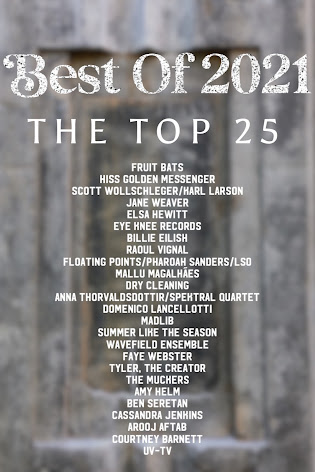
Best Of 2021: The Top 25


As wild a ride as 2020 was, at least it had some kind of trajectory. We were learning to live with a pandemic, taking action to put it in the rearview. We were rallying to the cause of dumping Trump. There were fears and challenges aplenty along the way, but also a narrative to which our storytelling genes could give shape. Then came 2021, with so many neck-snapping reversals for every step forward that any shape the story had would resemble that of the path of a worm chewing its way through wood. 

Fortunately, there was no shortage of new music, including dozens of albums that I leaned on like a crutch. I am filled gratitude once again for all the players, writers, singers, producers, labels, and other elements of this delicate ecosystem who were able to keep going. Still, I worry about some who seem to have dropped away, like Novelty Daughter, Natalie Prass, and Jane Church, and hope they are OK. And while I was glad to see some semblance of a return to concerts and touring, I only attended a handful of shows as I am as yet unable to project myself into an indoor space crowded with my fellow music lovers. It was a privilege to see the shows I attended, all of which were outdoors. 

It's hard to say how the lack of the additional dimension a live performance can provide to a piece of music is affecting my devotion to the artists I follow, but I can only work with what I have. I can be certain that my feelings for the 25 albums below - and the many others I will share in genre-specific lists - are as strong as any other year. I hope you find some measure of comfort, joy, inspiration, validation, energy, and all the things you look for in music in these miraculous releases. 

All of the albums below - except one - were written about in previous posts; click through to read my original review. Listen to selections from all of them in this playlist or below to get the flavor of each release as you explore. While my use of Spotify is certainly fraught with concern about how artists are paid, it has also connected me to music I might never have heard, which I have gone on to support in a myriad of ways. I urge you to do the same should you hear something you love. We need all hands on deck to keep the lifeblood of music flowing!

1. Fruit Bats - The Pet Parade

2. Hiss Golden Messenger - Quietly Blowing It Note: M.C. Taylor also gifted us with a most supremely chill holiday album in O Come All Ye Faithful, featuring gorgeous originals like Hung Fire and Grace alongside covers of everything from Joy To The World and Silent Night to Woody Guthrie's Hanukkah Dance and CCR's As Long As I Can See The Light. The deluxe edition came with a separate disc of dubbed out versions, also available here, that are absorbing, immersive, and some of my favorite music ever from Hiss.  

3. Scott Wollschleger & Karl Larson - Dark Days

4. Jane Weaver - Flock

5. Elsa Hewitt - Lupa

6. Eye Knee Records Note: This is not an album but a series of remarkable singles released by Holly Miranda, Amb. Parsley, and Chris Maxwell's new collective label. Ranging from sweetly hilarious to delicate and from devastating to inspiring, they made for an incredible playlist that became a crucial listen for me. I can't suggest more strongly that you get yourself to their Bandcamp site to buy all these songs and make your own playlist!

7. Billie Eilish - Happier Than Ever Note: Having signed on for a month of Disney+ to watch Get Back, I was thrilled to have the opportunity to watch Happier Than Ever: A Love Letter To Los Angeles, which featured stunning orchestral versions of every song from Eilish's sophomore album. Played by the Los Angeles Philharmonic under the engaged direction of Gustavo Dudamel and with string arrangements by David Campbell, the reworks were exquisitely sensitive to the songs and further convinced me of their elemental strength. I can only hope for an audio-only release of the concert!

8. Raoul Vignal - Years In Marble

9. Floating Points, Pharoah Sanders & The London Symphony Orchestra - Promises

10. Mallu Magalhães - Esperança

11. Dry Cleaning - New Long Leg

12. Spektral Quartet - Anna Thorvaldsdottir: Enigma

13. Domenico Lancellotti - Raio

14. Madlib - Sound Ancestors

15. Summer Like The Season - Hum


18. Tyler, The Creator - Call Me If You Get Lost

19. The Muckers - Endeavor

20. Amy Helm - What The Flood Leaves Behind

21. Ben Seretan - Cicada Waves

22. Cassandra Jenkins - An Overview On Phenomenal Nature

23. Arooj Aftab - Vulture Prince

24. Courtney Barnett - Things Take Time, Take Time My heart sank the first time I listened to this, her third album. Where was the low-slung bass of Bones Sloane and the locked-in drumming of Dave Mudie? Where was Dan Lunscombe to provide guitar and keyboard interplay? Why did she choose to work with Stella Mozgawa from the perpetually underwhelming Warpaint? Now, I knew some of those choices were due to the multiple lockdowns in Australia during the pandemic, but still, I was disappointed with what I was hearing. But two songs grabbed me initially and kept me coming back until the whole album just snapped into place. The first of these was Here's The Thing, the most vulnerable song she's ever recorded, filled with romantic yearning - a color that has been mostly absent from her wonderfully clever songwriting. The second was Turning Green, which has some creative drum machine deployment, meditative keyboards, and builds slowly to a terrific guitar solo, abstract and angular yet restrained. The lyrics reveal a sort-of love song ("You've been around the world/Lookin' for the perfect girl/Turns out she was just livin' down the street) that in its series of missed connections seems never far from current events. Take It Day By Day is the perfect prescription for these times, with a chorus that reminds us never to take the survival of others (or ourselves) in isolation for granted: "Tuesday night, I'm checking in/Just to see how you're going/Are you good? Are you eating?/I'll call you back next week." There's more variety here than on her last album and a bravery to the way she's just putting herself out there, with no attempt to conceal her fears or enervation in the face of all that's gone on these last two years. Also, the stripped back intimacy of the production foregrounds some of Barnett's most well-developed melodies and seems to welcome a personal connection to the record, making it feel like a dispatch from a friend. It's Barnett's best album since her debut. As the title instructs, give it the time it deserves and you just might feel the same.

25. UV-TV - Always Something

You may also enjoy:
Best Of 2020: The Top 25
Best Of 2019: The Top 25
Best Of 2018: The Top 25
Best Of 2017: The Top 25
Best Of 2016: The Top 20
Best Of 15: The Top 20
Best Of 14 (Part 1)
Best Of 14 (Part 2)
Best Of 2013
The Best Of 12: Part One
The Best Of 12: Part Two
The Best Of 11
Best Of Ten
A Blog Is Born: Best Of 2009