Monday, September 05, 2022

Record Roundup: Evocative Voices

The origins of all music lie in the body and the voice. Here are some remarkable recent releases that foreground the voice in various ways.

The Crossing - Born "So this is his mother. This small woman. The gray-eyed procreator." So begins Born, the arresting poem by Wislawa Szymborska that provides the text for the emotionally incisive piece (2017) by Michael Gilbertson that opens this album. Scored so it feels like the singers are feeling their way through the poem's universe and reacting in real time, it's a gorgeous tribute to the mother of conductor Donald Nally, whose sure hand guides the choir. Gilbertson's Returning (2021), which draws on Biblically-inspired text from Kai Hoffman-Krull, closes the collection in two parts of dynamic, searching music. In between those bookends is Edie Hill's Spectral Spirits (2019), 13 short movements meditating on extinct birds through the poetry of Holly J. Hughes and observations by Henry David Thoreau and other naturalists. Hill uses the words and occasional vocalise to create gently flowing phrases, interspersed with short solos announcing the naming of the lost animals. It's a gorgeous elegy and an original way to reflect on all the ways humankind has been unkind to the earth. Typically for an album by The Crossing, the recording and performances are impeccable. 

Carlos Simon - Requiem For The Enslaved If a piece of music can be seen as a container for emotion, then Simon's extraordinarily powerful Requiem is near to bursting. Such is the weight of what he's conveying - "marking eternal rest" for the American slaves sold off in 1838 to keep Georgetown University afloat - that it would seem an impossibility for any work of art to encompass it. But Simon is both brave and skilled enough that he pulls it off in a way that should silence any argument about slavery's central role in the American legacy. The idiom he creates, drawing on musical colors associated both with the European classical tradition and the diaspora, including spirituals, hip hop, New Orleans jazz, and others, would become a morass for almost any other composer, but Simon moves his brush around the palette with dazzling ease and great depth of feeling. 

While I hope this bold, at times shattering, work becomes a concert hall staple, it's going to be hard to match Simon's collaborators here, including rapper and spoken word artist Marco Pavé, who also wrote the text, trumpeter Jared "MK Zulu" Bailey, and Hub New Music, a quartet that sounds like an orchestra. Simon himself takes on the piano part, lending it the dynamic range and compelling flow of a great preacher, making it another voice in the piece. Another masterstroke is Simon's complete ownership of the 10-movement requiem structure, using the soul-nourishing force of ritual to his own ends. To be clear, however, while there is a healing force here, there is also deep sorrow and anger. Pavé's text ends with this blistering couplet: "Now when you read the word slave in your false history books...you will know the truth. The so-called masters unknowingly elevated the souls of their property while simultaneously building a tomb in hell for themselves." Amen. 

Kate Soper Feat. Sam Pluta - The Understanding Of All Things On this fantastic and fantastical collection, Soper shoulders her way into a small but elite group that includes Scott Johnson and Laurie Anderson. Using her voice to convey content that is both informational and musical, all with a wry wit that seems to say, "Can you believe I'm getting away with this?" she takes us on a thrill ride grounded in her piano and Pluta's electronics. At times her voice is a ghost in the machine, getting pulled like taffy or chopped into bits, while never losing sight of the thoughts she wishes to explore. Pulling texts as wide-ranging as Kafka, Parmenides, and W.B. Yeats, to explore the meaning of existence, this is like hippest philosophy class - or Ted Talk - ever, and one you can play over and over again. To be honest, however, I wasn't feeling it much on my first go round. But then I listened to Season Two of the Miller Theatre's Mission Commission podcast, on which Soper is a featured composer, and something clicked. Whatever journey you take to find this, get started now. You don't want to be late for class. 

Loadbang - Quiver This quartet puts baritone voice (Jeffrey Gavett) alongside trumpet (Andy Kozar),  trombone (William Lang), and bass clarinet (Carlos Cordeiro or Adrián Sandi) almost as if it were just another breath-powered instrument  - yet one that can outdo the others in flexibility and variety. As on their last album, which featured a string section, they unflappably take on whatever the pieces demand, whether it's the (mock?) solemnity of Gavett's own Quis Det Ut (2016), which takes inspiration from the renaissance, or the gasps and warbles of Heather Stebbins' fragmented title track (2014). Other pieces by Quinn Mason, Cordeiro, ZangYun WE, Kozar, and Chaya Czernowin, are more text-based, featuring poetry by Lydia Davis, William Blake, and others, in settings like you'e never heard before. Venture in and be as fearless in your listening as Loadbang was in the act of creation.

Ethan Woods - Burnout After 2019's Hyperion Drive, a sleek and sexy collaboration with Alice TM, Woods returns to similar realms as his earlier Mossing Around EP, applying his warm singing to  meandering melodies in chamber-folk arrangements of his most assured set of songs yet. Many of the lyrics address animals or are even from the point of view of the feathered and the furred, adding to the gently dissociative vibe that could be called psychedelic, but also reaches back to Lewis Carroll and Edward Lear. Woods' approach to song-craft is unique enough that it's easier to see it as a parallel path rather than tangential so when you get tired of our storyline, give a listen to his.

Moor Mother - Jazz Codes Though not obviously a concept album, there's a cinematic sweep to this latest from poet, professor, composer, and visual artist Camae Aweya that calls back to Barry Adamson's movie of the mind, Moss Side Story. While there is great musical variety here, with bright touches from Mary Lattimore's harp, Nicole Mitchell's flute, and other guests, the whole thing is slathered in a rhythmic juiciness, like a lost dream of the late, great Ras G. The vocal blend is top notch, with singers Orion Sun, Wolf Weston, Melanie Charles, and others lending their hearts and souls to the project alongside rappers including Yungmorpheus and Akai Solo. But dominion over all comes from Moor Mother herself: her composition, her intention, her spoken words, and even her sharp flow on Rap Jasm, the obvious single here. Her kaleidoscopic overview of the Black musical experience encompasses everyone from Woody Shaw to OutKast and Linton Kwesi Johnson. Her lyrics are impressionistic, revealing, and arising out of a depth of knowledge and feeling that power through any haziness due to their roots in the traditions of "great Black music, ancient to the future," as the Art Ensemble of Chicago put it. The song Evening gives us plenty of bread crumbs to follow, from "Free jazz lifestyle, yeah, I'm off the cuff," to "Spirits in the dark, let Nina sing, because it DON'T mean a thing/If it ain't got the blues." I mentioned a lot of names here, but the only one you should remember is Moor Mother's as she continues to astonish and become ever more crucial to the tenor of our times.

Lizzo - Special When her last album, Cuz I Love You, exploded in the sky over 2019, I worried about the influence success might have on her future work. But as she was just remaking pop, hip hop, and r&b in her own image, I was probably overthinking it. Either way, I'm overjoyed that her latest goes down so easy you might play it twice just to keep feeling so good. No song overstays its welcome and if Am I Ready causes a slight cringe with its Katy Perry-esque chorus, its still catchy as heck and goes by fast. Standouts are the pure disco of About Damn Time, the electro overshare of I Love You, Bitch, and the swinging folk-pop of If I Love You, but she plays to her strengths throughout for a fun, fizzy ride. And we all owe her thanks for the great opening lines of The Sign, an epitaph for a pandemic that is not quite over: "Hi, motherfucker, did you miss me?/I've been home since 2020/I've been twerkin' and making smoothies, it's called healing/And I feel better since you seen me last." So do I, now that I have Special in my life.

Billie Eilish - Guitar Songs While the death of the album has been an ongoing debate for a decade or more, it seems like singles are the things that can disappear more easily. So I'm pinning this here, like the beautiful butterfly it is. With Eilish in intimate, reflective mode, accompanied by her brother Finneas' delicate backing, these two songs show off her songwriting and singing in their purest form. The lyrics are deeply personal, with TV finding her alone on the couch after a breakup, asking "What's the point of anything?" and The 30th detailing the aftermath of a friend's terrifying car accident. But her sense of drama never leaves her and the way she finds comfort in a stadium audience near the end of TV, or the crescendo of The 30th ("You’re alive, you’re alive, you’re alive!"), are strokes of genius that nail the songs to your soul like the end of a Raymond Carver short story. Deceptively simple stuff and hopefully a signpost to her next album.

You may also enjoy: 
Record Roundup: Rooms Of Their Own
Record Roundup: Vox Humana

Sunday, August 14, 2022

Record Roundup: Envelope Pushers

Here are seven albums that work on many levels, each one of them seeking to take their chosen form - whether chamber music, folk rock, or electronic music - somewhere new. Their ultimate success, however, is the shifts they cause within me, either displaying future vistas or calling back to early memories I'd nearly forgotten. What will they do for you?

Ted Reichman - Dread Sea The tale Reichman tells in the liner notes and in a poem contained in the Tripticks cassette's j-card, of encountering a "heavily drugged juvenile sloth" attempting to swipe him with a "long, slow arc of its claw," has a certain lysergic flavor that matches these multi-layered audio collages perfectly. Assembled from electronically treated mbira and accordion combined with prepared piano, synth, and tape, the resulting tracks come to your ears fully formed, as if created from one instrument. Of course, there is no requirement to think about aggressive sloths (I prefer the cute ones I see on Instagram!) while you listen. The music will most likely transport you to realms related to your own experiences. Take the journey.

Greg Davis - New Primes As a recovering arithmophobe, reading that prime numbers form the basis of Davis's new album on Greyfade is enough for me to tune out to avoid past anxieties. But that stuff is all behind the scenes. You don't need to know that Davis is using "custom-written software to translate prime number sequences" into music, using only sine tones as his medium, to listen and respond to the sounds contained herein. And while all that sounds super-cerebral, there is definitely an emotional reaction to have to these throbs and drones as they rise and fall, thicken and attenuate. I can't help being taken into an alien space of almost pure loneliness, as if engaged in a space-walk between ships, hungry for the noise, clatter, and melodiousness of human existence. But I can just as equally let the hum of an air conditioner, laboriously beating back the heat, blend with Davis's music as I zone out to the play of leaves and sunlight just outside my window. My mind drifts, imagining the activities of tiny animals for whom a blade of grass might constitute their entire universe. Davis is surely on to something here, and you don't need to know any math for it to grab you.

Congregation Of Drones - Twenty Twenty That artists have their antennae up is well known, so the idea that violinist/composer Pauline Kim Harris and electronic musician Jesse Stiles came together to record the first two foreboding tracks here in February 2020, just days before COVID lockdown, makes perfect sense. After an interruption of some months, they reconvened virtually and continued the project. When complete, they named each track after a headline in the New York Times from the day it was recorded: Gesture Of Devotion, See What Happens, Experimental Treatment, and No Spinning. With that background, it is also no surprise that these richly evocative tracks could make for an excellent soundtrack for reflecting upon what we’ve all been through for last two - now almost three - years. 

But Twenty Twenty is so much more than a mirror to the past. This is stunning, nail-you-to-your-chair music, with Harris’ extraordinarily versatile sound-making abilities - from long, arcing lines to percussion, pizzicato, and beyond - fully matched and intertwined with Stiles’ starlit and multi-hued electronics. While some of it is spaced out and slow, it never lets up in intensity, occasionally exploding into segments that are near metallic. This landmark in electro-acoustic music is also available on vinyl, which should be a fantastic experience, although I do like losing myself in the full 71-minute sweep without having to change sides. I urge you to get to Twenty Twenty STAT, through whatever medium you prefer, and let it mold itself to your life.

Josh Modney - Near To Each I think I might have just found David Bowie's next band and it's a goddamned pity he's not around to take advantage. But knowing how Blackstar's collaboration with Danny McCaslin and Co. turned out, get your mind around Bowie working with Modney, a brilliant violinist here making his debut as a composer, Ingrid Laubrock, a saxophonist equally at home in jazz and new music, Cory Smythe, the genius pianist with the International Contemporary Ensemble, and Mariel Roberts, a fearless virtuoso cellist whose last album was a series of brutal improvisations. And they really play like a band, too, with Modney tailoring the compositions to each player's unique style and engaging in deep collaborations to arrive at the final product. 

The results are a series of gripping dynamic pieces of chamber music that incorporate drones, spiky duels between instruments, pounding ensemble work, and moments of crystalline beauty. Near To Each opens with a solo violin piece that casts back to Engage, Modney's triple-album from 2018, which included a series of improvised solos, but other than Tenor Solo for Laubrock, the rest is all about interaction, juxtaposition, and overlap. The pieces also take you through a series of emotional states, from angst to contemplation, and how you relate those to your own life will be very personal. A couple of my favorite passages in Whalefall and Crystallization I bring to life that sensation of lying back on grass on a hot summer's day, only to have the whine of a small airplane cross the sky - and your consciousness. It's a lonely, restless sound that brings the vastness of our planet into dramatic focus. 

Ballad contains yearning interplay, with Smythe's measured chords reminiscent of Messiaen's Quartet For The End Of Time, his custom software subtly enhancing the sound world. The last piece, Chorale, is a 23-minute tour-de-force and the track that put Bowie dreams in my head. Opening with Roberts' violent cello intertwining with Modney's squirrelly violin, the work gradually develops a narrative flow as searching piano from Smythe transitions it to a different mood. While Chorale doesn't echo anything specific from Bowie's world, it rhymes very nicely not only with Blackstar but the exploratory sides of Low and "Heroes" in the way it works with unexpected sounds and structures to create something as grabby as an avant garde pop song. I can imagine an adventurous listener and creator like Bowie being jazzed by this piece and the others, becoming eager to get involved. I know I am!

Steven Ricks - Assemblage Chamber Rather than questing into the future, Ricks bravely spelunks into the Baroque, pulling out modes and methods (and the occasional harpsichord, played by Jason Hardink) to inform his own bricolage approach. This gives the three acoustic pieces here a wonderful off-kilter feeling as past and present collide in lighthearted and inventive ways. The addition of guitar (Dan Lippell) and bass clarinet (Benjamin Fingland) creates ever more delightful anachronisms in Reconstructing The Lost Improvisations of Aldo Pilestri, while the title track eliminates instruments altogether, with Ricks cutting and pasting bits and pieces of the earlier works into a sound collage that both sums everything up and points in new directions. With great playing by members of Counter)Induction and the NOVA Chamber Music Players, among others, this is a satisfying feast of a collection suitable for gourmands of many genres.

Maya Bennardo - Four Strings Bennardo is one half of the redoubtable duo AndPlay, a core member of the Mivos Quartet, and has played on countless great records in recent years. Here, she finally steps out on her own and the results are captivating. Consisting of two long works for solo violin, Four Strings not only allows Bennardo to pursue her interests in stasis and simplicity, but premieres two important pieces by composers demanding wider attention. The first, Kristofer Svensson’s Duk med broderi och bordets kant, has a folk-like simplicity, with a repeating motif and overall warmth that will call you back home, wherever you're from. The title piece by Wandelweiser composer Eva-Maria Houben is a spacious meditation on individual tones and notes, like pick-up sticks where none of the sticks are touching. Bennardo's concentration and the care she gives every draw of the bow shine brightly here, making a nice contrast to Svensson's more gregarious work. Bennardo can do no wrong, apparently, and I will be glad to follow her to more fantastic music in the future. P.S. She and her AndPlay partner Hannah Levinson publish one of the best newsletters in the biz - in fact, it was they who led me to Twenty Twenty! Subscribe here.

Florist - Florist The permission granted by The Beatles on the so-called White Album to fill a double album with a wide variety of styles and approaches is often more of a curse than a blessing. See under: Sandinista by The Clash or that new goulash by Big Thief, which has some very good songs but makes you work to find them. Not so with Florist, sometimes the solo project of Emily Sprague, but presented here as a full band. Drawing together all of the threads cast out by a decade's worth of Florist releases, as well as those under Sprague's own name, Florist presents everything these musicians can do at the pinnacle of artistic success. From the gleaming chamber-folk perfection of a song like Red Bird No. 2 to the sketches like Duet For Guitar And Rain, the parts assemble into a whole that envelops and inspires. The use of field recordings or ambient sounds of nature only enhances that sense of environment, as if you've turned on one of those old lights with a paper cylinder that sends stars rotating around your room.

Like the sounds in the background, the lyrics are filled with references to nature, relating the night sky, fireflies, breezes, and so on, to various inner states. The results are pure poetry, as in these lines from Spring In Hours: "oh, the light inside you now oh, the wild inside you now/maybe there’s something that takes us beyond this/and flowers like spring in our arms." Among the shorter songs and fragments are several longer tracks that really show off the interplay between Sprague (vocals, guitars, synth), Jonnie Baker (guitars, synths, sampling, bowed guitars & bass, saxophone, vocals) Rick Spataro (bass, vocals, engineering, piano, synths), and Felix Walworth (percussion, vocals, synths, guitar), like 43, which extends into a jam reminiscent of Jonathan Wilson circa Gentle Spirit. And those player credits are a hint of what Florist means when they call themselves a "friendship project," also pointing out their gently radical reimagining of what a band can be when you break down silos between the individual roles in the group.

Whatever path Florist took, they arrived at a very special place and have given us a masterpiece of an album. I'm slightly despairing at the play counts on Spotify, which suggest people are picking and choosing between the songs.I strongly suggest that, if listening digitally, you entrust yourself to this whole album. I believe you'll find yourself richer for the experience.

You may also enjoy:
Record Roundup: Solos, Duos, Ensembles
Record Roundup: Rooms Of Their Own
Record Roundup: Novelty Is Not Enough
Best Of 2019: Electronic
Record Roundup: String Theories
Record Roundup: Avant Chamber And Orchestral
Best Of 2017: Rock, Folk, Etc. 


Saturday, July 30, 2022

Book Nook: Music Made Words

Books take longer to consume than records, so I find it hard to be as up to the moment with my reading as I am with my listening. But I'm always reading and most of that is (shocker) music books. Here are a few notable books on music from recent years.

Laurie Anderson’s Big Science by S. Alexander Reed (2021) It was over 40 years ago that I first became aware of Laurie Anderson, introduced by a double-page spread in Life Magazine’s The Year In Pictures. There she was, spiky-haired and playing a violin with a magnetic tape bow. Mike Tyson was a page or two over, shot from the back to emphasize his impossibly thick neck. But it was Anderson who intrigued me, having already developed an interest in avant garde music. Oddly enough, however, when people around me were going nuts over her 1982 debut album, Big Science, it kept me at arms length. Maybe the possibilities the photo had set whirling in my mind were too different from what I was hearing to be reconciled. I kept up with her over the years, though, intrigued by her collaboration with William S. Burroughs and later charmed by her relationship with Lou Reed. But it wasn’t until Landfall, her 2017 album with the Kronos Quartet, that I truly fell in love with one of her pieces.

Big Science still loomed, however, so when Reed’s book showed up, I welcomed the opportunity to take a deeper dive into its background and creation. This handsome little book is the 15th in Oxford’s Keynotes series, and only the second to take on a work of the second half of the 20th century, following John T. Lysaker’s 2018 book on Brian Eno’s Ambient 1: Music For Airports. It’s also the third book for Reed, following Assimilate: A Critical History of Industrial Music and an entry in the 33 1/3 series on They Might Be Giants. And while Reed, a professor at Ithaca College, occasionally writes like the academic he is, the book is mostly a fizzy read, with his excitement about following Anderson’s trail of creativity coming through loud and clear. He also doesn’t shy away from musicological dissection when it seems useful, but always provides a way in for the uninitiated, using musical examples that almost everyone will know.

I was especially taken with his brilliance in setting up a structure that takes into account the album’s creation in the past and how it exists now. I’ll let him explain: 
“Foremost, I'm interested in the circa 1980 creation of these songs: "now" in the sense of chronos, or historical sequence. How did their concept, text, and music develop, and in dialogue with what real-world artifacts and events?…Second, I also describe what it's like to inhabit a private listening encounter, marking time not by dates and eras but from second to second: "now" in the sense of kairos, or experiential action. Third, I ask without nostalgia how Big Science resonates now in the twenty-first century, acknowledging in the book’s final chapter what some have heard as an eerie prescience in the record.” (Reed, Page 3)
This is a paradigmatic way to approach a work of the past and will be a great guide next time I revisit a classic album.

As for this classic album, Reed’s three-dimensional excavation and explication of the musical and conceptual components of every song, made the end result - when it works - even more impressive. There are still a couple of duff tracks - Sweaters, for one - that no amount of advocacy will rescue, but I find myself more immersed when listening to the songs I do like. Reed also gives Anderson her due as an extraordinarily brave, intelligent, and original artist in three mind-expanding chapters on her relationships with the musical context of the time (“New Music Versus New Wave”), sexuality and gender, and politics. People often bemoan the lack of liner notes in the streaming era. Reed’s book makes up for that lack - and then some - for an album that is a nearly bottomless well of fascination.

Ted Gioia - Music: A Subversive History (2019) Near the end of this enthralling, game-changing book, Gioia notes:

"...every major music genre today echoes, at least in part, some of the imperatives of prehistoric song. The rock star evokes the scapegoat from ancient rituals of symbolic violence. The country artist re-creates the pastoral strains of the herders, who relied on music to soothe domesticated animals, and celebrates the stable life of home and hearth. The hip-hopper returns to the monophonic chant that served to unite the first human communities, the oldest 'hoods of them all. The pop star draws an audience with erotic stylings and dance moves that remind us of the fertility rituals that gave birth to the love song." (Gioia, Page 450)

If any of that sounds farfetched to you, you desperately need to read this book. If it sounds like something you almost take for granted but don't understand why, you also need to read this book. Each one of those examples is based on broad research, and spectacularly synthesized into a text that informs you even as it excites you. Gioia goes DEEP, looking beyond and away from musicology to explore the transformative power of song, from the use of chants to scare away alpha predators from prey so human's could feed themselves to the ongoing threats to those in power from the artists engaged in a long line of "permanent revolution," such as Pussy Riot, those punk rock thorns in Putin's side. 

A key point he makes over and over again is that musical innovation almost always comes from where you least expect it - the oppressed, the poor, the marginalized - a trope that goes back to the earliest civilizations. Perhaps even more importantly, he notes that when rulers make claims about musical innovations they brought about, we need to "study these powerful figures in musical history, not for what they did, but for what they hid." That last quote come Gioia's Epilogue: This Is Not A Manifesto, 40 statements about music and its role in life and society. He describes them as precepts that forced him to "alter his beliefs" as he was researching and writing. Reading Music not only altered some of my beliefs but helped me to reposition my relationship to music, narrowing down for me what is of core importance in the music I love, and for that I am immensely grateful to Gioia. 

Alan Niester - Beyond The Printed Page: The Life And Times Of A Big Time Rock Critic (2014) The title for this often hilarious book is slightly misleading. While the first 50 pages or so detail, in his wry and witty style, his upbringing and the winding path he took to becoming a music journalist, the next 250 comprise reprints of concert reviews from Niester's time as a critic at the Toronto Globe And Mail. Not that there's anything wrong with that - and the reviews have more personality than most memoirs - but I wouldn't have minded a bit more "life" along with the "times," especially since he's got killer anecdotes, like the time he rode a bicycle from Niagara Falls, Ontario to downtown Buffalo for a concert, or playing in a garage band with future Bowie/Iggy axe-man Stacey Heydon, or nearly starting a race riot with a very drunk Lester Bangs. Lord knows what tales are still in the vault! 

The live reviews, however, constitute a fascinating, and often very funny, chronicle of the state of rock and pop from the Ramones in 1978 ("an explosion of torn jeans, aging black leather, and cultivated acne") to Jeff Mangum in 2011 ("intense but casual"). In between you get upstarts struggling to establish themselves, like U2 in 1980 ("one of the most vital and interesting new bands I've seen in the past few years"), to hall-of-famers struggling to live up to their past, like Carole King in 2005 ("She has developed a noticeable Rod Stewart rasp, most evident in the high notes and higher volumes"). Every review is a breeze to read and never less than interesting, and a few are all-time classics, such as Niester's snarky but evenhanded response to the Jonas Brothers in 2009, which he structures like a report card, grading them lowest on their lyrics: 

"English - D. Sadly, the boys' lyrics are cliché-ridden and banal, and filled with grammatical mistakes. For example, in the song World War III, they insisted they didn't want to fight "wit chyou" (sic). In Poison Ivy (not the Coasters' classic) they claimed that "Everybody needs some Poison Ivy." This is clearly wrong." (Niester, Page 299)

I look forward to having Niester's book on hand when needing to refer to a real-time reaction to a legendary band, say when writing an anniversary review. I will make sure to correct any typos, which are rife in the book, when quoting him, however. In the end, while his true love is prog-rock (he finally convinced me to listen to Wishbone Ash - the guitars are indeed great), he brings a broad knowledge and love of the music to everything he reviews, providing a fine example for critics everywhere and a fun read for everyone else.

Paul McCartney - The Lyrics: 1956 to Present (Edited with an Introduction by Paul Muldoon) (2021) This is a sly book in so many ways. From the start, Sir Paul admits he will never write a memoir but he’s happy to go song by song and talk about the process and context behind them and let something of himself take shape in your mind. Then there’s the fact that the first thing 90 percent of people will think when hearing his name is an endless spool of melody, then his fantastically versatile voice (at least in its prime), then his remarkable skill as a multi-instrumentalist. Lyrics could be dead last, although he has certainly crafted some gems, whether Blackbird, Dear Friend, Eleanor Rigby, For No One, or She’s Leaving Home, which are marvels of compressed emotion and/or narrative.

You’ll note that my little list of songs is alphabetical, which hints at my only real frustration with the book. Rather than progress through his songwriting chronologically, which would allow you to see his skills develop, from the “pronoun songs” of the early Beatles to the more allusive and surrealist stuff that came later, we are led alphabetically. Ordering them this way could also be his bid to reduce the distance between his achievement as a Beatle and his solo years, to which I say: Nice try. Moreover, putting things chronologically would also allow him to build on stories, such as the "Nerk Twins" Paris trip of 1961, or The Beatles in India, rather than just have them crop up here and there as fits the song under discussion. I suspect it's all in the game of one of the world's most famous people holding on to a shred of his privacy. 

That's not so say that The Lyrics isn't a revealing book. It's satisfying to read that even he his baffled by The Beatles' shocking trajectory, as when he says when talking about Eleanor Rigby: “To this very day, it still is a complete mystery to me that it happened at all...All these small coincidences had to happen to make The Beatles happen, and it does feel like some kind of magic. It’s one of the wonderful lessons about saying yes when life presents these opportunities to you. You never know where they could lead.” In the entry for Carry That Weight, he describes the business meetings as The Beatles headed to dissolution as "soul-destroying" - and you feel his pain at friendships and collaborations being ripped apart. He also goes deeper on his complicated relationship with that most complex of characters, John Lennon.

Naturally, there are plenty of instructive tidbits about his approach to songwriting, as when he remarks about Come And Get It, which he wrote for Badfinger: “But I was trying to write a hit, so I didn’t want anything too complicated.” He is also not shy about his bossy side, describing how he told the band not to change a thing from his demo (which he recorded in 15 minutes) rather than trying to "interpret" his song. Bossy, but 100 percent right as proven by the song's chart success.

He also drills down a little on his attraction to the ordinary, which stems from the working class roots he continues to stay in touch with, even with his fabulous wealth. In the section on Café On The Left Bank, he notes: 

"I'm actually quite a fan of 'ordinary'. I hope in many ways it defines me, and so also many of the songs I've written. Don't get me wrong; I like extraordinary people and things, but if people can be great and ordinary at the same time, that to me is kind of special. So my Liverpool family - my parents, all the aunties and uncles - they were great and ordinary, and I think the fact that this combination can be easily dismissed makes it even more special. So many people would dismiss my Liverpool family, but they're actually a lot smarter than the likes of Maggie Thatcher, say. Their attitude to life was not as uptight as many people I've encountered since. They were always up for a song around the pub piano, for example. So you can choose to be highly sophisticated but very uptight, or you can be not so sophisticated but at peace with yourself. I try and be a bit of a mixture, and I draw very strongly on that ordinariness."

One thing that is decidedly not ordinary is the physical heft and beauty of The Lyrics, which comes as two splendidly illustrated volumes in a handsome green slipcase. The photographs, may of them unfamiliar to me, are only surpassed by the artifacts, whether handwritten lyrics or drawings (many of which are quite good - another talent!), which make the books a joy just to flip through. Speaking of heft, the 858-page book only contains lyrics for 156 songs out of the 500 or so Sir Paul has written or co-written. Not only does that give you an idea of how much additional material is contained within, it also lets you know that songs were selected based on what McCartney wanted to get across. So Why Don't We Do It In The Road is here, giving him an opportunity to talk about the primal urge to procreate, while a late-career near masterpiece like Riding To Vanity Fair is left out - perhaps its still too soon to talk about what led to that dark-hued number. 

But as Paul himself says when talking about the line "Spending someone's hard-earned pay" in Two Of Us: "I don't know where that came from or what it means. I don't necessarily want meaning. I don't root for meaning all the time. Sometimes it just feels right." And this book, on the whole, feels very right. Make room on your groaning shelf of Beatles books for one more!

You may also enjoy:
Getting Back To Let It Be
Not The Price But The Cost
The Book Of Fab
The Beatles Thing
Overdosed On Pleasure: The Book Of Nilsson

Sunday, July 03, 2022

The Best Of 2022 (So Far)


While the news keeps finding new ways to be terrible, music keeps finding new ways of bringing joy,  inspiration, energy, calm, and even a satisfying dose of mirrored despair, to our lives. Here are 25 of the best ways its done that in 2022. Much gratitude to all the artists pushing through and delivering these remarkable albums to my ears!

As usual, anything that's been reviewed previously is linked to those earlier words. You can listen to selections from most of these albums in this playlist or below. Otherwise, find them on Bandcamp - and consider paying for the privilege of listening.

1. Angel Olsen - Big Time This magnificent album is a dream come true for me. Pairing Olsen's glorious voice and incisive, informed songwriting with the genius production of Jonathan Wilson is an idea so delicious that I never even thought to hope for it. They both outdo themselves, too. Olsen cuts to the bone over and over again as she processes the recent grief of losing both her parents, the painful process of becoming ever more herself, and the overwhelming joy of finding true love. When she sings "Never thought the day would come/When I would find someone/To love me only," it's impossible not to believe her and root for her new relationship with Beau Thibodeaux, who also co-wrote the soaring title track. Wilson, who plays drums on every song, marshals some of the same deep knowledge of Americana he displayed on his last album, Dixie Blur, even lending a "countrypolitan" grandeur to some tracks, like This Is How It Works with its weeping pedal steel. But Olson and Wilson are not tied to any particular genre, giving each song just what it needs. When they bring on Drew Erickson and Dan Higgins, for string and horn arrangements respectively, the widescreen approach is reminiscent of All Mirrors, Olsens's 2019 epic. There's no better example of this than the stunning Go Home, which starts out dead simple, just two chords from Erickson's piano and Emily Elhaj's bass, and Wilson's ticking percussion. Olsen first enters quietly: "The world is changing/You can't reverse it," but soon pushes her voice into the stratosphere: "I wanna GO HOME/Go back to SMALL THINGS" and the music gathers itself to catch up, with sweeping strings, stentorian horns, and Wilson's fuzz guitar bringing the hammer down. When the song returns to earth and Olsen sings, almost to herself, "Forget the old dream/I got a new thing," all you can do is agree. It's a wonderful thing, too.


5. Hollie Cook - Happy Hour When someone's mission statement is pure delight, each new album becomes more and more like a high-wire act: how can she keep it up? Which makes Cook's big, bold fourth album even more thrilling. While still sticking to her patented blend of lovers rock and sunshine pop, she does expand that fabulous formula a little. Whether it's the strings on Gold Girl, which should be the next James Bond theme, the guest spot on Kush Kween from Jah9, whose florid style shows off Cook's clean soprano perfectly, the hints of dancehall on Love Is A Losing Game, or the 90s dance rhythms of Move My Way, she pushes the envelope with aplomb. My favorite characters on the recent Pistol miniseries were Paul Cook's parents, who were loving and warmly supportive of their son's musical ambitions. With them as her grandparents, Cook's bounteously beauteous spirit must run deep in her blood. Get a transfusion here.


10. Jascha Narveson - Flash Crash + Remixes According to his notes, Narveson "...crafted Flash Crash especially for internationally acclaimed cellist Ashley Bathgate out of raw stock market data culled from high-frequency trading bots" - a sentence that tickles my mind the same way the music here excites my ears. The main piece finds Bathgate carving a gorgeous line through Narveson's electronics, like an expert skier cutting through the trees. It's a rich, deeply involving piece on its own, then all hell breaks loose - in the best way - when Narveson's collaborators get their hooks into things. And the word "hooks" is especially appropriate for Lorna Dune's remix, which finds catchy bits in the original and bolts them to a four-on-the-floor beat, cooking up a killer groove. It's the perfect follow up to Matthew D. Gantt's take, which adds percussion and clarinet samples to create a type of artificial chamber music. Lainie Fefferman manipulates the sound of the cello to create a character study she calls Repairbot Q Sent To Engine Room 3, Working Through The Loneliness, which is as good a description as any for the fun and feeling to be found throughout the album. Angelica Negron sends Bathgate deeper into space, with pulsing beats moving through like debris from a dead satellite. Then Vadislav Delay - a "Finnish electronic music legend," apparently - drops the hammer with serrated power chords and breaking glass, treating Narvson's original like a trash compactor treats a robot. What a way to go! 

11. Horsegirl - Versions Of Modern Performance Smashing debut from a Chicago-based trio (Penelope Lowenstein (guitar, vocals), Nora Cheng (guitar, vocals), and Gigi Reece (drums)) who know exactly what they want from their sound. Picking up on 90's alt, 80's indie, 70's post-punk, and even a touch of 60's psych as they blast through their songs, their division of labor finds guitars acting as basses and (maybe) basses acting as guitars. Occasionally, they pause for an artfully fractured instrumental but with Reece pummeling away in the engine room, it's a very unified sound. Veteran producer John Agnello may have helped give the guitars a burnished quality that comforts even as it energizes. Deadpan but melodic vocals complete the picture to deliver lyrics that are allusive, elusive, and often mantric, like the repetition of "How does it breathe?" from Beautiful Song. Pleased to meet them and I think you will be, too.

12. Sarah Plum - Personal Noise In 2015, I worried that I would have trouble keeping up with Plum’s boundless curiosity and tireless efforts to expand the violin repertoire. Then I had to wait seven years for her next album, although she has been busy as a performer, teacher, and commissioner of new works. Thankfully, this colorful, varied, and passionate album was worth the wait. It kicks off with Eric Moe’s Obey Your Thirst (2014), which opens with a synthetic exhalation as if to say, “Now, where was I?” before launching in to a spiky dialog between Plum’s strings and his electronics. It’s a rhythmic piece, with digital percussion that seems to be driving the violin at a breathless pace. Eric Lyon’s Personal Noise With Accelerants (2015) follows, continuing the jagged rhythmic feel and high tempo. It’s fully acoustic, but features a structure determined by white noise. Kyong Mee Choi’s Flowering Dandelion (2020) slows things down a bit, filling the space with starlit electronics that occasionally remind me of the transporter on Star Trek. Sarahal (2013) by Mari Kimura adds Yvonne Lam on second violin and interactivity to the electronics for a flight into even deeper space. Several of these pieces were written for Plum and are featured here in their world-premiere recordings, including After Time: A Resolution (2013) by Jeff Harriott and Il Prete Rosso (2014) by Charles Nicholls. Both works also feature interactivity and a bit of randomness but feel fully realized in these performances even as they search for resolution. Mari Takano’s Full Moon (2008) literally ends the album with a bang, or at least several explosions of pounding sound. Plum sails through it all flawlessly, once again proving that close collaboration with composers and deep engagement with the work is a recipe for artistic success.


14. String Orchestra Of Brooklyn - Enfolding String orchestras of America! Those intrepid folks at the String Orchestra Of Brooklyn have given you your season-opening program right here! You don't even need to add the Barshai Shostakovich arrangement, which I'm sure you've played hundreds of times - and I love Shostakovich! First you get Scott Wollschleger's Outside Only Sound, specifically commissioned by the orchestra to be ready to play with minimal rehearsal and to work well outdoors. With each player operating semi-independently and added spice from percussion instruments, this live recording from Fort Greene Park works a treat, with "outside" noises - laughter, chatter, sirens - integrating but not interfering with the skirling storm of sound. There's no reason why it can't be played in the concert hall, however, so don't try to worm out of it that way. Then you get Anne Leilehua Lanzilotti’s expansive With Eyes The Color Of Time, which was a finalist for the 2022 Pulitzer Prize in Composition. Based on pieces in The Contemporary Museum in her native Honolulu, there is a strong narrative thrust to the eight parts. Starting with the long, exhaling lines of The Bronze Doors and taking you through the dense scrapes and scratches of Les Sortilèges and on to the warm resolution of Enfolding, it adds up to a very satisfying whole. With both pieces coming in at a little under an hour, this program will leave you enough time for cocktails with your subscribers, who will throw money at you for the next season. Just don't try to claim bragging rights for the world-premiere recordings - the String Orchestra Of Brooklyn already beat you to it on this excellent album.

15. Tomberlin - I Don't Know Who Needs To Hear This... Who knew sonic adventure could be so quiet? In the four years since her debut, At Weddings, Sarah Beth Tomberlin has maintained utter control over the dynamics of her songs, but manages to fill them with exquisite details that deepen the experience. A perfect example is Tap, with its ticking percussion (Kenny Wollesen, from Sylvie Courvoisier's trio), plucked cello (the great Gyða Valtýsdóttir), and gentle woodwinds (Stuart Bogie and Doug Wieselman), all combining into a little miracle of a musical engine. Tomberlin coproduced the album with Philip Weinrobe so I don't mention all those notable musicians to remove any agency from her achievement here, but rather to add to it. The strength of her songwriting is what attracts players like that and the strength of her vision is what has them combining to make such specific sounds. Her voice is even more wondrously light and supple than in the past, delivering the deeply felt poetry of her lyrics with a gossamer ease. The words will repay your attention, too. This line, also from Tap, is one of my favorites: "Do you think about the trees in the breeze/How they swing and scream and talk and breathe/I wish I was so tall and green/ Swing my branches only sing for me." Thank goodness Tomberlin sings for us, too.


17. Soccer Mommy - Sometimes, Forever Sophie Allison, who records as Soccer Mommy, pushed the sound and passion of her indie rock into new places on her last album, 2020's richly dynamic Color Theory. Rather than repeat herself on this, her third official album, she made the genius decision to work with Daniel Lopatin, who records electronic music as Oneohtrix Point Never and also made the brilliant soundtrack for Uncut Gems. This doesn’t mean Allison has made an electronic album, however, although there are more synthetic textures woven in than in the past. Rather, the collaboration has created a sleek and powerful album, gleaming with sonic jewel tones, where every sound seems placed deliberately in the mix. "...I want perfection/Tight like a diamond," she sings in Unholy Affliction, putting her cards on the table. Yet even if nothing here is casual, there's still plenty of heat generated by Allison and her band mates, especially drummer Rollum Haas, who pushes and pulls the rhythm in original ways. The key track for me is Darkness Forever, which has some of the hypnotic wash of I Want You (She's So Heavy) from Abbey Road but addresses the seduction of suicide as a relief from the pain of mental illness rather than the search for an elusive lover. Images of fire and water throughout the album lend elemental strength to the struggle within, but the ultimate triumph - ambiguous as it is - is the transformation of all this hurt into art. As long as she can keep doing that, she'll keep the devil on his leash - and keep us listening, raptly.

18. Revelators Sound System - Revelators There was a taste of this new project from Hiss Golden Messenger’s M.C. Taylor on last year’s The Sounding Joy, a selection of dub versions from his anti-holiday-album holiday album. O Come All Ye Faithful. That collaboration with Spacebomb magus Cameron Ralston slowed and stretched the songs, creating a warm bath of healing music that doubled down on the premise of the album itself. Rather than building on previous recordings, however, the four long tracks here make their own way, meandering in a most wonderful way through the minds of musicians who have absorbed the atmospheric majesty of Lee “Scratch” Perry and Miles Davis. But everything here is infused with the distinctive tang of Richmond, VA and Asheville, NC, adding a wonderful dimension to both the Hiss and Spacebomb projects, and creating a place of comfort where ever you happen to be.

19. Wilco - Cruel Country I'm not sure Jeff Tweedy has thrown down a songwriting masterclass like this since Sukirae in 2014. Across the 21 songs here he finds words and melodies that make classic themes seem new. The album is filled with gentle acoustic sounds and some songs have a strong country music inflections, the title is a clever feint incorporating the band's insider/outsider relationship with America and American music. "I love my country," Tweedy sings in the title track, as the band plays jauntily, "Stupid and cruel." While Tweedy wrote the songs, the arrangements were ginned up live in the studio, with all players contributing in a way that hasn't happened since The Whole Love in 2011. So, while there's lots of breezy strumming, and even pedal steel, the old adventurousness is still there in subtler form, as in the psychedelic shimmer of Bird Without A Tail/Base Of My Skull or the slightly dissonant French horn in Darkness Is Cheap. Lyrically, the songs mostly address either national politics or personal politics, which can each serve as metaphors for the other. But there are also a number of literally cosmic moments, such as The Universe and Many Worlds, which center the album in bigger themes. The song I keep going back to, however, is Falling Apart (Right Now), which might just be the best song Buck Owens or Roger Miller never wrote. Witty and perfectly constructed, it features stellar playing that would rival any Nashville session band. On their 12th album, Wilco has offered up quite a feast and even if Tweedy is preaching to the choir on songs like Hints, with its refrain of "There is no middle when the other side/Would rather kill than compromise," I'm happy to sing along.


23. Bakudi Scream - Final Skin Albums like Barry Adamson's Moss Side Story pioneered the soundtrack in search of a movie. Now, Rohan Chander, under his new Bakudi Scream alias, has given us a soundtrack in search of a video game, not unlike what Phong Tran gave us on The Computer Room. The first hint of what was to come on this startling, immersive, and, heartfelt new collection came at the height of lockdown, when pianist Vicky Chow premiered The Tragedy of Hikikomori Loveless on one of many spirit-rescuing online marathons from Bang On A Can. The video confused and delighted viewers as Chow triggered synthetic sounds from a MIDI-enhanced piano and voices popped in and out of the mix. Unsurprisingly for a COVID-era piece, a central theme here is loneliness, building on documentary Chander watched about hikikomori, a form of extreme withdrawal which has young Japanese people living reclusively with their parents, unable work, attend school or participate in society in any meaningful way. Just as the bad guys get all the best lines in movies, a villainous character called Somnus has some of the richest music in a three-part piece that's the heart of the album. Part 1, Nightmusic, sparkles and shimmers seductively, sucking you in to a reverie only to boot you out of the game with the sampled voice of a blues singer saying: "What I wanna know, is why don't you love me like you used to do?" It's just one of many moments where Chander stuns you with his deep humanity, putting real flesh and bone under this final skin. 


You may also enjoy:

Saturday, June 18, 2022

Record Roundup: 22 For 22 (Part Two)

As promised, here's Part Two of this little series, now focusing mostly on what I call "Rock, Folk, Etc." - but kicking off with an excellent new Latin release.

JAZZ, LATIN, AND GLOBAL

Jimmy Delgado - A Mis Mentores...To My Mentors Delgado is master percussionist who's recorded with everyone from Ray Barreto, Willie Colon, and Eddie Palmieri to Celia Cruz and the Fania All-Stars. He also toured behind Harry Belafonte for years. While I have definitely heard some of those records, his was not a name with which I was familiar - nor did I know he was my upper Manhattan neighbor - until I listened to a terrific interview with him on the Inwood Art Works podcast. He talked about his glittering past but also mentioned his latest album, which pays tribute to those earlier masters of "hard salsa" in fine style. Beautifully recorded and featuring expert playing (especially the trumpets of Nelson Gazu Jaime, Dennis Hernandez, and Chris Sanchez) along side Delgado's blazing timbales, conga, and bongos, A Mis Mentores shows how vital this music still is. Delgado's fantastic debut solo album from 2002, Salsa Con Dulzura, has also been reissued digitally and should not be missed.

ROCK, FOLK, ETC.

Wet Leg - Wet Leg A great melody can be like a river, pulling you along with undeniable strength. Even better is when it sounds like the singer is in the same thrall, holding on for dear life as they wend their way through the song. That was the first thing that caught my ear when Wet Leg began releasing their bright and buzzy singles last year, starting with Chaise Longue. Then the musical surrounds came into focus, filled with chiming guitars, bright keyboards, melodic bass, tight drumming, and the occasional hint of sheer abandon. But the deal was sealed when the lyrics hit me like a lobster to the face. Is there a better put down than Wet Dream's "What makes you think you're good enough to think about me when you're touching yourself...?" Except for the come-on line attributed to the same feckless man: "You said, "Baby, do you want to come home with me? I got Buffalo '66 on DVD"." And there are many such delightful examples, pricking any distended male egos within hearing distance. Bandleaders Rhian Teasdale and Hester Chambers give everything the ring of truth, drawing on their unfortunate relationship experiences in ways to which anyone can relate. After each single, I would say to myself, "How long can they keep this up??" Well, as this smashing debut proves, there may be no limit to their effervescent brilliance.

Laney Jones - Stories Up High Somehow I missed the moment when Jones was given “next big thing” status, which may be what led to a six-year gap in albums while she made her way through TV and movie sync deals. So I had probably heard her voice in a commercial or film along the way, although I don’t recall it. But this album seems remarkably untroubled by a need to be successful, coming rather from a place of deep interiority and a personal expression. That’s not to say it’s solipsistic; rather it’s inviting and easy to lose yourself in her songs. Even when they have familiar themes (I Can’t Stop The Rain, for one), there is a sense of artistic discovery that is hard not to get excited about. Working with producer Andrija Tokic and sympathetic musicians, Jones seems to give each song the surroundings it needs, mostly guitars, organ, and a rhythm section that lays back in the groove. Sometimes the music is delicate, and sometimes dynamic, even dropping a little 90s loud-quiet-loud on Remember, which also works as an epic soul ballad. But everything is wisely focused on Jones' remarkable voice, which wraps itself around your heart and then ever so gently slips a knife between your ribs. Hurts so good!

Father John Misty - Chloe And The Next 20th Century I am well aware that there are those who hate on FJM's music as much as I love it. So I can't help thinking that the opening track, a nodding and winking cabaret tune, complete with muted trumpet and a herky-jerk rhythm is more catnip for them than for us. How ya hate me now? he seems to be saying. It could just be I don't like that song very much, clever lyrics aside, even though I'm a huge Weill/Brecht fan. As a distancing device, setting up an album about a range of characters, it's a bit too obvious. But all is IMMEDIATELY forgiven with Goodnight Mr. Blue, a gorgeous, time-suspending ballad in the Nilssonian mode and an elegy for a dead cat that represents "the only thing left of me and you." Jonathan Wilson's warm production, aided by Drew Erickson's lush string arrangement, shines here, making for an instant classic. That song sets a high bar, which the album meets more than once, especially on the epic sweep of corporate satire Q4 and the Braziliana of Olvidado (Otro Momento), which finds Erickson in full Claus Ogerman mode. The lyrics are uncharacteristically spare, perfect for a song about a language barrier: "All I want to say is words have failed me many times before/But never so completely as with you." If FJM wants to make an all-bossa nova album next, I would not complain! Funny Girl is also excellent - and hilarious - as the protagonist wanders a hall of mirrors, haunted by pizzicato strings and old TV music, and the swagger of Only A Fool could make Bob Dylan jealous. A couple of songs seem to recede pleasantly, but the finale, The Next 20th Century, is grand indeed, a brooding and tense traverse through the mind of Misty. When it erupts in a guitar freak out (likely Wilson), it seems to release millennia of tension. Breathe out, breathe in, start again. It's all we really know how to do.

Charlotte Adigery & Bolis Pupul - Topical Dancer I wrestled with where to include this album, which has elements of electronic pop, dance music, and art rock. Finally, it fused with some loose synapses that connected it to the Ze Records sound, which fused uptown dance floors with downtown punk clubs in a way that briefly felt like the next big thing. This Belgian duo wrap their polemical statements ("Do you carry the burden of this privilege?/Do you see this guilt as leverage?") in colorful grooves constructed from blooping synths, burbling bass, digital drums, and the occasional sharp guitar. In the ironically titled in Ceci n'est pas un Cliché, Adigery speak-sings "I bet this song sounds familiar" like a lighter Grace Jones, and I'm thinking, sure, but only in the most original way. And if you think they take themselves too seriously, check out Haha, which uses sampled laughter in a way unheard since Scott Johnson's Involuntary Songs - and it's impossible not to chuckle along with it.

Katie Dey - Forever Music Like Billie Eilish, Dey prizes the illusion of intimacy, processing her vocals into a near-AMSR texture that comes across like a voice note. Listen in your earbuds and you may just think she's speaking to you alone. The musical backings are spare, digital, and tuneful without ever going totally pop and the lyrics are baked down and telegraphic, describing painful life moments with sensory details and bursts of insight. Real Love, for example, describes a home life of "constant violence/smells of alcohol and cigarettes/when you got home," leading to worries of "what of you lives within me." She's not sure, but knows she wants "love that hurts my skin" and "rots through my limbs." As a confessional songwriter for the social media age, Dey has honed her craft to a fine point on this, her fifth album. I came across her in a tweet about how this was the worst music ever - which I suspect has more to do with prejudice against her trans identity rather than what this actually sounds like. I hope she finds not only "real love" but a bigger audience - don't be surprised if you see her opening for Eilish in a stadium somewhere.

Dexy - Sleeping Through Summer For someone who claims to be sleeping too much, Dexy sure knows how to channel some explosive energy, starting off the album with the righteous blast of I Don't Think I Turned Out Right. With loud guitars, barroom piano, and an ass-kicking rhythm section, it practically dares you to sit still. And the album doesn't let up for the first three songs, before A Shrug To The Floor proves his way with a ballad, giving it the sweep of a glam epic. Even with two more ballads at the end, Sleeping Through Summer serves as the perfect rock and roll wake up call for any doldrums in which you might find yourself.

The Smile - A Light For Attracting Attention Is there a rueful tone to that title, considering how easy it is for Thom Yorke and Jonny Greenwood - the ostensible leaders of Radiohead - to attract attention? That aligns with the anonymous name of the group, which also includes Brit-jazz drummer Tom Skinner. Radiohead producer Nigel Godrich is at the controls, probably doing more than producing. But what if you didn’t know who was involved and were unfamiliar with their main band? Would this hold your attention? First up is Yorke’s voice, which I’ve heard some complain about. I think he sings better than ever here, often using the minimum of power to emit angelic tones from ghostly to soul-piercing. He’s also rediscovered his snarl, which is energizing. If you think you don’t like it, try it, and if you still don’t like it, no disrespect. Then you’ve got Greenwood, as inventive a guitarist as we’ve got, smoothly transitioning from densely picked patterns to dirty chords and equally versatile on acoustic guitar. If you’re bummed he hasn’t played guitar much on recent Radiohead albums, get here quick. The short, sharp blast of You’ll Never Work In Television Again may just take your head off.

Then there is Skinner, just an astonishing drummer with the dazzling technique of Tony Allen (Fela’s drummer) and the left field inventiveness of Can’s Jaki Liebezeit. On songs like The Opposite or A Hairdryer, Skinner is so good that you even wonder if Radiohead drummer Phil Selway is a little jealous - or worried. Greenwood also flexes his compositional and arranging muscles to wonderful affect, adding dark, velvety strings and dimensional horns to several songs. Melodic intrigue abounds and the lyrics find Yorke at his most stripped down, even telegraphic at times. If you’re a Radiohead fan, I know I’m preaching to the choir - but if you’re a lapsed fan, this could be the album you’ve been waiting for. And if you’ve never been into them but you just like art-rock shot through with a golden seam of passion, take my highest recommendation for this extremely accomplished work.

Empath - Visitor In the two-three years since their last full-length, every band has endured a stress test like no other. So the fact that this young Philly band is still together is itself a kind of miracle. And the fact that they managed to hone their craft in that time is even more special. Somehow they’ve managed to increase both the noise factor and the glossy, shiny elements, amping up their sound and heat-seeking straight to my pleasure centers. Guitars and keyboards enthrall through their interactions and the drums pummel and bounce, while the vocals chirp and soar. So Visitor is wilder AND more addictive than Active Listening: Night On Earth. Get hooked.

Mattiel - Georgia Gothic Ever since their towering 2019 album, Satis Factory, I’ve been waiting to see this band live, but the closest I’ve gotten is buying a t-shirt for their cancelled 2020 tour. Only 60 were made, so it’s a cool thing to have, but it also represents a lot of heartbreak on both sides of the stage. Mattiel Brown is not only a gifted singer and songwriter, but she’s also a fantastic communicator, so she’s managed to stay connected to her audience through deft use of social media. We saw her pivot to printmaking to create another income stream, which was inspiring, and when she and her main collaborator, Jonah Swilley, began work on this album, we shared their excitement - a sensation that only grew when Georgia Gothic finally arrived. Despite all the troubles and challenges of our times, Brown and Swilley, have given us a fun and fizzy record full of danceable rhythms, sharp guitars, swaggering horns, and badass vocals. Brown seems to have found some new directions for her voice, too, like the hyper-romantic wail on Lighthouse, or the Siouxsie Sioux incantation of You Can Have It All. Cultural Criminal seems tailor-made for Grace Jones and gives an opportunity for Brown to show that kind of strength. Swilley is an inventive partner, too, conjuring up settings ranging from the perky new-wave of Jeff Goldblum or a spaghetti western folk song for Blood In The Yolk. While I still have yet to see them in concert, I cheered them on as they took their songs on the road. I saw it all on Instagram, which was even better than getting a t-shirt.

Spoon - Lucifer On The Sofa My wife and I have a running argument about Spoon. She thinks they lack dynamic range and are too minimalist. I love that quality about them, how the tight control of the sound seems to be the only thing keeping leader Britt Daniel, a rock & roll lifer, from going completely ape. But even she perked up a little at the opener for this, their 10th album. Held, a blistering cover of a typically shaggy Bill Callahan song, might in fact be the most unleashed Spoon recording yet, with gritty guitars and drummer Jim Eno actually flailing away at one point. The torrid pace does not let up for the first four songs, culminating in Wild, an anthemic barnburner with rolling gospel piano like Nicky Hopkins working with the Glimmer Twins - and radio-friendly gloss from Jack Antonoff. Things grow more varied after My Babe, a sweet ballad, with a couple more rockers alongside Astral Jacket, which is so atmospheric it practically starts a smoke machine in my apartment. The title track ends the album at the after-party, a mid-tempo elegy full of regret over loss and what could've been: "What am I gonna do/With your last cigarettes/All your old records/All your old cassettes?" It's a haunting way to end an album that evinces an ongoing belief in the power of rock and roll, even as Spoon innovate new textures within the confines of the genre. Still questing, still engaged, still exciting - on the eve of their 30th anniversary, how cool is that?

Coming next: The Top 25 of 2022 (So Far)

You May Also Enjoy:
Record Roundup: Plugged In
Of Note In 2020: Jazz, Latin, and Global
Of Note In 2020: Rock, Folk, Etc.
Record Roundup: Rock Formations
Record Roundup: Rock 100s
Record Roundup: Rock On (And On)

Saturday, May 28, 2022

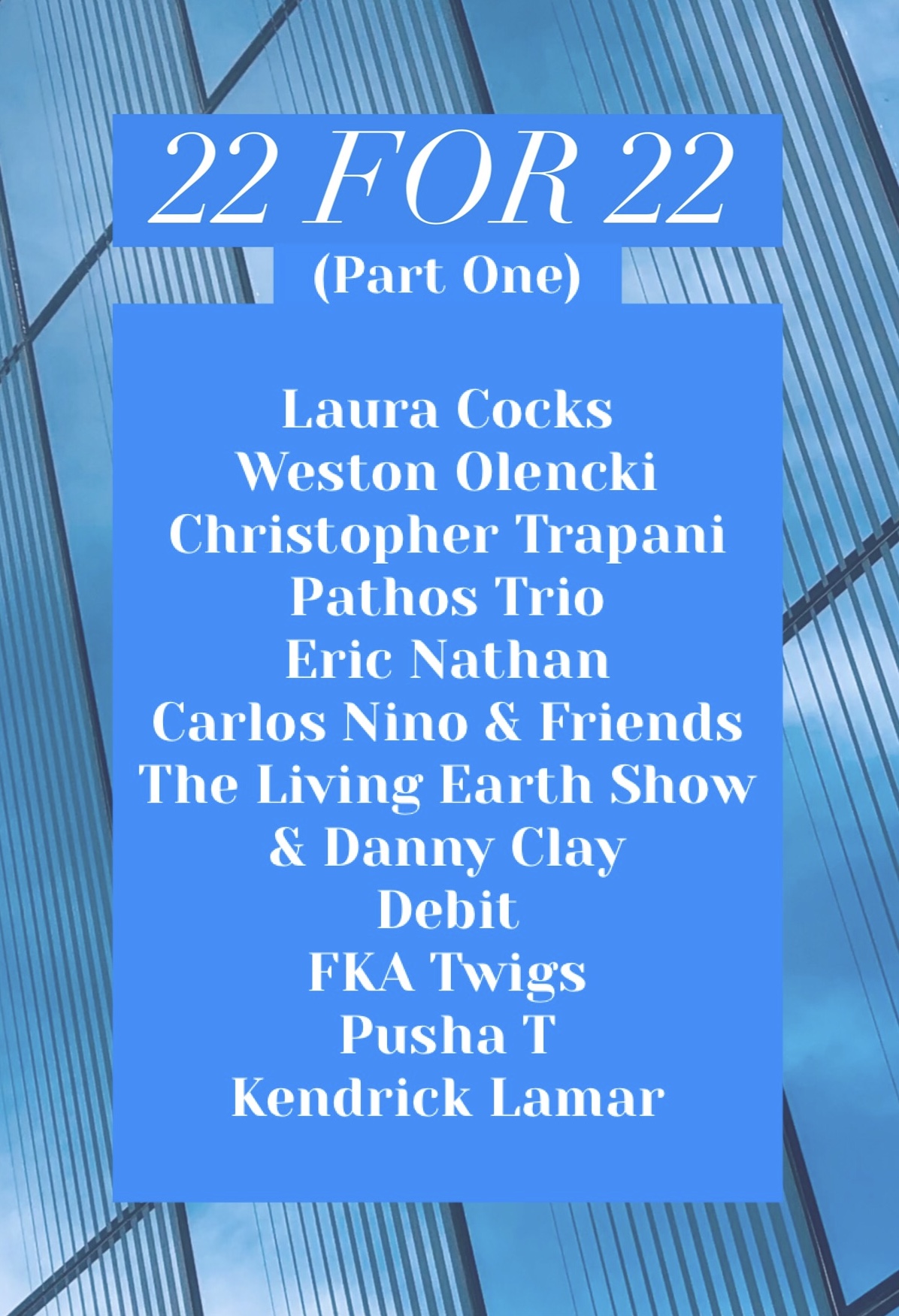
Record Roundup: 22 for 22 (Part 1)


There's no single reason why it took me so long to complete my "Best Of 2021" series, just life - in all its stress, strife, wonder, and joy. But all throughout everything that was going on and while I was doing my darnedest to put some shape to the music of last year, I was listening - passionately - to music from this year. And there has been plenty of brilliant stuff, more than enough to fill a dozen roundups. In order to keep myself (and you) from getting overwhelmed, I'm starting off with 22 albums across all genres, split in two parts. Future posts will drill down further into each genre. 

Find songs from most of these albums (some are only on Bandcamp) and follow along with my 2022 listening in these playlists:

Classical

Laura Cocks - Field Anatomies It's only fitting that an album of "blisteringly physical works for flutes" comes in an exquisite package, hand-collaged with dried flowers and decorated with beeswax. The beauteous outside, however, belies the often fierce sounds inside, as Cocks (known for their work with the ever-questing Tak Ensemble), goes toe to toe with some very extreme conceptions of what can be done with a flute, breath, the body, electronics - and some even less expected sources of sound. Bethany Younge's Oxygen And Reality, for example, was composed for piccolo, electronics, balloons, and hardware, and includes at least as much rhythmic breathing as anything else. It also features Cocks in seeming conversation with theirself, as half-heard spoken sentences cross the soundscape. That's the second track; the first is David Bird's Atolls for solo piccolo and 29 spatialized piccolos, which kicks things off with what sounds like someone taking oxygen from the flute before eventually exploding in dazzling swirls of gleaming sound. 

Jessie Cox, whose work was recently heard on the excellent Wavefield Ensemble album Concrete And Void, contributes Spiritus for solo flute, which alternates meditative tones with busy flurries of melody. "Contributes" is the wrong word, however, as the collaboration between composer and performer is as deep as it gets on Field Anatomies, beautifully detailed in the conversations on episode 22 of the Tak Editions podcast. The two other pieces are You'll See Me Return To The City Of Fury for glissando flute and electronics by DM R (Diana Marcela Rodriguez), both jarring and space-age sleek, and Produktionsmittel I for amplified flute, aluminum foil, glass bottle, and fixed media by Joan Arnau Pàmies, frantic and animalistic even when its just the sound of crinkling foil. All of these works are fully formed and as rewarding as they are demanding. Field Anatomies is a remarkable piece of art, which will cause emotion and inspiration to sprout faster than the packet of seeds that comes with the special edition CD.  Act fast, in any case: only five copies remain.

Weston Olencki - Old Time Music The Tak Editions podcast also gave me the opportunity to focus on the mind of Olencki, which was perfect (though not required) prep for their music, as represented by this monster of a tape from Tripticks. The three works here astound in their invention, conceptual gravitas, and sheer listenability. Wittily titled Tenor Madness, the opener puts sax player Anna Webber through more changes than a dozen fake books as she interacts with some very messed up electronics derived from  short extracts of over 300 albums spanning recordings of the (improvising) tenor saxophone from 1939 to the present. And that should give YOU an idea of how Olencki's mind works! A Vine That Grew Over The City And No One Noticed is a four-part work for "two electro-mechanically controlled banjos, homemade magnetic resonators, solenoid motors, AM radio transmitters, vintage transistor and tube radios, railroad spikes, mason jars, carriage bolts, South Carolina red clay distortion unit, 60Hz ground hum, field recordings, and neural net re-synthesis of seminal old-time repertoire and Markov-driven Scruggs-style banjo picking." I swear I hear a snippet of John Lennon's Well Well Well in there, too...but for all that it's compulsively listenable, a drone that sounds as old as Appalachia and as new as the Boeing Starliner that just connected to the International Space Station. The last piece, Charon Guiding The Weary 'Cross The Long River (Or, How To Care For A Dying Instrument), is comprised of a similarly baffling array of source material, including "hydrophonic recordings made of the Connecticut River transduced through found slate roofing tiles," and would probably give the titular hell-bound oarsman a chill up his demonic spine.  Kudos to Olencki for putting as much thought into how the end products sound as he did into making them. Drastically original and staggering stuff.

Christopher Trapani - Horizontal Drift On the title track of Trapani's latest portrait album, Dan Lippel plays a quarter-tone guitar through software of the composer's own design called LoopSculptor. The piece incorporates tropes from Delta blues and other genres native to Trapani's hometown of New Orleans, resulting in a 10-minute trip through museum of hazy half-memories. The title seems to do double duty, referring both to American expansion and the interactions of various loops across the software's grid layout. The unusual instrument, the engineer's approach to sound, and the emotionally resonant results are paradigmatic of the whole album, which opens with Targul, a piece for vioara cu goarna, a horn-enhanced instrument similar to a Stroh violin. Played with seemingly casual mastery by Maximilian Haft, the sound is not unlike a gramophone, with a sharp, tinny edge that blends perfectly with the sketchy, truncated phrases of the music. Haft also finds himself in a sort of duet/competition with electronics played through megaphones, adding immersive depth to the attenuated sounds. Trapani also puts new-music piano maven Marilyn Nonken through her paces in Lost Time Triptych, a piece for scordatura-tuned instrument that manages to be inspired by both Gerard Grisey and Bob Dylan. The other works, including Linear A, for microtonal clarinet (Amy Advocat) and electronics, Forty-Nine, Forty-Nine, for a MIDI-controlled equal-tempered Fokker organ, and Tesserae, for viola d’amore (Marco Fusi) grab the attention as well. Trapani continues to prove himself to be smart, playful, and fearless explorer on this triumphant collection.

Pathos Trio - When Dark Sounds Collide The first thing that struck me upon listening to this was how richly it was recorded, with the percussion of  Felix Reyes and Marcelina Suchocka fairly leaping out of my speakers and taking up space in my living room like blow-up furniture. The piece, Evan Chapman's Fiction Of Light, begins with Alan Hankers delicate (and delicately enhanced) piano, which only gives the drums more presence. Two-thirds of the way in, things get glitchy and pulsating and we're in the realm of a Radiohead remix. The group's versatility is further proven by Alison Yun-Fei Jiang's Prayer Variations, which includes some very subtle work from Reyes and Suchocka, letting Hankers takes center stage, before they drop the "boom." It's a dynamic and satisfying piece, as are works by Alyssa Weinberg and Finola Merivale. Hankers' own Distance Between Places ends the album on a brooding note. Each work was commissioned by Pathos and has an accompanying video by Four/Ten Media (Chapman is a co-founder), lending even more of a sense of occasion to this excellent debut.

Eric Nathan - Missing Words I got a great sense of kissenkühlelabsal from Whitacre Hill's horn in the first part of Missing Words, performed by the Boston Modern Orchestra Project. And in case you think I've lost my mind, "kissenkühlelabsal" is a word Ben Schott invented to describe "the ineffable pleasure and instant relief of a cool pillow." Every movement of this six-part work is in fact based on one of Schott's words from his Schottenfreude project, which turns into a great excuse for Nathan to produce reams of chamber music, from sparkling to introspective, and have it performed to a fare-thee-well by BMOP, the American Brass Quintet, cellist Parry Karp and pianist Christopher Karp, the International Contemporary Ensemble, the Neave Trio, and Hub New Music. Whether you know the words or not, this is a delight to listen to, although it did require some fingerspitzentanz ("tiny triumphs of nimble-fingered dexterity") to get the booklet out of the CD package so I could read the liner notes!

Electronic

Carlos Nino & Friends - Live At Commend, NYC For some reason it took me years to find out that the innovative label RVNG had a performance space and store in lower Manhattan. Now sadly on hiatus, at least I got to spend one blissful night in that jewel-box of artistry back in 2019, listening to sets by Phong Tran and Adam Cuthbért. But I wasn't there on November 16, 2021, when Nino assembled this crack lineup to make peaceful, yet intricately textured music. Adding to Nino's bells, chimes, and percussion were the great Laraaji (electric kalimba, vocals, and iPad), Surya Botofasina (keyboards), Photay (Buchla, 808, and electronic drums), and Will Logan (drum set). That should give you an idea of the sound dimension you can enter when you press "Play" - and I hope you do.

The Living Earth Show and Danny Clay - Music For Hard Times Composed/organized by Clay as "calming strategies" for musicians stuck at home, these 15 gentle, twinkling tracks find Living Earthers Andy Meyerson (percussion) and Travis Andrews (guitar) and, in Book Two, a cast of dozens including the San Francisco Girls’ Chorus and students from the San Francisco Conservatory (who sent in tracks via Dropbox) finding their way towards the light. Let it shine on you.

Debit - The Long Count Just in case your existential dread has been too well alleviated by the sweet sounds above, here comes Delia Beatriz using machine learning to process the "ancestral technology" of Mayan wind instruments, creating a disquieting dreamscape that pays homage to a culture that has not so much been forgotten but "purposefully erased." Whether the Mayans would find anything to recognize in these sounds is unknown, but I think they would appreciate the effort - and we can enjoy the spare, spectral beauty either way.

Hip Hop & RnB

FKA Twigs - Caprisongs As someone who has championed Twigs since before she was FKA but was disappointed in both her long-form releases (LP1 and Magdelene), this album - she calls it a mixtape - is a balm to my ears. While still on the leading edge of electronic RnB, there's a sense of play and lightness on these 17 tracks that's a far cry from the overly considered work on those earlier releases. Whether it's the presence of new collaborators like producer El Guincho, who worked on most of the album, or just the fact that she considered it a mixtape rather than an album allowed her to fly more freely. A breezy, but deeply creative, caprice.

Pusha T - It's Almost Dry Four years after the perfection of Daytona (my #3 album of 2018), "cocaine's Dr. Seuss" is back with his fourth album, collaborating almost equally with his two greatest partners, Pharrell Williams and Kanye West - and nearly hits those same heights. The album starts with three knockouts, the first two produced by Williams and the third by West. Brambleton opens the album with a door-knock snare drum and spooky keyboards as Pusha details his sense of betrayal after his former manager claimed credit for his stories. Let The Smokers Shine The Coupes deals out a deeply funky groove as Pusha once again finds new ways to be the king of coke rap, saying "If kilograms is the groove/I done sold the golden goose." 

Then, in a masterstroke only West could come up with (and that Pusha T begged for), Dreaming Of The Past drops the hammer with a slightly sped-up sample of Donny Hathaway's take on John Lennon's Jealous Guy. The ice-cold vibe warms right up as Pusha practically duets with Hathaway while reminiscing about the good old days when "We hollowed the walls in back of bodegas" and "Gun stutter, make the drumline like Grambling." Even as he relitigates his old life, he's self-aware enough to point out that he "Didn't have to reinvent the wheel, just a better design." But even so he tries out some new things, like the way he floats his voice over Williams' nagging groove on Call My Bluff. The final track, Pray For You, combines old and new as Pusha T takes a "side step back into the duo/The kings of the Pyrex," by having his brother Malice (aka No Malice) join him on the song. Over a churchy track by producer/singer Labrinth that flashes back to Prayer, which opened Clipse's unreleased debut album (finally available!), Malice brings the heat like the old days, which has me both dreaming of the past and eager for the future.

Kendrick Lamar - Mr. Morale & The Big Steppers In one of the instantly busy hot-take threads that popped up when this eagerly awaited album dropped - Lamar's fifth and first since the Pulitzer prize-winning Damn in 2017 - a friend of a friend said, "I like the rapping but I wish the music was more hip hop." This reminded me of another exchange where someone asked if Revolution #9 was a Beatles song. My response was that, while it's an unwieldy sound collage, it is a Beatles song by virtue of being on a Beatles album. Mr. Morale comes from a similarly imperial view: it's all hip hop because Lamar is a hip hop artist, and one of such creativity and stature that he can bend whole genres to his will. To be clear, there are sonic references to reggae, jazz, r&b, and, of course, many sub-genres of hip hop - but like iron filings on a magnet, they all adhere to Lamar's wiry form, moving the genre along rather than leaving it behind. 

Lyrically, Lamar is on another plane than most rappers, dishing out a memoir's worth of tangled reflections, observations, stories, and histories. The dense firehose of words is often challenging to sort through and revealing enough to occasionally cross into "TMI" territory. But as Lamar himself says on Worldwide Steppers: "I am not for the faint of heart." He then continues with a few lines that give a hint of the micro and macro concerns of the album: "My genetic build can build multi-universes, the man of God/Playin' "Baby Shark" with my daughter/Watchin' for sharks outside at the same time/Life as a protective father, I'd kill for her." The cover depicts him with a child in his arms, a crown of thorns on his head, and a gun in his waistband, all signifiers for the world's weight, which he feels heavily on his shoulders. In Mother I Sober, which features featherweight vocals from Portishead's Beth Gibbons, Lamar remarks, "I'm sensitive, I feel everything, I feel everybody/One man standin' on two words, heal everybody." That sense of responsibility may have led him to overstuff the album, which runs an hour and 13 minutes. But Lamar is a visionary artist and incapable of being less than fascinating at this point in his career. It's still early days for my relationship with Mr. Morale - for all I know a song that now feels half-baked might prove to be a favorite in a few months. An essential listen.

Next time: Latin, rock, folk, pop, etc.